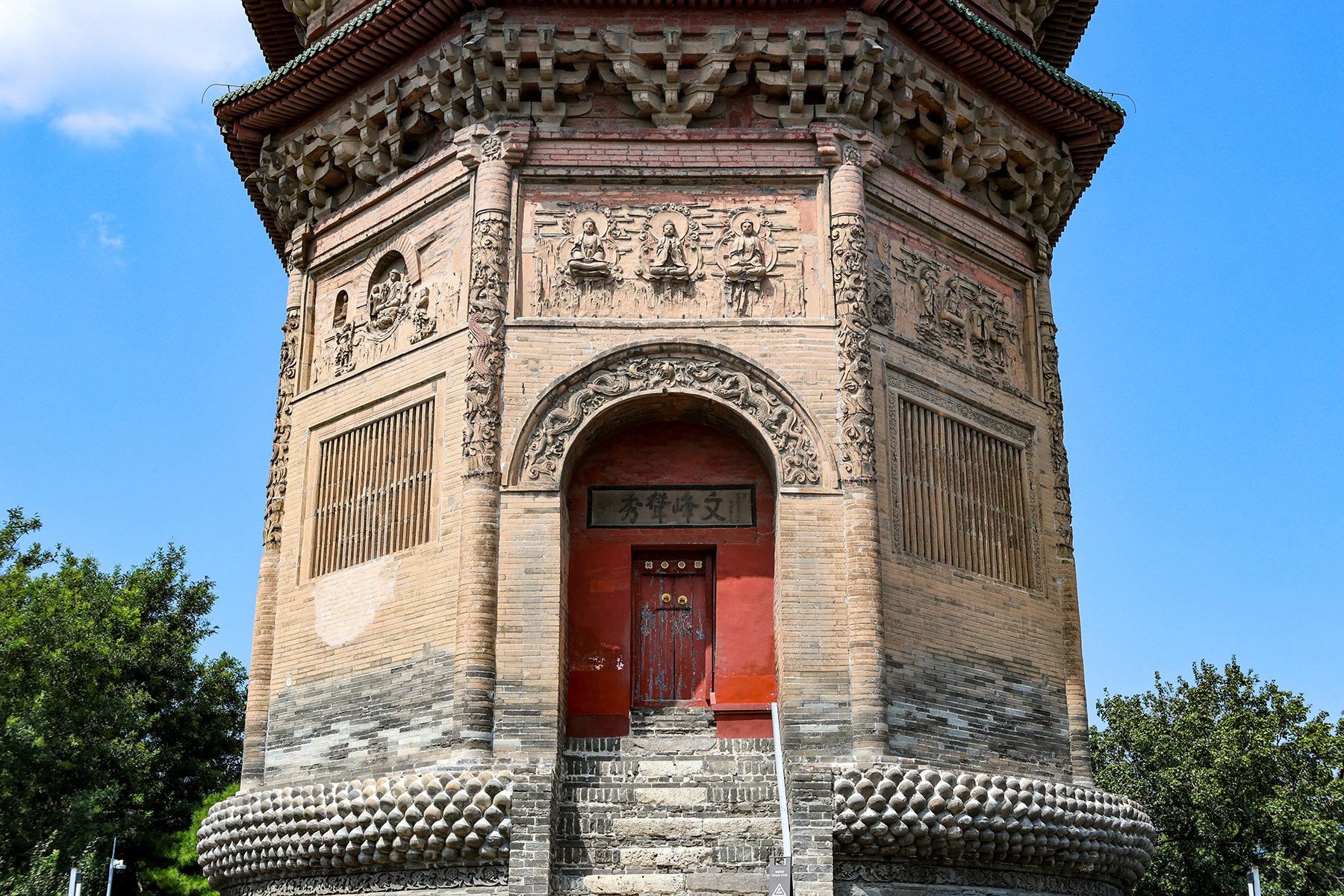
Anyang sits at the northern edge of Henan, and its claim on Chinese history is extraordinary: this was the last capital of the Shang dynasty, one of the earliest settled sites of Chinese civilisation, and the place where Chinese writing was born. Farmers in the late nineteenth century kept discovering strange bones with strange markings, and it was only in 1899 that scholars recognised them as oracle bones — tortoise shells and ox scapulae inscribed with the earliest known form of Chinese script. The Yin Ruins, as the excavated Shang capital is known, are now a UNESCO World Heritage Site and the anchor of a visit to the city.
The National Museum of Chinese Writing is an architectural statement in its own right — a gold-roofed building housing a survey of how Chinese characters evolved from Shang-dynasty bone inscriptions through bamboo slips, silk manuscripts, paper scrolls, and beyond. The Yin Ruins museum on the actual excavation site goes deeper into the Shang world: royal tombs, bronze ritual vessels, and row upon row of oracle bones that still retain the incised characters asking kings about harvests, battles, and sacrifices. Within the ruins, the Tomb of Fu Hao is the only unlooted royal burial from the site, yielding nearly two thousand objects that give an unparalleled view of Shang court life. Entry to the ruins costs ¥70. Across town, Cao Cao's Mausoleum offers a very different historical layer — the warlord who dominated the end of the Han dynasty and inspired one of China's great literary traditions is buried in a surprisingly modest tomb that was only officially confirmed in 2009.
The Red Flag Canal, about an hour northwest in Linzhou, is the city's most dramatic socialist-era attraction. In the 1960s, tens of thousands of local people spent ten years carving a 1,500-kilometre irrigation network out of the Taihang Mountains by hand. The engineering is remarkable, but so is the human story — it's one of the great acts of collective will in modern Chinese history, and the scenic area now lets you walk sections of the canal and see how it was built. The scale becomes comprehensible only when you're standing on the narrow ledge carved into vertical cliffs.
Anyang has good high-speed rail connections on the Beijing–Zhengzhou line, making it easy to fold into a broader Henan itinerary. The city itself is not pretty — coal and industry left their marks — but the concentration of early Chinese history here is unmatched anywhere in the province. Come for the bones, stay for the bronze age.