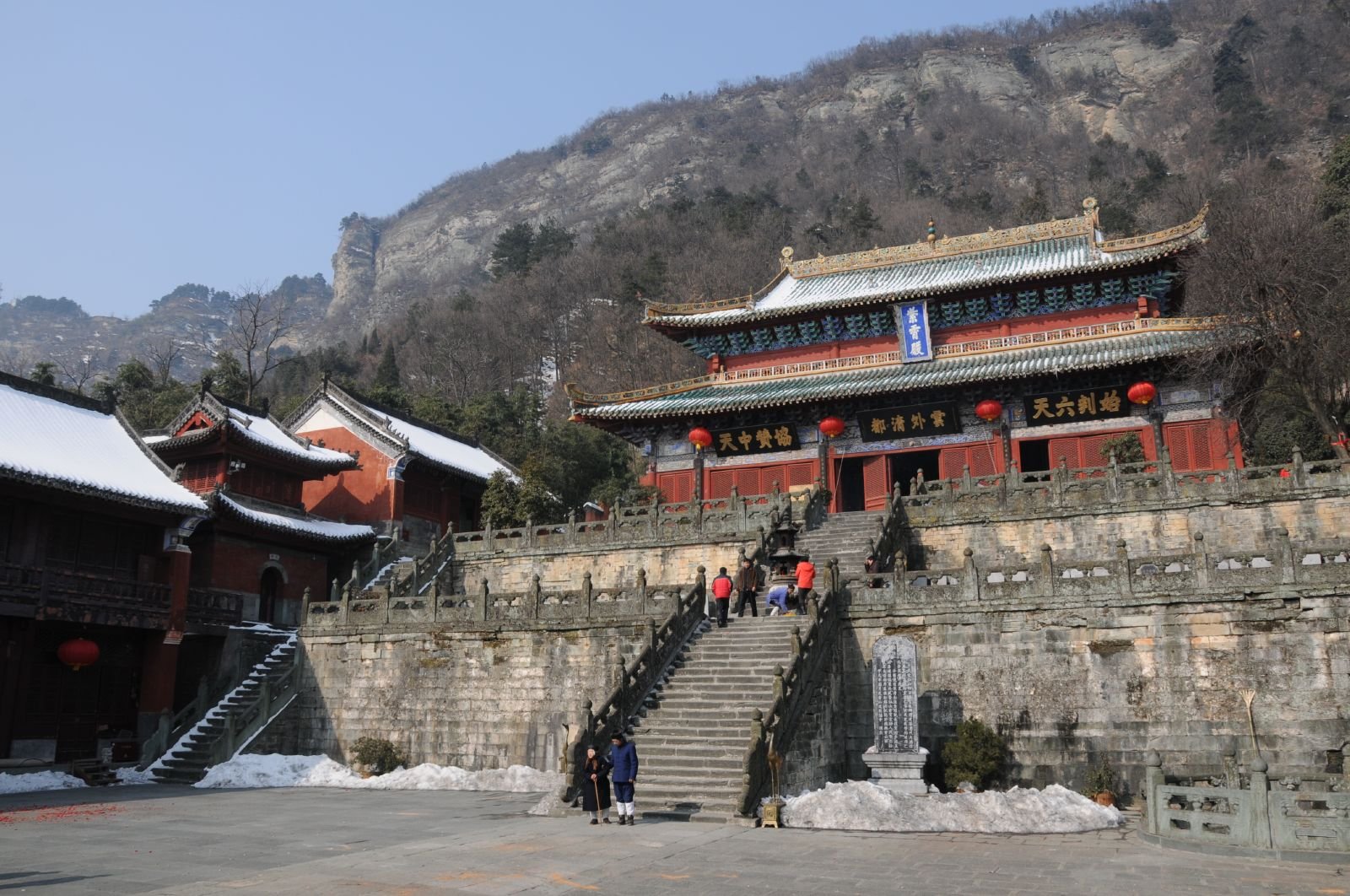
The Wudang Mountains (Wudang Shan) are the holiest site in Taoism and, by general agreement, the birthplace of Tai Chi. Zhang Sanfeng, the semi-legendary Song dynasty hermit credited with creating the internal martial arts style, is said to have had his insights here while watching a fight between a crane and a snake. Whether or not the origin story is historically sound, the mountains have been the centre of Taoist practice, philosophy, and martial arts cultivation for over a thousand years, and the traditions are very much alive.
UNESCO inscribed the ancient building complex at Wudang in 1994. The site includes more than thirty temples and palaces built or expanded during the Ming dynasty (14th–17th centuries), when the Yongle Emperor devoted enormous imperial resources to the mountain in gratitude for his victory in a civil war, which he attributed to Taoist divine support. The buildings are integrated into the natural landscape with considerable skill — hanging from cliffs, perched on peaks, tucked into forest clearings — and the overall effect is unlike any other sacred site in China.
The summit complex centres on the Golden Hall (Jin Dian) atop Tianzhu Peak at 1,612 metres, a bronze pavilion gilded entirely in gold that has survived without rust for six hundred years. The Zixiao Palace lower on the mountain is the largest and best-preserved of the temple complexes, with vast courtyards and magnificent carved archways. The Nanyan Temple clings dramatically to a sheer cliff face, its Dragon Head rock jutting out over a vertical drop.
Visiting the mountains takes at least two days to do it properly. There are cable cars to the upper areas, but walking the stone-paved paths through the forest connects you to the long history of pilgrims and martial arts students who have made the same ascent. Wudang town (Danjiangkou city) at the base has guesthouses and restaurants. Several Taoist martial arts schools accept short-term residential students for week-long or month-long immersive programmes.
The mountains are easiest to reach from Wuhan — about three and a half hours by high-speed rail to Wudangshan station, from which buses run to the scenic area entrance.