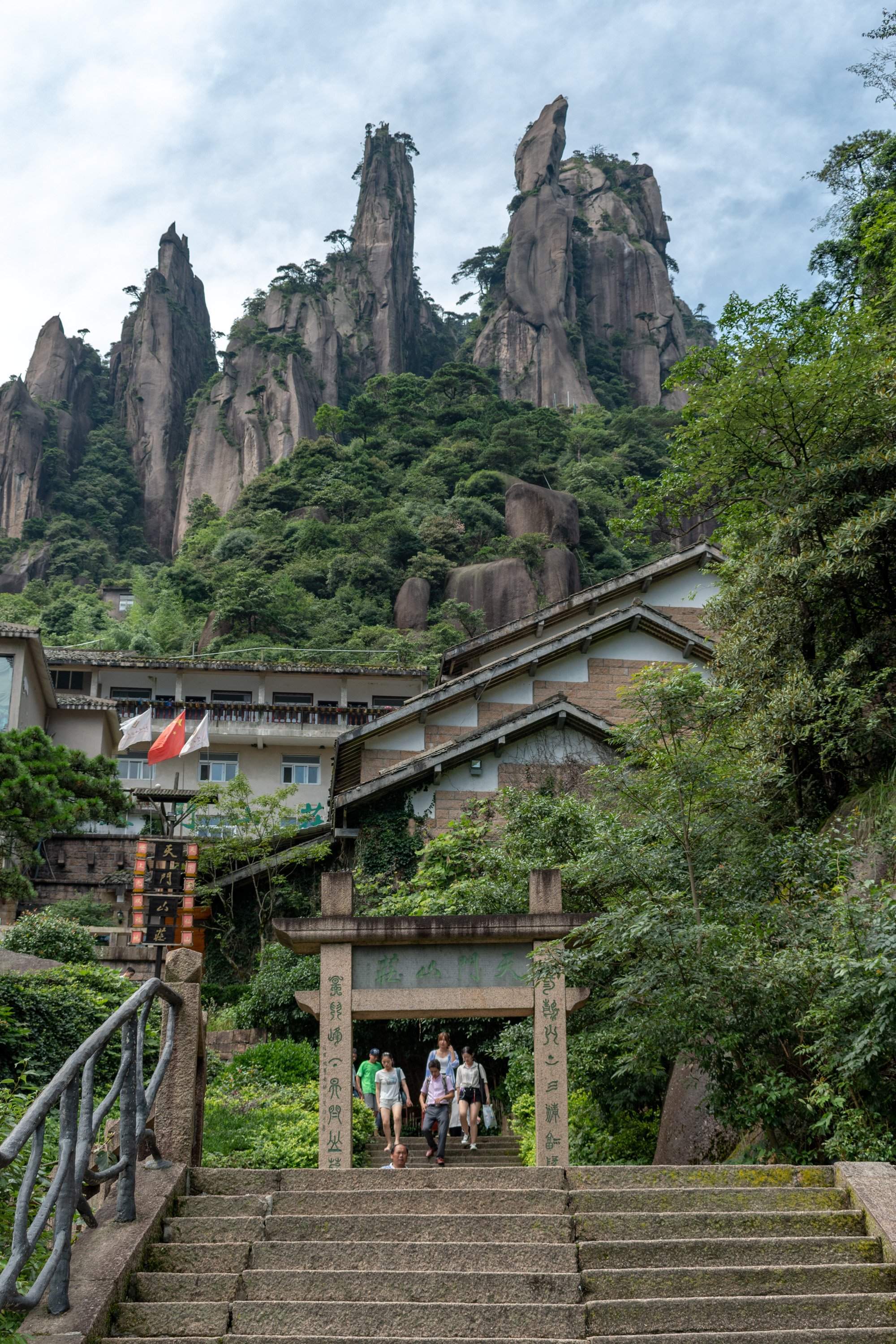
Mount Sanqingshan is a UNESCO World Heritage Site in northeastern Jiangxi that earns its designation through sheer geological spectacle: thousands of granite pillars, many of them capped with twisted pines, rise through clouds and mist in formations that have been inspiring Taoist painters and poets for over fifteen centuries. The mountain's highest peak, Yujing, reaches 1,820 meters, and the three summits — named for the three Taoist Pure Ones — give the mountain its spiritual identity. The Sanqinggong Temple complex, founded during the Eastern Jin dynasty, remains an active place of worship embedded in the scenery rather than separate from it.
The trail network clings to the cliff faces via concrete paths and iron railings bolted directly into the rock, a construction method that looks improbable from a distance and feels perfectly secure underfoot. The most photographed formation is Giant Python Rock, a massive stone pillar that protrudes from a cliff at an angle that needs no imagination to interpret. Sunrise from Jade Terrace, when the peaks emerge from a sea of cloud, is the kind of scene that explains why Sanqingshan's motifs recur throughout Chinese landscape painting. May brings the rhododendrons, which carpet the upper slopes in considerable quantity.
The mountain sits about 150 kilometers southeast of Jingdezhen and 50 kilometers northeast of Shangrao, the nearest high-speed rail station. Regular buses run from Yushan to the mountain entrance, and the ropeway reduces the climb to the main scenic areas considerably. Accommodation is available both at the summit — expensive, basic, and recommended for catching sunrise without the morning crowds — and in the base villages. The park is notably less visited than comparable mountains in neighboring provinces, which significantly improves the experience.