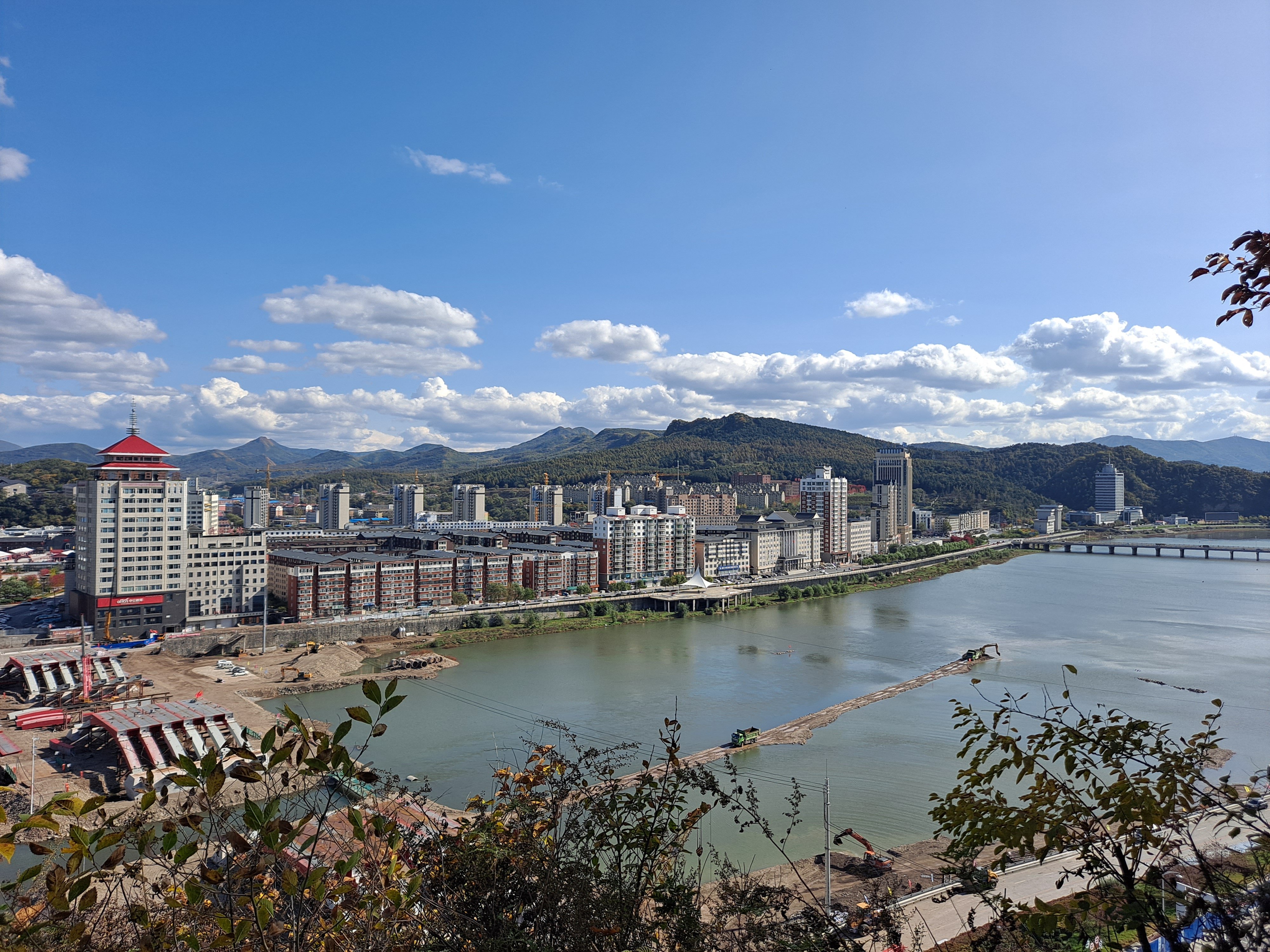
Tonghua is not a place people visit for Tonghua itself — the city is frank about this in most travel accounts, and there is a straightforwardness to its modest charms. The hills that ring it are attractive, the renovated riverfront offers pleasant walking, and the modern downtown has the clean, undistinguished quality of a Chinese city that has been rebuilt in the last twenty years without leaving much of its older self behind. What Tonghua does well is function as a base for two things that are worth serious attention in their own right: the Koguryo sites at Ji'an, and access to the southern approaches of Changbaishan.
Ji'an, about an hour east of Tonghua along the Yalu River, contains the remnants of the Koguryo kingdom, one of the Three Kingdoms of ancient Korea that controlled much of this territory for centuries before 668 CE. The Koguryo Tombs — royal burial mounds with elaborate painted interior chambers — are a UNESCO World Heritage Site and represent some of the most important early Korean heritage outside the Korean peninsula. The General's Tomb, a stepped pyramid tomb attributed to the King Jangsu, is a particularly arresting structure: large, well-preserved, and with an architectural ambition that complicates any simple narrative about this region always having been simply Chinese. The Gwanggaeto Stele, commemorating the conquests of the great fifth-century Koguryo king, stands in Ji'an and remains a contested historical artefact claimed as cultural heritage by both China and Korea.
Tonghua's own wine production deserves a mention — Tonghua wine, made from wild mountain grapes and produced since the early twentieth century, has a sweet, distinctive character quite unlike conventional wine, and the local industry takes some pride in it. It is the sort of thing that improves with low expectations and genuine curiosity. The Yang Jingyu Martyrs' Cemetery along the Tongjiang River honours the resistance commander who fought the Japanese occupation in these mountains. Baijifeng National Forest Park, twenty-five kilometres southeast, offers some of the most intact temperate forest in the region. The city is also a transit point for travellers moving between Shenyang, Changchun, and the Changbai Mountains.
The train station is the city's practical centre, with buses and connections radiating out from it toward Ji'an, Baishan, and Changchun. Accommodation near the station serves transit travellers adequately, and the city's honest position as a stopover rather than a destination makes it easier to plan around.