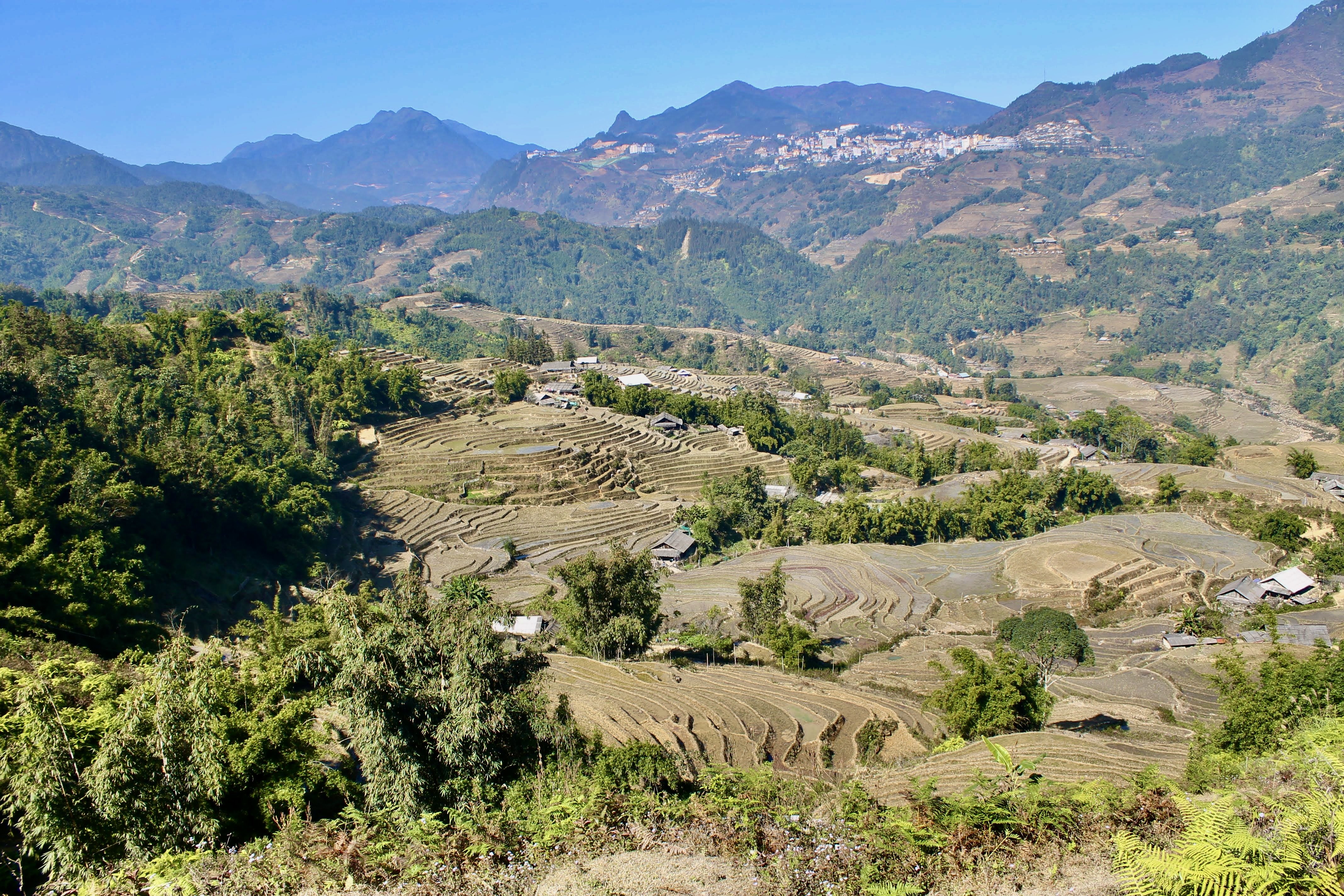
Northern Vietnamese hill station and trekking base among Hoang Lien Son peaks and hill-tribe villages
Sapa is a hill station in the far north-west of Vietnam, set at 1,600 metres in a spectacular valley surrounded by the Hoang Lien Son mountains — the highest range in Indochina, culminating in Fansipan (3,143 m), Vietnam's tallest peak. The French built it as a mountain retreat in the 1920s, and the remnants of their stone villas — crumbling, moss-covered, atmospheric — still dot the hillside above the town. Today Sapa is Vietnam's main trekking base and a window onto the hill-tribe cultures of the northern highlands.
The draw is the landscape and the people. The terraced rice paddies that cascade down the valleys around Sapa are among the most photographed in Southeast Asia, especially in September and October when the rice turns gold before harvest. The valleys are home to several ethnic minority groups — the Hmong (Black Hmong and Flower Hmong), the Dao (Red Dao), and the Tay — who still wear traditional dress, farm the terraces by hand, and sell embroidery and indigo-dyed textiles in the town market. Trekking from Sapa through Cat Cat, Lao Chai, Ta Van, and Ta Phin is the standard one- or two-day excursion, and hiring a local guide from one of the minority communities is both the most ethical and the most rewarding way to do it.
The town itself has changed rapidly — what was a quiet backpacker stop a decade ago is now a busy resort town of hotels, karaoke bars, and tour operators. The construction is relentless and not always attractive. But the mountains don't care: step five minutes out of town on any trail and you are in some of the most dramatic highland scenery in Vietnam. Fansipan can now be reached by cable car (opened 2016), which has democratised the view but annoyed purists; the two- or three-day trek up the old route is still available and still worth doing.
Come in September–November for the harvest and clear skies, or March–May for spring flowers. December–February is cold and foggy — Sapa can drop below freezing at night, and the cloud often sits in the valley for days, though the ethereal mist has its own beauty. Sapa is reached by overnight train from Hanoi to Lao Cai (8 hours), then an hour by bus or taxi up the mountain.
Guide
Day Trips in Sapa
The best time to witness the scenic beauty of Sapa is in April and May. Before that period, the weather might be cold and foggy; after that period is the rainy season. In April and May, Sapa is blooming with flowers and green pastures. The clouds that settle in the valley in early morning quickly disappear into thin air.Located at 1,500 m above sea level, Sapa lies on the side of the Hoang Lien Son Mountains, 333 km northwest of Hanoi. Sapa’s flora is diverse, ranging from flowers to tropical fruits; among the most popular fruits produced in Sapa are apples, pears, peaches, and plums.Sapa has many natural sites such as Thac Bac, Thuy Cung Grotto, Gio Cave, Troi Gate, and Truc Forest. Sapa is also the starting point for many climbers and scientists who want to reach the top of Fansipan Mountain, the highest mountain in Vietnam at 3,143 m. Hoang Lien Son Mountains is also called the Alps of the North Sea area since Fansipan Mountain is not only the highest peak in Vietnam, but also in the Indochina Peninsula. The pyramid-shaped mountain is covered with clouds all year round and temperatures often drop below zero, especially at high elevations.To reach Sapa, one can take a train to Lao Cai and then a bus to Sapa from Lao Cai. On Sundays, Nung, Dao, Tay, Cao Lan, Paxi, and Xa Phong minorities ride down the mountain in their colorful clothes to take part in the Sunday market at the foot of Fansipan Mountain.
Can Cau Market
( Saturday only )
Can Cau Market is a small, but very colourful market, set in the mountains near the Chinese border. The Flower Hmong minority is the most common here, and their colourful dresses makes is a beautiful sight. Almost every Saturday around 8 different minorities are represented at the market.
Bac Ha Market
(Sunday only)
Leaving Sa Pa early Sunday morning we drive with land cruiser to Bac Ha Market. This drive will take us approx. 3 hours. We visit this huge market with all it’’s colourful ethnic people as Flower Hmong, Phu La and Dao Tuyen who gathers to buy and sell. We enjoy lunch in a local restaurant and we leave Bac Ha and drive to Trung Do village - inhabited by Tay minority. From the village we go by boat down the river, where we experience the magnificent sight of the beautiful caves. The boat trip takes us about 2-2 1/2 hours before we are picked up by our jeep. The jeep takes us
Guide
Getting There
Sapa is in the far northwest of Vietnam, about 380 km from Hanoi. The journey is the classic highland approach: overnight train to Lao Cai, then an hour by road up the mountain.
By train: Overnight trains from Hanoi to Lao Cai run nightly, departing around 9–10 pm and arriving around 5–6 am. Several operators run services; the standard soft sleeper is comfortable enough and the timing is efficient. Book tickets well in advance for weekends and the September–October peak season.
Lao Cai to Sapa: From Lao Cai station, shared minibuses and private taxis run the 38 km up the mountain road. The minibus is cheap and easy; the ride takes about an hour. Taxis are faster and useful for early arrivals when buses are scarce.
By bus: Direct buses from Hanoi's My Dinh station run the full 8–9 hour journey to Sapa, avoiding the train change. These are comfortable sleeper buses and cheaper than the train, though the road is winding and can be slow behind trucks.
By car or motorbike: A rented motorbike from Hanoi is possible for experienced riders — the road is largely good but the last section into Sapa is steep and can be very foggy. Allow two days from Hanoi.
Guide
When to Go
Sapa has a mountain climate that is substantially cooler and wetter than the Vietnamese lowlands. The key seasons to plan around:
September to November is the best time. The rice harvest turns the terraces gold in September and October — this is when the landscape is at its most photogenic. November brings cooler, drier days and clear visibility. This is the peak season for trekking and photography.
March to May brings spring flowers — cherry blossom, peach blossom, and wildflowers across the higher slopes — and warming temperatures. Cloud is common but the light can be beautiful. This is the second-best period.
June to August is the rainy season. The paddies are lush and brilliantly green, but rain can make trekking muddy and unpleasant, and leeches are active. Views are often obscured. Still viable but bring waterproofs.
December to February is cold and often foggy. Temperatures can drop below freezing, and snow occasionally falls on Fansipan. The cloud can sit in the valley for days at a stretch. The mist has a ghostly beauty but visibility is poor and trekking is limited. Bring warm layers — far more than you'd think necessary for Vietnam.