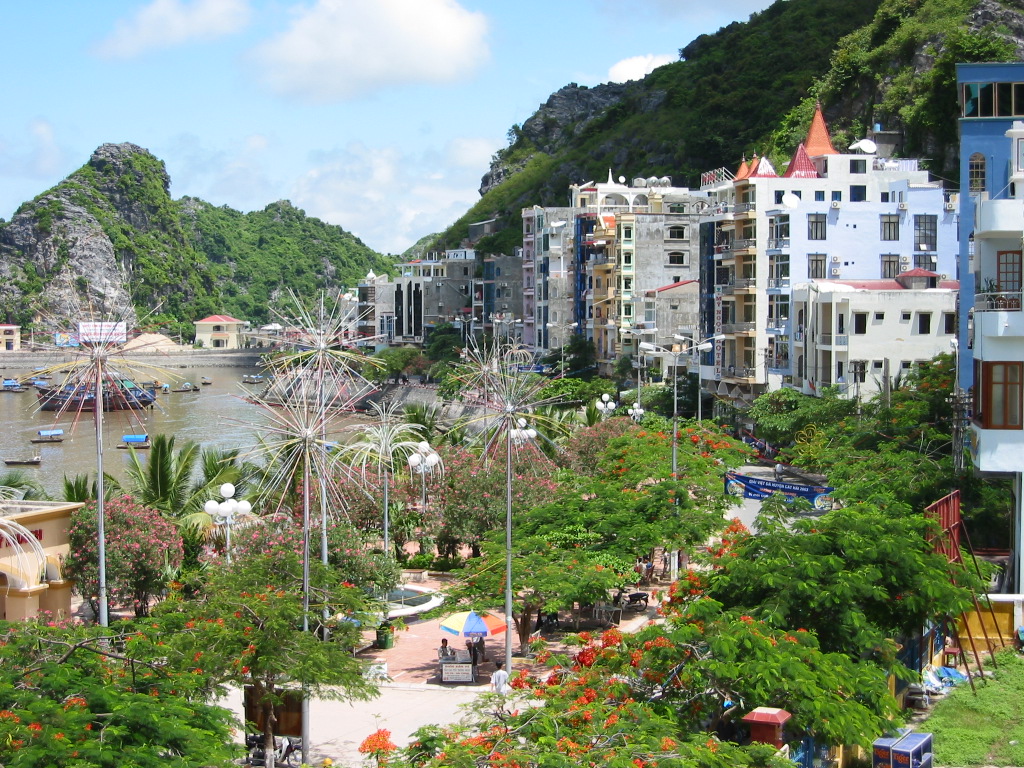
Cat Ba is the largest island in Halong Bay, and it gives you something the bay's famous overnight cruises rarely offer: a place to actually stay and explore on your own terms. Most travelers pass through on a tour, but those who linger discover limestone karsts from the water, dense jungle inland, and a small, unpretentious fishing town that has learned to accommodate visitors without entirely losing itself.
About half the island is protected as Cat Ba National Park, a mix of tropical rainforest, freshwater lakes, mangrove swamps, and coral reef. The park is home to the critically endangered Cat Ba langur — one of the world's rarest primates — and makes for excellent hiking. The trail to the park's summit takes two to three hours and rewards you with panoramic views over hundreds of karst peaks rising from the water. Inside the park, Trung Trang Cave and the Vietnam War-era Hospital Cave are both worth a stop, and the hidden Frog Lake makes a longer walk.
The beaches are the other draw. The Cat Co beaches — Cat Co 1, 2, and 3 — are sheltered coves just south of town, good for swimming in calm weather. If they feel crowded, hire a boat and head into Lan Ha Bay, the southern extension of Halong Bay that falls administratively under Cat Ba. The water there is clearer, the traffic lighter, and kayaking through the karst-studded passages is genuinely spectacular. Boats out from town also reach the rhesus macaques and white sand of Monkey Island, the floating houses of the Cai Beo fishing village, and the isolated farming hamlet of Viet Hai on the eastern coast.
Cat Ba Town itself is no postcard — a working Vietnamese harbor with a tourist strip along the seafront — but above it the restored gun emplacements at Cannon Fort give the best sunset view of the bay. The island has also become a serious sport-climbing destination, with around 100 bolted routes at Butterfly Valley and famous deep-water-soloing in Lan Ha. The restaurants and bars are mostly functional, the prices are reasonable, and the locals are used to foreigners without being jaded. It is a good base, not a destination in itself — the island around it is the point.
Getting here from Hanoi takes roughly four to five hours: bus to Haiphong, then a ferry to the island. There are also direct tourist buses that make the journey in one go.