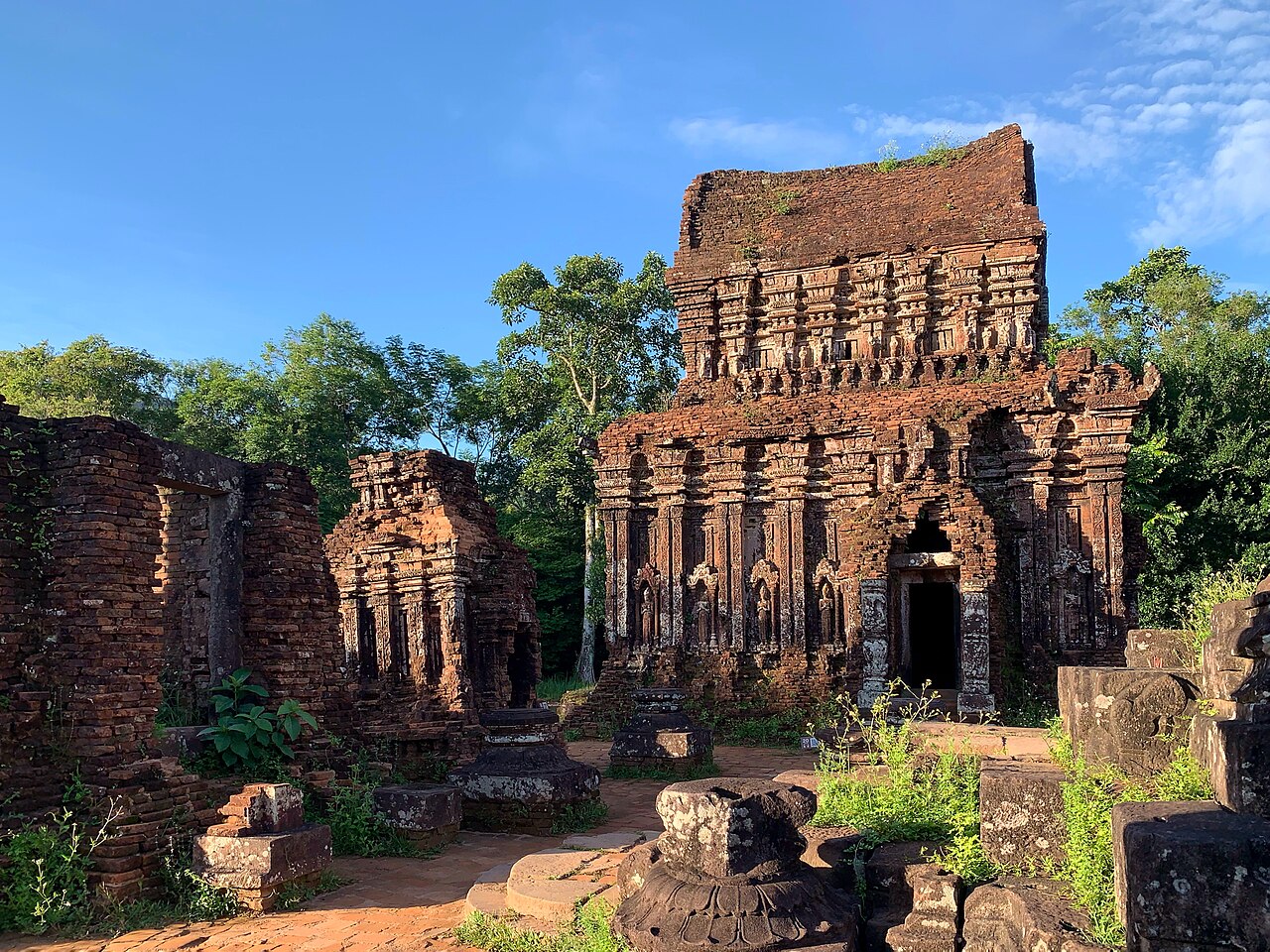
Cham temple valley near Hoi An, Vietnam's key red-brick archaeological site from the Champa kingdom.
My Son is the most important Cham archaeological site in Vietnam — a cluster of red-brick temple towers set in a narrow valley surrounded by jungle-covered mountains, about 40 kilometres southwest of Hoi An. Built between the 4th and 13th centuries as the religious and political capital of the Champa kingdom, My Son was the equivalent of Angkor for the Cham civilisation. UNESCO listed it as a World Heritage Site in 1999.
The towers and sanctuaries are Hindu temples, mostly dedicated to Shiva, and the stone carvings that survive are remarkably detailed despite centuries of weather and war. Groups B, C, and D are the most intact — you can still see carved lintels, mythological reliefs, and the distinctive Cham brick tower silhouette, built without mortar using techniques that scholars have still not fully explained. Group A, once the grandest complex, was largely destroyed by American bombing in August 1969, and the craters and rubble remain as a sobering reminder of what was lost. Groups E and F show earlier 8th-century construction, with a different architectural vocabulary. A small in-situ museum in the Group D mandapas displays carvings and context panels; the finest pieces are now at the Museum of Cham Sculpture in Da Nang.
Most visitors come on a half-day trip from Hoi An. The site opens at 6:00 a.m., and the first hours of the morning, before the tour buses arrive, are the best time to explore. The drive through the countryside and the Thu Bon river valley is part of the experience.
Guide
Getting There
My Son is about 40 kilometres southwest of Hoi An and about 68 kilometres from Da Nang city. Most visitors come on organized half-day tours from Hoi An, which depart in the morning and typically include a boat ride on the Thu Bon River as part of the return journey. These tours are inexpensive and easy to book at any guesthouse or tour office in Hoi An.
Self-drive by motorbike from Hoi An takes about an hour on mostly good roads through countryside and villages. The turn-off is well-signed from the main Da Nang–Hoi An highway. Renting a motorbike in Hoi An and riding independently gives you more control over timing and the ability to stay past the tour groups.
The site opens at 6:00 a.m. and closes at 5:00 p.m. Going early — before 8:00 a.m. — means arriving before the tour buses from Hoi An and having the temples largely to yourself. The first light of the morning also makes the red brick particularly vivid. Entrance fees apply; check current prices at the gate.
Guide
When to Go
The best time to visit My Son is February through August — the dry season in this part of central Vietnam. The site is exposed, with limited shade, and exploring it in heavy rain is unpleasant and can make paths slippery. October and November are the wettest months; typhoon season runs from September through December and can bring flooding to the entire Thu Bon river valley.
Within any given day, early morning is best. The tour groups from Hoi An typically arrive between 8:30 and 10:00 a.m. Getting there before 8:00 a.m. means relative quiet, cooler air, and dramatically different light — the low morning sun catches the brick textures and carved surfaces in a way that midday flat light completely misses. The site is open from 6:00 a.m., making an early start easily achievable.
Cham dance performances are staged at the site daily for tour groups — usually short, tourist-oriented shows in the main amphitheatre near the entrance. They are optional and add nothing to understanding the temples themselves, but the music and movement draw on a living performance tradition that has some genuine connection to the Cham cultural heritage on display in the ruins.