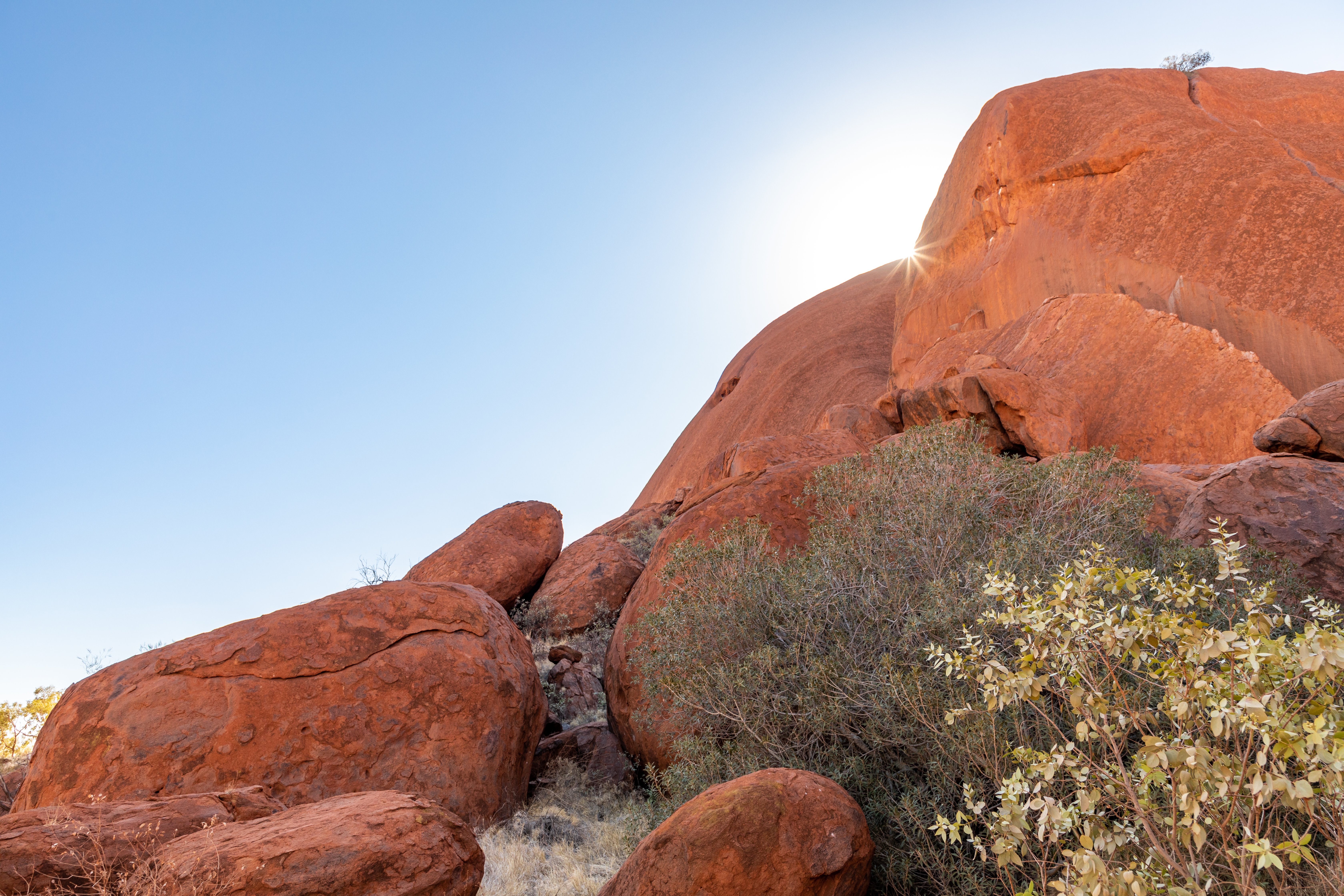
Uluru-Kata Tjuta National Park is the spiritual heart of Australia's Red Centre, a UNESCO World Heritage site in the southern Northern Territory. The park is jointly managed by its Anangu traditional owners and Parks Australia — Uluru is a deeply sacred site, and visiting it respectfully is part of the experience.
Uluru itself needs no introduction: a single enormous sandstone monolith rising 348 metres above the flat desert plain, measuring 3.6 by 2.4 km at the surface, with a circumference of 9.4 km. The rock changes colour dramatically through the day — deep orange at sunrise, glowing red at sunset, grey-purple after rain. The base walk (10 km, flat) takes you past waterholes such as Mutitjulu, caves with ancient rock art, and patches of surprising green. Climbing Uluru is permanently closed, at the request of the Anangu people.
Kata Tjuta, 36 km to the west, is a collection of 36 rock domes that many visitors find equally impressive. The Valley of the Winds walk (7.4 km loop) weaves between the domes and is one of the best hikes in central Australia. Geologists believe these domes may once have formed a single monolith far larger than Uluru.
The nearest town is Yulara (Ayers Rock Resort), purpose-built to serve the park. Connellan Airport has direct flights from Sydney, Melbourne, and Cairns. The park is about 450 km by road from Alice Springs.