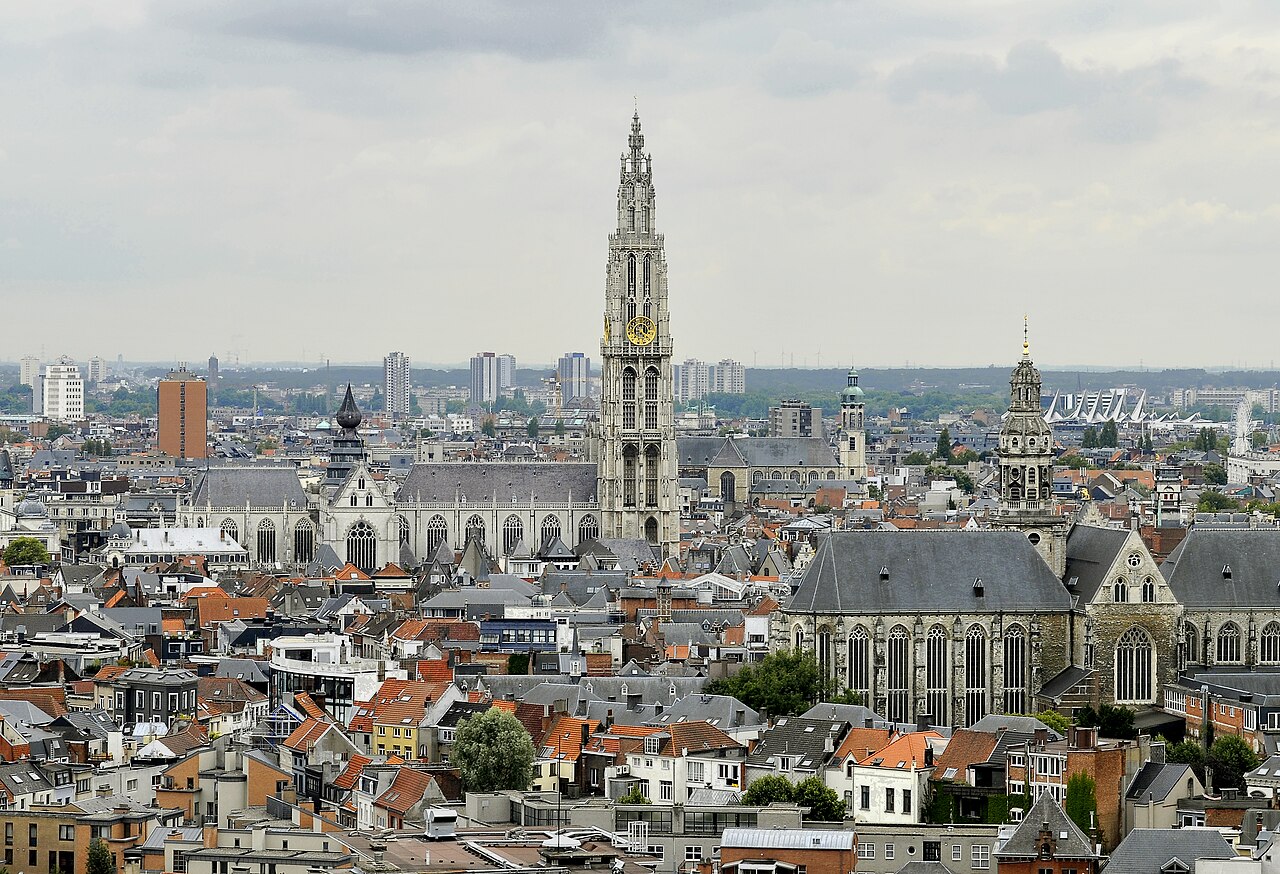
Antwerp is the place where you can sit on the Grote Markt with a Bolleke glass of De Koninck beer in front of the old guildhouses and feel for a moment like a wealthy sixteenth-century merchant. Belgium's second city, and the biggest in Flanders, is a working harbour, a centre of the global diamond trade, the home town of Pieter Paul Rubens, and — quietly, since the 1980s — one of the most important cities in international fashion. It is also a city with a slight inferiority complex about Brussels and Bruges, and a sharper edge than either.
The heart of the city beats at the Grote Markt, an irregular square surrounded by stepped-gable guild houses and dominated by the Stadhuis and the Brabo Fountain. The Cathedral of Our Lady, one block south, holds four Rubens masterpieces including the Descent from the Cross; its 123-metre tower is the highest in the Low Countries. Rubenshuis on Wapper is the painter's own Italianate palace, restored as a museum.
For the Renaissance city, the Plantin-Moretus printing works on Vrijdagmarkt is the unmissable sight — a sixteenth-century workshop preserved intact, UNESCO-listed, with the two oldest surviving printing presses in the world. The Sint-Pauluskerk holds three more Rubens paintings and a strange Baroque rocky-Calvary garden. For the modern city, the MAS museum on the docks has a free panoramic roof terrace and tells the harbour story. The Royal Museum of Fine Arts (KMSKA) in Het Zuid reopened in 2022 with one of Europe's best Flemish collections, and the Red Star Line Museum on the old emigrant docks is one of the most moving museums in Belgium.
The Diamond District — a square mile of streets behind Central Station handling 84% of the world's rough diamond trade — gives the city its unusual social mix of Orthodox Jews and Indian Jain traders. Out beyond Berchem station, the late-nineteenth-century streets of Zurenborg, built up between 1894 and 1906, contain the best collection of eclectic and Art Nouveau architecture in Europe; Cogels-Osylei is the showpiece.
When your feet give out, settle back at the Grote Markt with another Bolleke, watch the cathedral spire light up at dusk, and start planning where to eat. The city earns the patience.