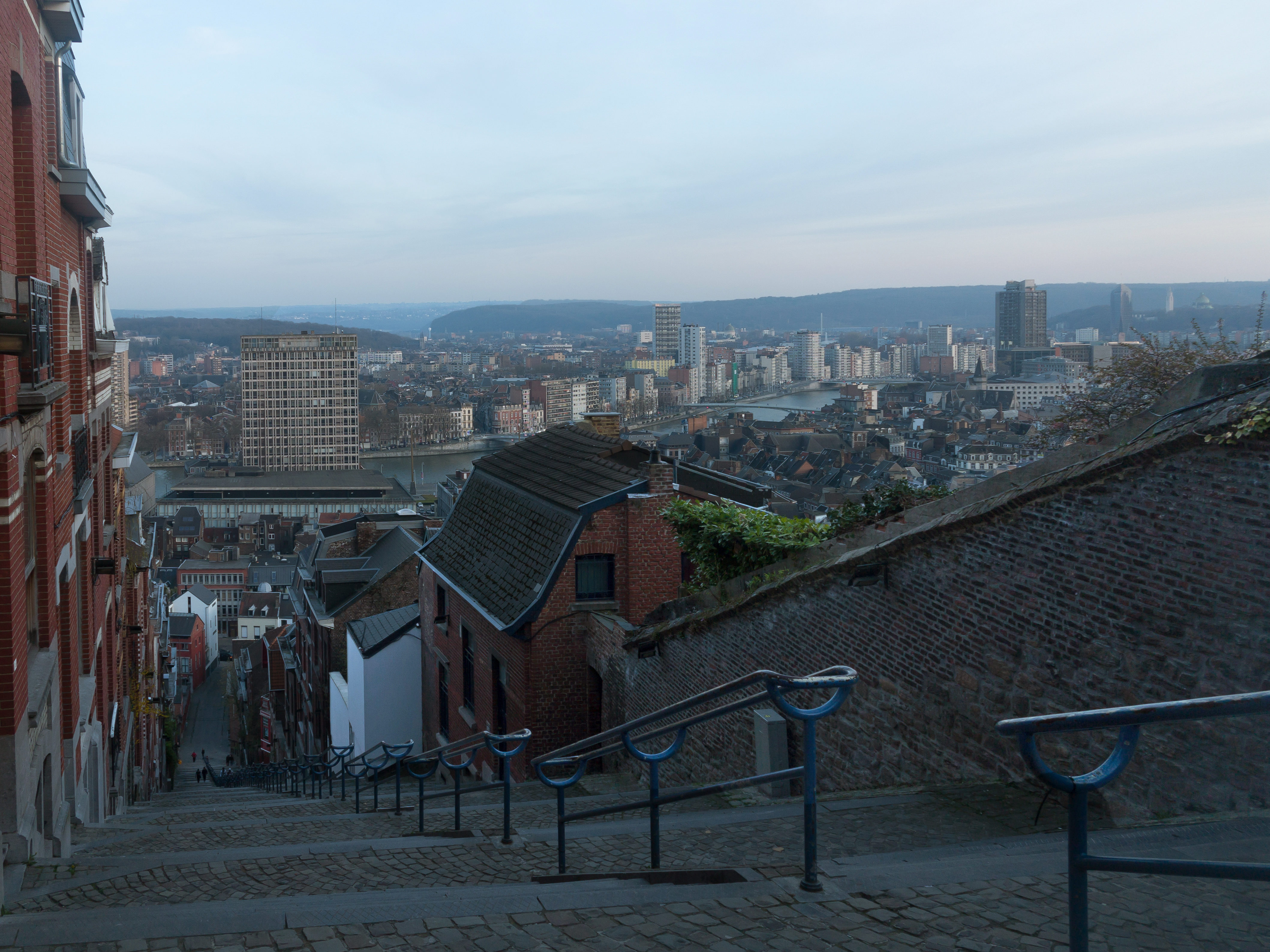
Liège calls itself La Cité Ardente — the fiery city — and the name fits. The city has a long history of popular revolt: against Burgundian occupation in the fifteenth century, against the Spanish Netherlands, against every authority that tried to suppress its liberties. It was the first continental European city to industrialise, the birthplace of modern steel and arms manufacturing, and it has never entirely shed the working-class energy that came with it.
The old city is compact and walkable. The Place du Marché, with the Perron and the old town hall, is the symbolic heart. The Palace of the Prince-Bishops on the Place Saint-Lambert — where the medieval cathedral once stood — is the most impressive building. The Montagne de Bueren, a staircase of 374 steps cut into the cliff above the Féronstrée, leads up to the citadel plateau and the best views in the city.
Liège is also the birthplace of Georges Simenon (1903–1989), the creator of Inspector Maigret and one of the twentieth century's most widely read novelists. Simenon grew up in the Outremeuse quarter — the island district on the far side of the Dérivation canal — which remains the most characterful part of the city, with its own pubs, its own folklore puppet (Tchantchès), and a particular local pride.
The Sunday morning market along the Meuse is one of the largest in Belgium and worth planning your visit around. The Liège waffle — dense, caramelised, utterly different from the Brussels version — is something you should eat at least once from a street stall.