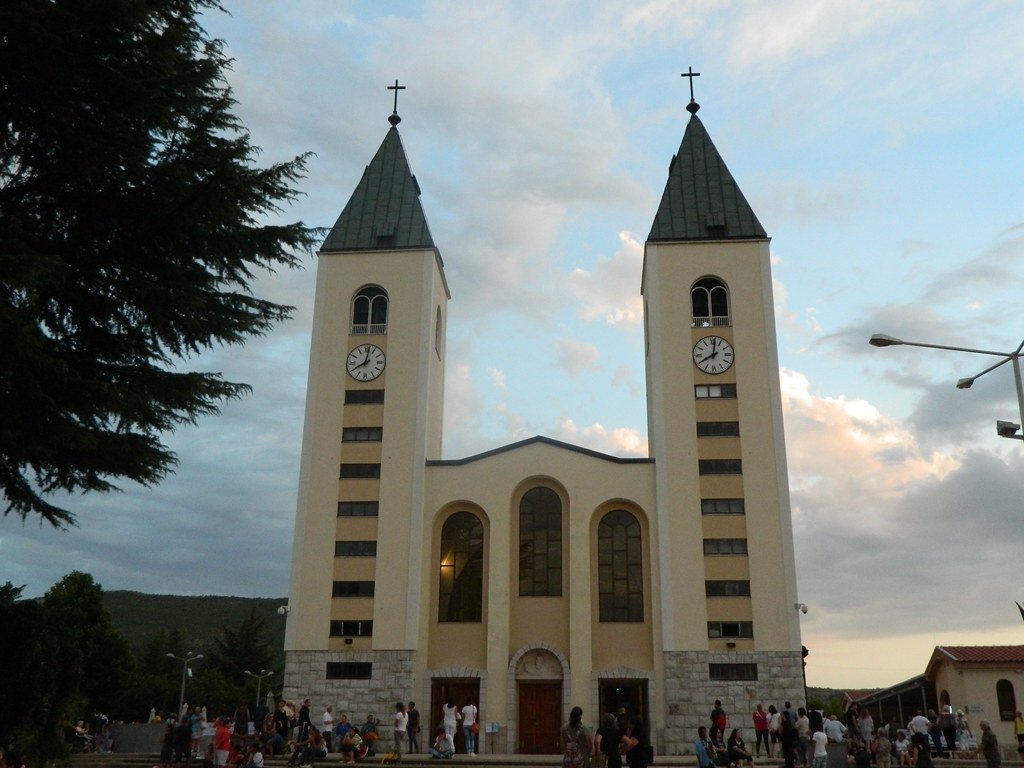
Herzegovinian pilgrimage village centred on Marian apparition sites, St. James Church, and surrounding hills
Medjugorje is a small village in the hills between Mostar and the Croatian border, and one of the most-visited Catholic pilgrimage sites in the world. Since June 1981, when six local teenagers reported seeing visions of the Virgin Mary on a nearby hillside, over forty million pilgrims have come. The Vatican has not officially recognised the apparitions as authentic, but in 2019 Pope Francis authorised official pilgrimages.
The village itself is small. The Church of St. James, at the centre, was built long before the apparitions and is now the focal point — masses run several times a day in different languages, and the evening prayer service draws large crowds. Apparition Hill (Podbrdo), where the original visions were reported, is a rough climb up a rocky track; Cross Mountain (Križevac), a tougher two-hour hike, is marked by a 14-metre concrete cross and by fifteen bronze stations of the cross along the path.
Most pilgrims come as part of organised tours, flying into Split or Dubrovnik in Croatia and travelling overland by bus — about two hours from either. Hotels and guest houses line the approach roads; outside of the peak summer months, accommodation is easy and cheap.
Medjugorje is not for casual tourism. If you are not here to pray or walk the hills, an hour is enough. But the atmosphere — the multilingual crowds, the vendors selling rosaries in fifteen languages, the devotion — is hard to find anywhere else in Europe.
Guide
Bars and Cafes
Medjugorje is a pilgrimage town and the nightlife reflects that -- there are bars, but the village is quiet by eleven and properly asleep by midnight. Most pilgrims gather in the cafes around St. James' after the evening prayer service, drinking coffee and the local cherry brandy.
The square in front of the church has the largest cluster of cafes; almost all serve the standard Bosnian range of espresso, macchiato, and Turkish coffee, plus rakija and the local wines. Caffe Bar Galija, just off the square, is a long-running spot popular with both locals and pilgrims and stays open later than most. The bar at the Hotel Sunce, slightly out of the centre, has a quieter atmosphere if you want a glass of wine without the crowd.
A note: bars in Medjugorje will sell alcohol to anyone -- enforcement of age limits is essentially non-existent. If you are travelling with teenagers, this is worth knowing.
Guide
Day Trips
Medjugorje sits in good day-trip country. Mostar and its rebuilt Ottoman bridge are about 25 km and 30 minutes north -- easy to do in a morning, with time for lunch by the Neretva. The Walled Town of Pocitelj, a stunning hillside Ottoman village with a fortress and minaret, sits 30 km southeast and combines well with Mostar.
For something cooler and greener, Kravica Waterfalls are 15 km west on the Trebizat river -- a wide curtain of falls dropping into a swimmable pool, busy in summer. The Franciscan monastery at Zitomislici, 10 km north, has fifteenth-century frescoes and a graveyard with ottoman tombstones.
Across the border, Dubrovnik is 130 km south (around 2 hours) and Split 170 km north -- both are reachable as long days from Medjugorje, but better as overnight stops.
Guide
Eating Out
Medjugorje's restaurants line the main road through the village and the side streets near St. James'. Most cater to pilgrims and offer multilingual menus heavy on grilled meat, fresh trout, and Herzegovinan staples like cevapi, peka (meat or vegetables baked slowly under an iron bell), and roast lamb. Local wines -- Zilavka (white) and Blatina (red) -- come from vineyards on the hills around the village and are worth ordering.
For something more authentic, head out to Herceg Etno Selo at Tromedja, a recreated village of stone houses about five kilometres from the church. The restaurant in the main longhouse serves the best peka and roast lamb in the area, along with the local wines. Closer in, Restaurant Most by the Trebizat river is reliable and unpretentious, with a summer terrace under the trees and the standard grills. Pero's near the church is a long-running family-run place with a decent set menu.
Expect to pay 15 to 30 KM (8 to 16 euros) for a main; less for cevapi and pizza, more for grilled fish. Tap water is fine to drink. Most places open from early morning to late, since pilgrims keep odd hours.
Guide
Getting Around
Medjugorje is tiny. The village core -- St. James' Church, the cafes, the pension strip -- is fifteen minutes end to end on foot, and most pilgrims do everything on foot. Apparition Hill (Podbrdo) is about 2.5 km from the church, an easy walk along the road; Cross Mountain (Krizevac) is closer, perhaps 1.5 km, and the climb starts at the edge of the village.
For day trips and onward travel, taxis are easy to find at the church square and reasonably priced. A car can be rented through one of the hotels or a local agency (try Globtour); roads in Herzegovina drive on the right, signs are in Croatian, and traffic is light. The closest big-name car rentals are at Mostar airport.
Guide
Getting There
Medjugorje has no railway and no commercial airport of its own. Most pilgrims arrive by bus or coach from the Croatian coast.
The nearest airports are Mostar (25 km, very limited flights), Split (170 km, two hours by motorway), and Dubrovnik (130 km, two hours by coastal road). Direct pilgrimage flights from Italy, Ireland, and Poland sometimes operate to Mostar during peak season, but most travellers fly into Split or Dubrovnik and take a transfer or rental car.
Daily buses run from Mostar (about 50 minutes), Split, and Dubrovnik. Border-crossing between Croatia and Bosnia is straightforward; carry your passport and be prepared for a short wait. Mostar to Medjugorje by taxi is around 40 KM (20 euros).
Guide
Shopping
Shopping in Medjugorje is almost entirely religious: rosaries, statues of the Virgin, prayer books, medals, holy water bottles, and crucifixes in every conceivable size. The stalls and shops line the approach roads to St. James' and the foot of Apparition Hill, and most of them sell roughly the same goods at roughly the same prices.
A few things are worth looking for. Olive-wood rosaries from Bethlehem and the Holy Land are a step up in quality from the mass-produced versions; some shops carry hand-carved pieces with origin labels. Local Herzegovinan wines (Zilavka, Blatina) and bottles of medovaca (honey brandy) are sold in the larger shops and make decent gifts. Bargaining is uncommon -- prices are written and stuck to.
Guide
When to Go
Medjugorje runs on the Catholic calendar. The two great peaks are Easter -- floating between late March and late April -- and the anniversary of the first apparitions on 25 June, which expands into a week-long youth festival in early August. The village is full to bursting during both, and accommodation needs booking months in advance.
For a quieter visit, May, September, and October are ideal. The weather is warm but not hot, the crowds thinner, and the wine harvest in October brings a good mood to the village. Summer (July, August) is hot -- temperatures can hit 35 C -- and the climbs to Apparition Hill and Cross Mountain are best done early in the morning. Winter is cool, mostly dry, and very quiet; most pilgrim guesthouses scale back, but the church services continue.