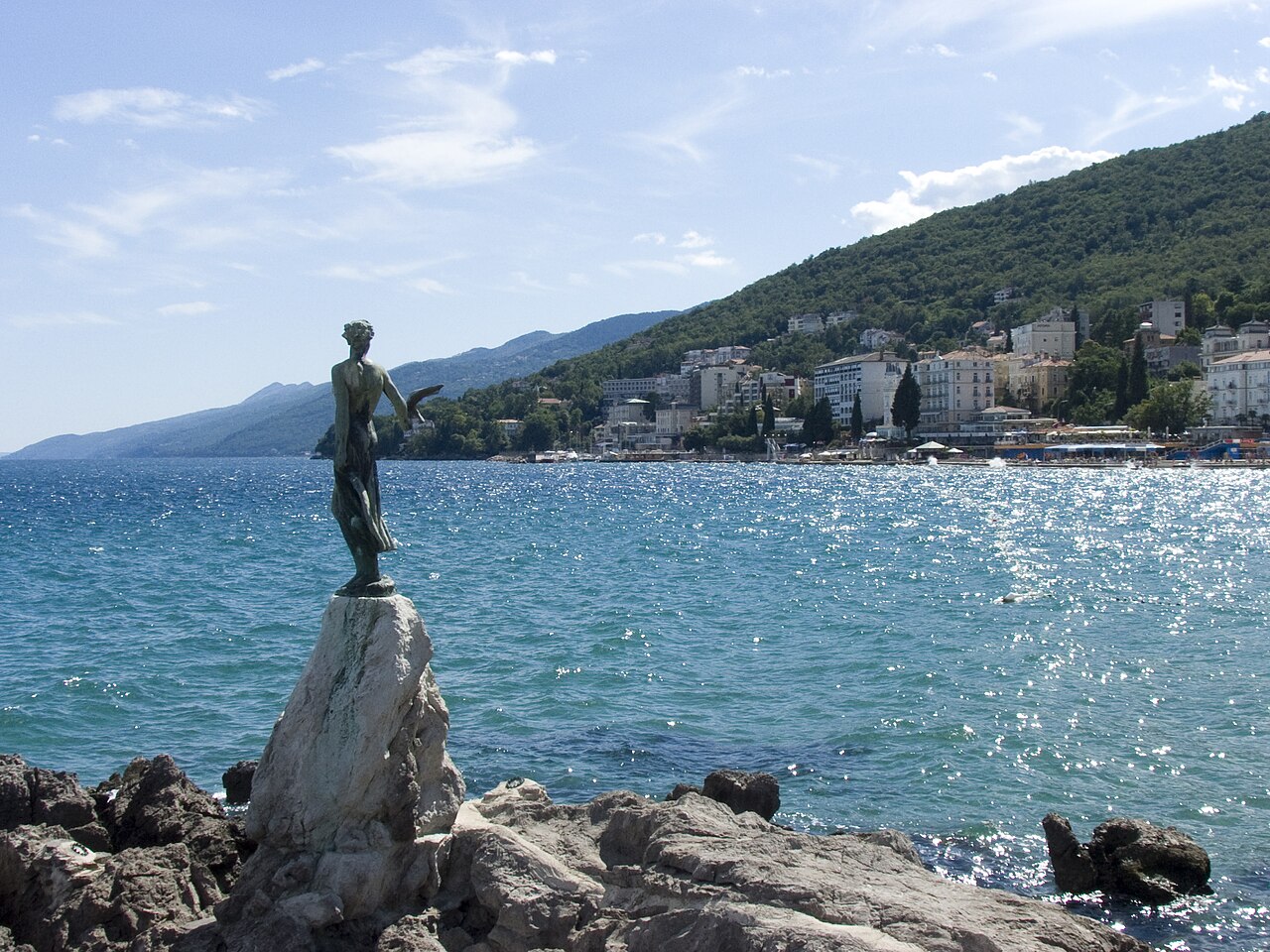
Opatija is Croatia's grandest old resort town, draped across a hillside above the Kvarner Gulf and still wearing its Austro-Hungarian finery with considerable pride. Where Dubrovnik has medieval walls and Split has a Roman palace, Opatija has Belle Epoque villas, formal gardens, and a promenade that once drew emperors and composers. Franz Joseph I, Kaiser Wilhelm II, Gustav Mahler, and Anton Chekhov all came here to take the sea air. Villa Angiolina, the neoclassical house that started the resort, and the Hotel Kvarner, the first hotel on the Adriatic coast, both still stand. The style they came for survives remarkably intact.
The town sits at the northern end of the Opatija Riviera, a 25 km strip of coast backed by the steep slopes of Ucka mountain (1,396 m), which shelters the bay from cold northerly winds. This microclimate made Opatija attractive to central European aristocracy as a winter resort from the 1840s onward — palm trees grow in the parks, and mild winters allowed the kind of promenading that was the aristocratic leisure activity of the age.
The Lungomare, a seafront promenade running 12 km south along the coast through Ičići and Lovran, is the town's great pleasure. Walk it in the morning and you share it with local women pushing prams and old men arguing politics. In the evening it belongs to lovers. The sea is clear enough to swim from the concrete platforms and small pebble beaches along the way.
Opatija is quieter and more sedate than Dubrovnik or Split — a place for people who want good food, a comfortable bed, and an unhurried walk rather than party bars and party boats. The restaurants are excellent by Croatian standards. The nightlife exists, with clubs, a casino, and late bars, but the dominant mood is refinement, not revelry.