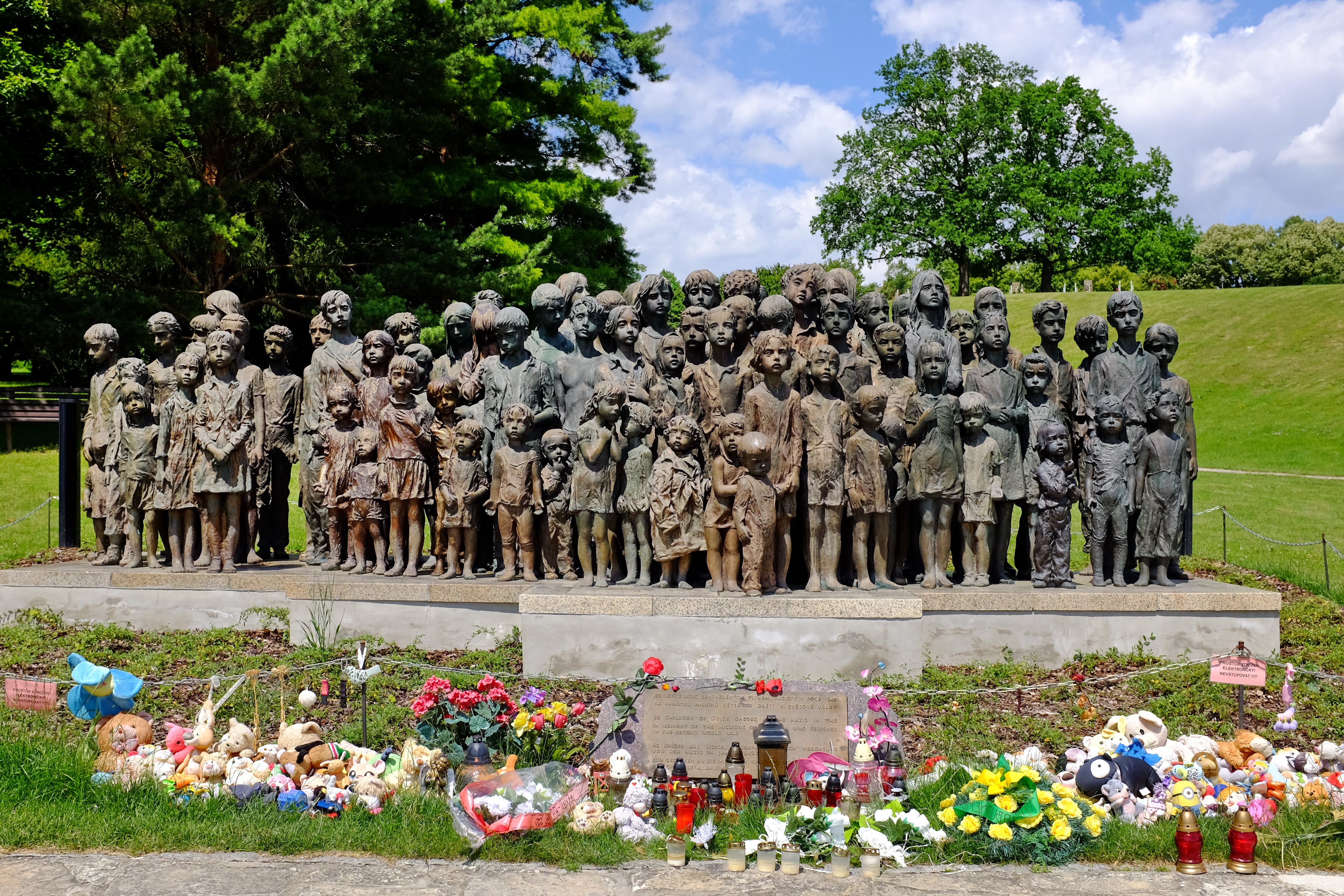
Czech village west of Prague, remembered for its 1942 destruction and memorial landscape.
Lidice is a village about 20 km west of Prague with one of the most sobering histories in Europe. In May 1942, Czech paratroopers trained in Britain assassinated Reinhard Heydrich, the Nazi Reich Protector of Bohemia and Moravia, in Prague. In reprisal, the Nazis chose Lidice at random for collective punishment. On 10 June 1942, all 173 men and boys over 15 were shot against the wall of the Horák family farm. The women were sent to Ravensbrück concentration camp. The children were mostly gassed at Chełmno. The village was then burned, the rubble bulldozed, and the ground ploughed over.
Today the site preserves the outline of the former village — the foundations of houses, the church, the school — as an open-air memorial. The Memorial to the Child Victims of War, Marie Uchytilová's bronze group of 82 figures, stands at the edge of the site. The adjacent museum tells the story clearly and without melodrama. The rose garden, established after the war with donations from around the world, is still maintained.
It's a quiet, heavy place. A couple of hours is enough. The memorial is open daily; the museum has modest entrance fees.
Guide
Getting There
Lidice is about 20 km northwest of Prague, easily visited as a half-day or full-day trip from the capital. The simplest way is the bus from Prague-Zličín (terminus of metro line B): bus 326 or 322 to Kladno passes Lidice and runs every 15 to 30 minutes during the day. The journey takes about 40 minutes; ask for the Lidice Památník stop.
By car, take the D7 motorway from Prague toward Kladno and exit at Buštěhrad — the memorial is 3 km south on a signed local road. Free parking at the entrance. The site is open from sunrise to sunset; the museum and gallery are open daily 9:00–17:00 in summer and 9:00–16:00 in winter.
Guide
When to Go
The memorial is open all year. June is the most powerful time to visit — the roses are in full bloom, the days are long, and the anniversary commemoration on 10 June draws crowds, dignitaries, and surviving relatives. The official ceremony is held on the Saturday nearest the date and is open to the public.
Other times of year are quieter. Autumn is wet but atmospheric; the empty meadow under low cloud has a particular weight. Winter is bleak and largely deserted; the museum is the warmest place on site. Avoid days when the sky is at its brightest summer blue — the contrast with the subject of the visit is awkward.