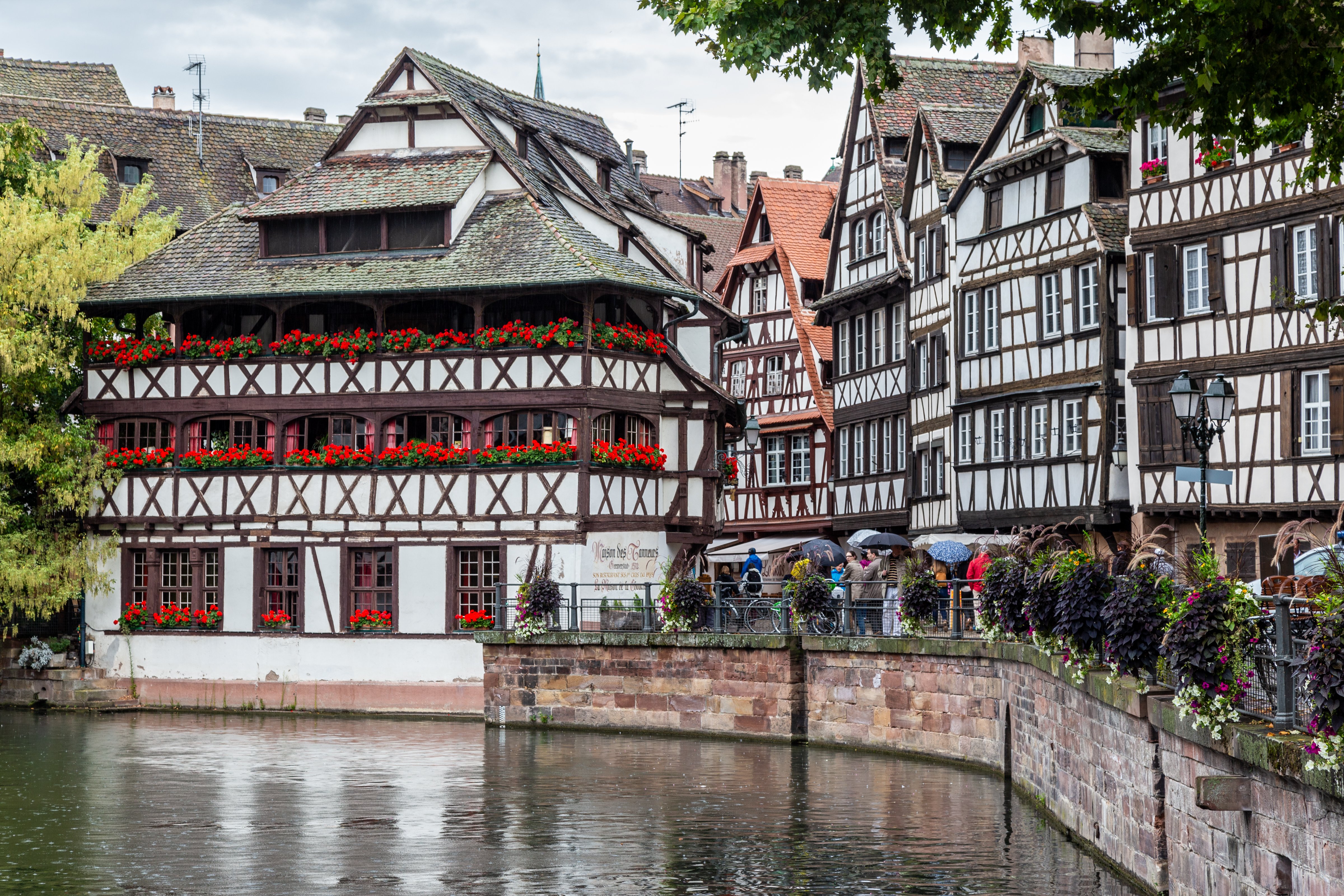
Strasbourg sits on the Rhine, on the border with Germany, and it shows: the language, the food, the architecture, and the beer all carry a German imprint, yet the city is unmistakably French. The Alsatian capital has changed hands between France and Germany several times over the centuries, and that dual identity is part of what makes it so interesting.
Today Strasbourg is home to the European Parliament, the Council of Europe, and the European Court of Human Rights — a fitting role for a city that has spent so long straddling two cultures. The institutions cluster in a modern quarter to the northeast, but the heart of the city is medieval.
The Cathédrale Notre-Dame dominates everything around it. Its single Gothic spire, completed in 1439, was for centuries the tallest structure in the world. Inside, the 16th-century astronomical clock still draws crowds at noon when its automata parade. The Palais Rohan, right beside the cathedral, houses three museums in one of the finest Baroque buildings in Alsace. The area around the cathedral — cobbled lanes, half-timbered houses, candlelit winstubs — is the best of Strasbourg.
Southwest of the centre, La Petite France is the most picturesque corner: a tangle of canals and 16th-century tanneries, now full of restaurants and tourists, but still worth walking. To the north, Place de la République is the centrepiece of the German imperial Neustadt, a grand ensemble of Wilhelmine civic buildings built after 1871 that makes a fascinating contrast with the medieval island. The city's Christmas market, held on Place Kléber and Place de la Cathédrale from late November, is one of the oldest and largest in Europe.