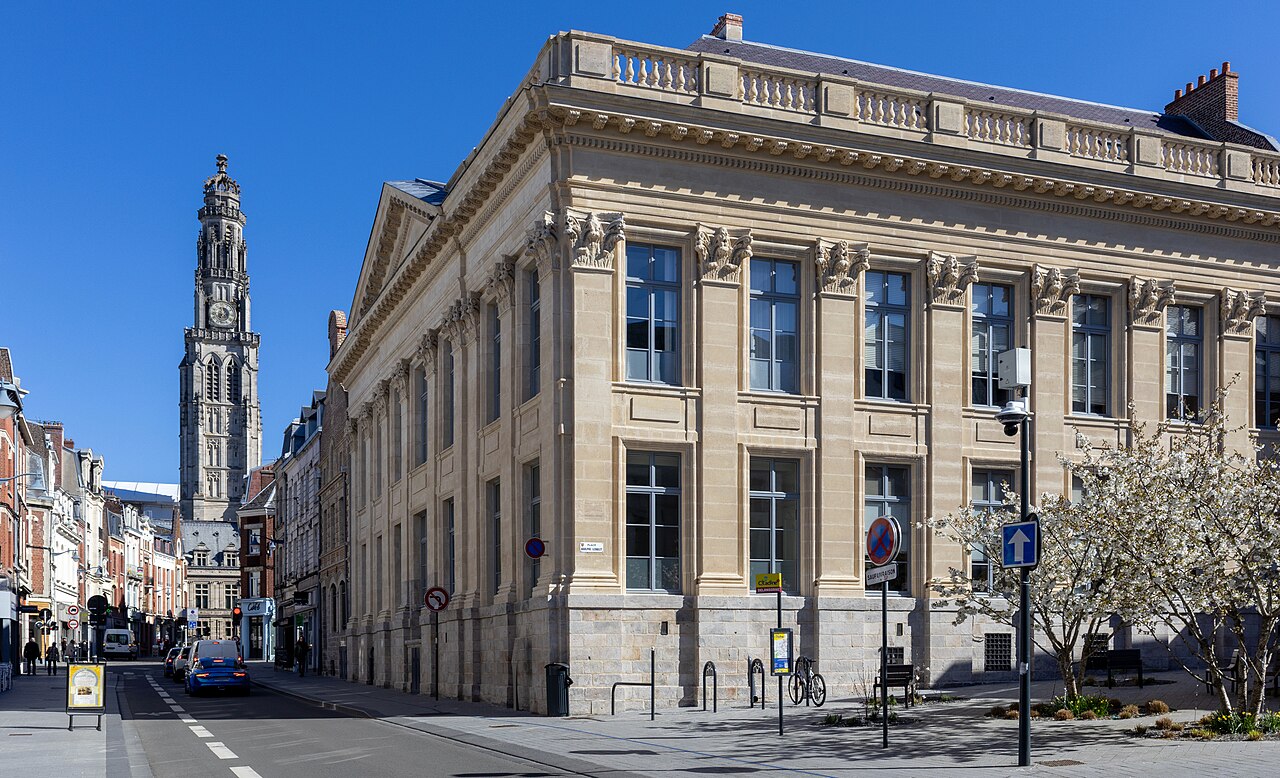
Arras is a small city with an outsized sense of place. Its centrepiece is one of the finest Flemish baroque ensembles in France: two vast cobblestone squares — the Grand'Place and the Place des Héros — ringed by tall gabled facades in honey-coloured stone. It is a deeply French town that looks conspicuously Flemish, a quirk of history that gives it a character unlike anywhere else in the region.
The city was razed during the First World War and rebuilt stone by stone, facade by facade, from photographs and engravings. That patience shows. The squares feel genuinely grand rather than falsely restored. Beneath them runs a network of mediaeval chalk tunnels, the boves, used by soldiers during both world wars and now open to visitors. The Carrière Wellington tunnels south of the centre provide a deeper and more extensively interpreted look at the same underground world.
Arras was the birthplace of Maximilien Robespierre, a fact the city acknowledges without excessive pride; his childhood home can be visited. The Hôtel de Ville's belfry dominates the Place des Héros, and on a clear day the climb to the top earns views across the flat Artois plain into Belgium. The Cathedral and Abbey of Saint-Vaast houses the city's fine-arts museum and is one of the best neoclassical ecclesiastical complexes in northern France.
The surrounding countryside is dense with Commonwealth War Graves Commission cemeteries. Vimy Ridge, a few kilometres north, is perhaps the most visited First World War memorial in the world, drawing Canadians in particular who see the battle there as a defining moment in their national history. The Arras Memorial in the western suburbs records 35,000 missing soldiers and is a more contemplative site. For anyone interested in the Western Front, Arras is an ideal base.