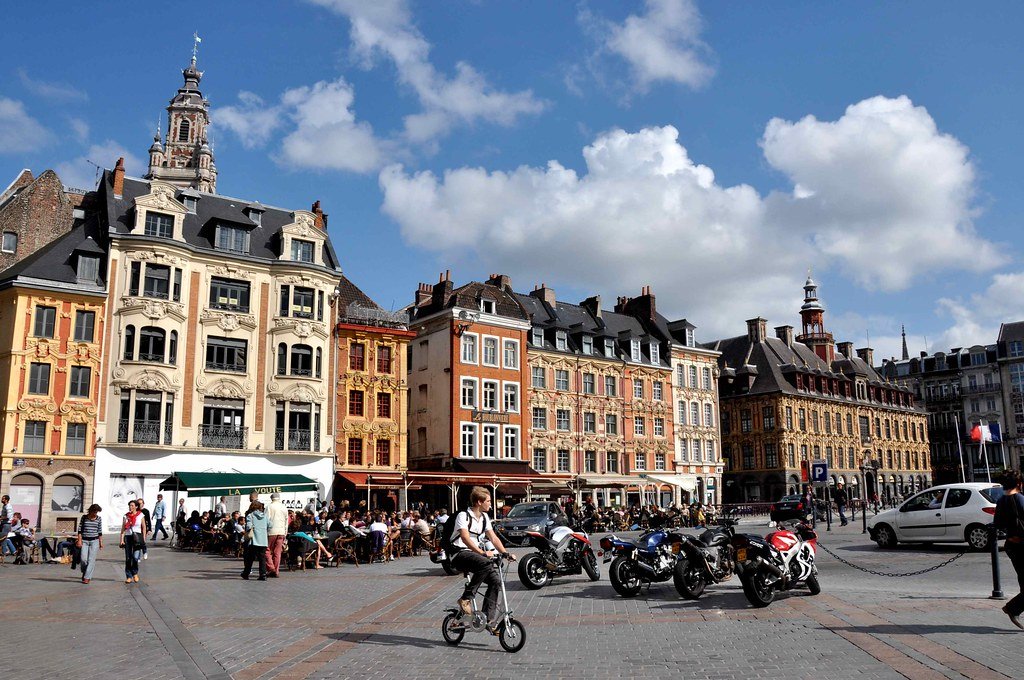
Lille is the fourth-largest city in France, with a metropolitan area of about 1.2 million people stretching across the Belgian border (Lille–Kortrijk–Tournai is effectively a single bi-national conurbation). For most of its history Lille was a Flemish city — it was part of the Spanish Netherlands, then the Austrian Netherlands, before Louis XIV took it for France in 1667 — and that history is still obvious in the architecture, the food, and the language (ch'timi, the local dialect, is closer to Walloon than to standard French). It is also the only major French city with a strong red-brick old town that looks, at first glance, more like Bruges or Antwerp than anywhere in France.
Most visitors spend their time in Vieux-Lille, the restored old quarter — a compact grid of cobbled lanes, 17th-century Flemish townhouses, stepped gables and small courtyards, centred on the Grand'Place (officially Place du Général de Gaulle, who was born in Lille in 1890). The square is dominated by the magnificent Vieille Bourse — the Old Stock Exchange, built in 1653, a Flemish masterpiece whose interior courtyard is now a gathering place for chess players and second-hand booksellers. Around it, the streets north and west are among the most pleasant in northern France for wandering, eating, and window-shopping. The Cathédrale Notre-Dame-de-la-Treille has a startling modern façade of translucent marble completed in 1999. The Citadelle, a massive star-shaped fortress designed by Vauban in the 1670s and still occupied by the French army, sits on the edge of the old town.
The city's big surprise for first-time visitors is the Palais des Beaux-Arts, which after the Louvre is the largest and finest art museum in France. Its collection spans Rubens, Van Dyck, Goya, Delacroix and Courbet, plus a superb medieval sculpture gallery and two of Raphael's finest drawings. It is exceptional, and exceptionally uncrowded. Beyond the city centre, Wazemmes is Lille's multicultural working-class district with one of the best Sunday markets in France.
Food is a major reason to come. The Welsh (a baked rarebit), carbonade flamande (a sweet-sour Flemish beef and beer stew), moules-frites, chicon gratin (endive wrapped in ham and baked), and the local maroilles cheese are the essential dishes. The twice-yearly Braderie de Lille — the enormous first-weekend-of-September flea market, the largest in Europe, when the entire city centre becomes a giant street sale — is an unforgettable event if you can time a visit for it. Lille is 1 hour from Paris by TGV, 80 minutes from London by Eurostar, and 35 minutes from Brussels — one of the most useful stopovers in north-western Europe.