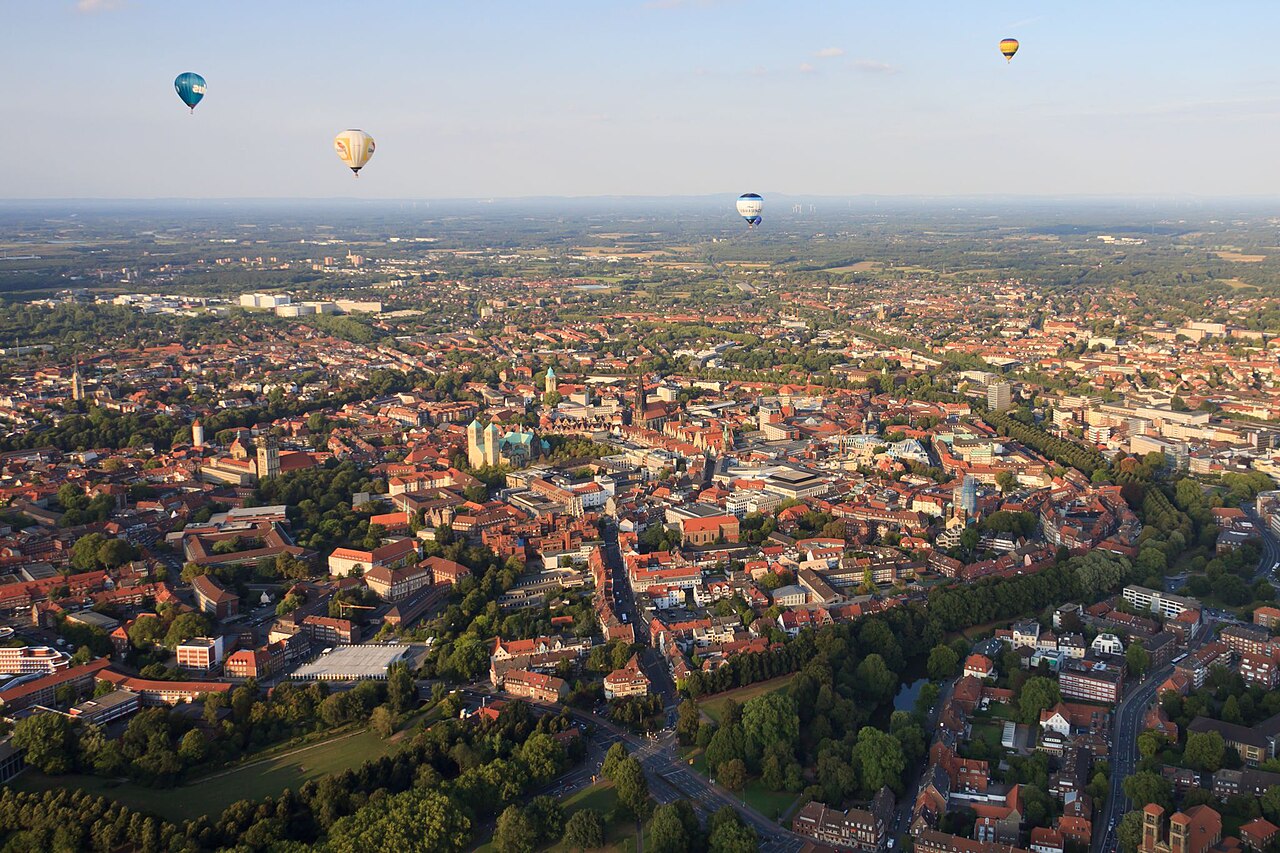
Münster (about 308,000 inhabitants) is an attractive city in the Münsterland, a flat green region dotted with charming little castles and ideal for cycling. If you arrive by train, don't be put off by the unattractive surroundings of the station — move on to the city centre and you'll find a different world entirely.
You would never guess the centre was almost completely destroyed in World War II, because it was rebuilt painstakingly, cobbled streets and all. The Dom with its treasury and 1540 astronomical clock is the obvious starting point. The Rathaus on the Prinzipalmarkt — where the Peace of Westphalia was signed in 1648 — is one of the most historically charged rooms in Germany. And St Lambert's Church still has the three iron cages hanging from its tower where Anabaptist corpses were displayed after the failed theocratic uprising of 1535.
With more than 40,000 students, the University of Münster is the third largest in Germany, and that shows: the city has a lively cultural scene, a good selection of museums — including the LWL-Museum für Kunst und Kultur and the Pablo Picasso Museum — and plenty of good bars and cafes. The Promenade ring of tree-lined boulevard on the old city walls encircles the centre, and with more bicycles than people the city is one of the best in Germany for two-wheeled exploration. In December, the centre comes alive with a popular Christmas market — actually four separate smaller markets spread around the old town.