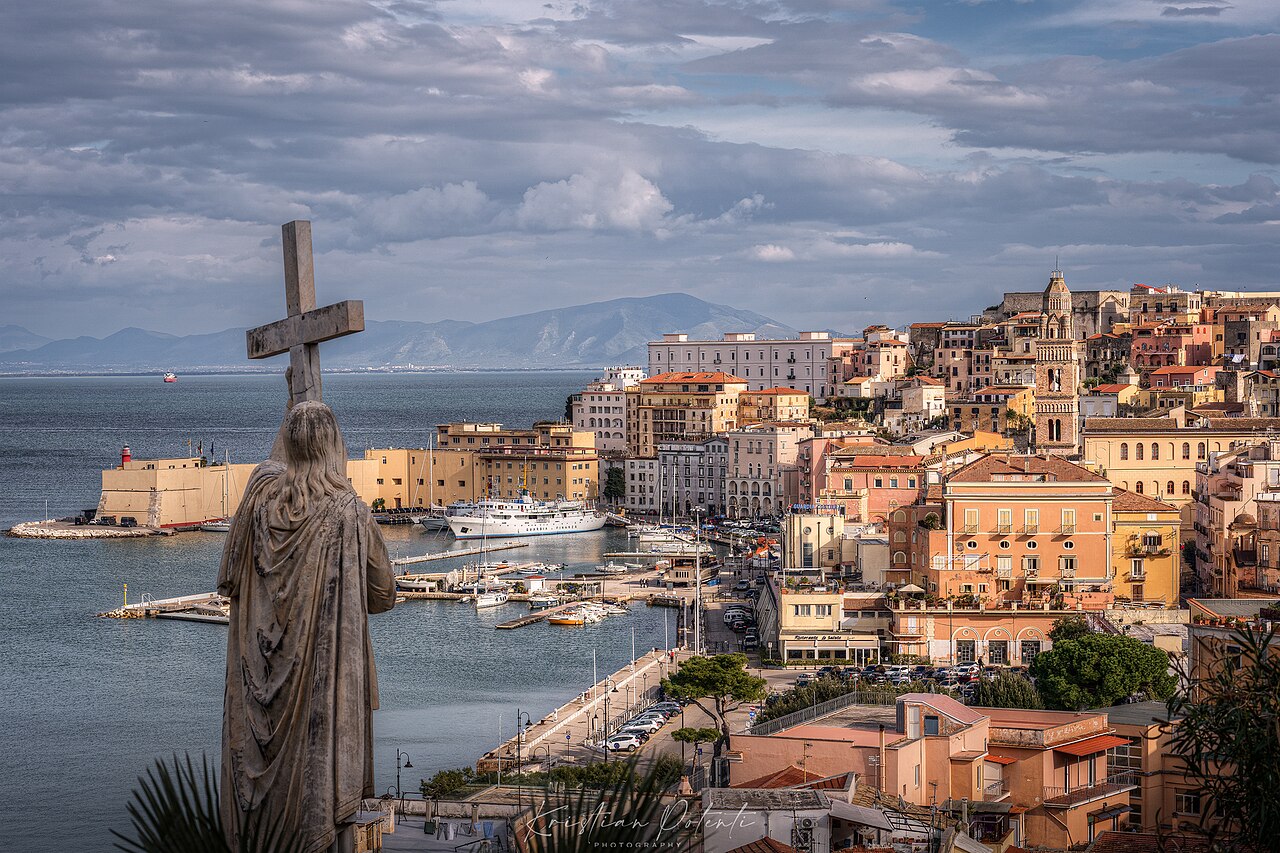
Gaeta sits on a rocky peninsula jutting into the Tyrrhenian Sea, about halfway between Rome and Naples. The coast here was described by Homer and Virgil — the stretch from Gaeta south to Sperlonga is still called the Riviera di Ulisse — and the town has been a strategic harbour since Roman times.
The medieval old town climbs steeply up Monte Orlando, the headland that gives Gaeta its dramatic silhouette. Narrow alleys wind past Baroque churches and open abruptly onto panoramic sea views. At the top stands the Castello Aragonese, a fortress that has held off everything from the Normans to Napoleon. At the far tip of the promontory, the Montagna Spaccata — a cliff split vertically from top to bottom — is one of the most striking geological features on the Italian coast. Legend holds that the rock cracked at the moment of Christ's death; the gorge now holds a cave sanctuary.
Below the old town, the bay curves around to Serapo, a wide arc of golden sand that ranks among the finest beaches on the Lazio coast. The newer part of Gaeta lines this lower stretch, offering seafood restaurants and a relaxed waterfront. The town is enormously popular with Italian weekenders from Rome but sees relatively few international visitors, which keeps prices reasonable and the atmosphere genuinely Italian. Gaeta's own contribution to the food canon is the tiella — a double-crust flatbread stuffed with local ingredients such as octopus, escarole, or salted cod.
Gaeta also makes a good base for day trips: the cliff-perched town of Sperlonga, the ruins of Tiberius's grotto, and the wild headland of Monte Circeo are all within easy reach. Formia, the nearest train station, is a ten-minute bus ride away and has frequent connections to both Rome and Naples.