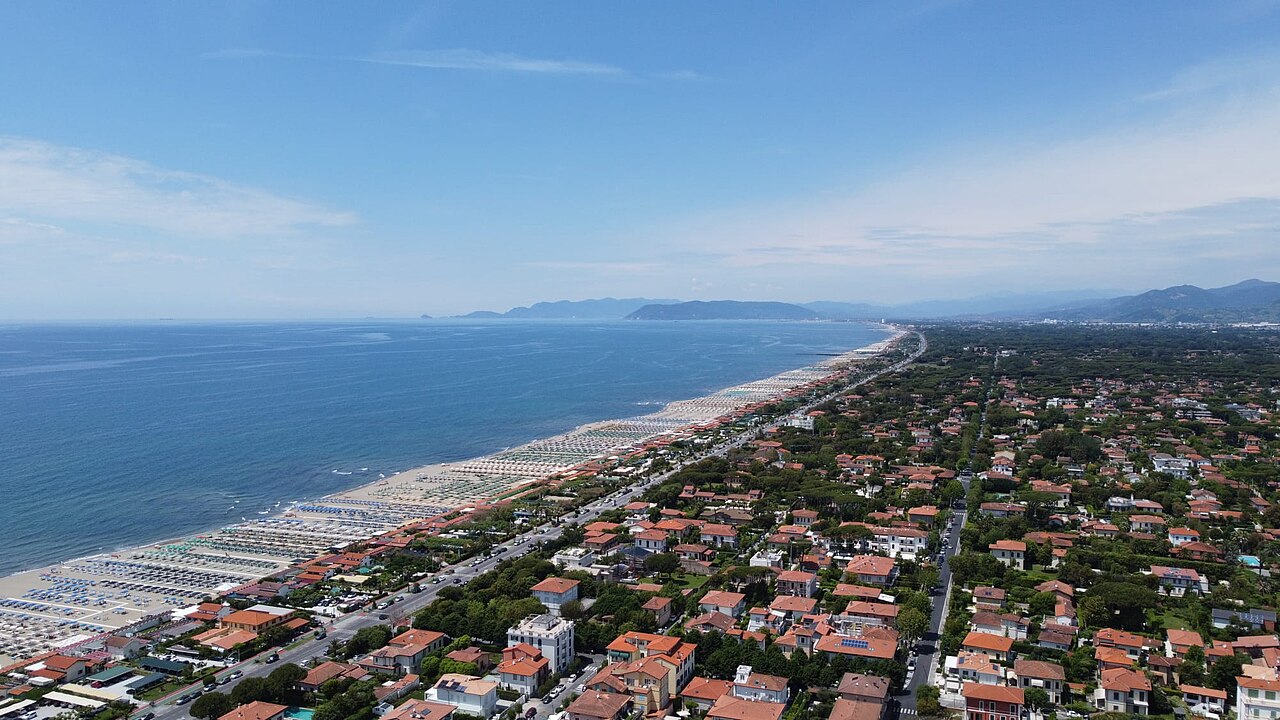
Forte dei Marmi is a small beach resort on the Versilia coast of northern Tuscany, about 30 km north of Pisa. It sits on a long flat stretch of fine white sand backed by pine woods, with the dramatic marble-topped peaks of the Apuan Alps rising directly behind the town — and it is from those mountains that Forte dei Marmi takes its name. For centuries this was the loading port where the famous white marble of Carrara was shipped out, brought down from the quarries on wooden sledges and stacked on the beach. The little 18th-century Fortino, a Grand Ducal coastal fort on the central square, was built to protect the valuable cargo; it is still the landmark at the heart of the town and what gives the resort its name.
Since the early 20th century, though, Forte dei Marmi has been something quite different: Italy's most expensive beach resort, and one of the most discreet. Unlike the flashier Côte d'Azur it has no casinos, few high-rises, and almost no visible signs of wealth — just block after block of villas hidden behind oleander hedges, a pine forest threaded with cycle paths, and a series of bagni (private beach clubs) where row upon row of striped parasols and wooden cabanas are rented by families who have held the same spot for generations. The town is famously popular with wealthy Russians and Northern Italians, and at the peak of August the restaurants, boutiques and the enormous open-air Wednesday market are packed with a very particular kind of summer crowd.
Beyond the beach, the town is small and quiet — a good base for exploring the inland hills. The marble quarries of Carrara are a short drive north, and the studios where sculptors from Michelangelo to Henry Moore chose their stone can still be visited. The mountain villages of the Lunigiana and the cliff-top towns of the Cinque Terre are within day-trip range. The famously excellent Passeggiata — the evening stroll up and down the main street, past ice-cream parlours and the Fortino — is as fixed a ritual here as anywhere in Italy.