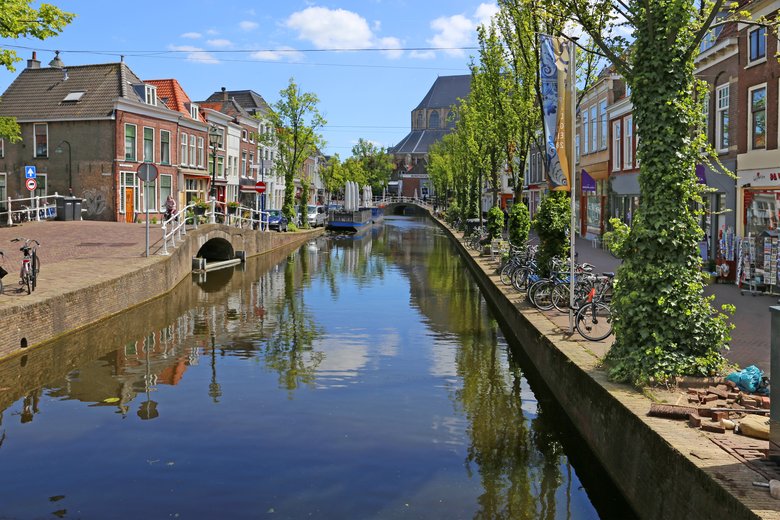
Delft is a small, handsome canal city wedged between Rotterdam and The Hague in the province of South Holland. It is one of the oldest cities in the Netherlands — the name comes from delven, to dig, after the canal that was dug here in the 11th century — and among the best-preserved, with a medieval centre of tree-lined canals, Gothic churches, and brick canal houses that has changed remarkably little in four hundred years. It is also a university town (the Delft University of Technology, founded 1842, is the Netherlands' oldest and largest engineering university), which means the cafés and bars stay lively even outside tourist season.
The Markt, the central square, is one of the most photogenic town squares in the country: at one end stands the Nieuwe Kerk (New Church, "new" in the sense that it was begun in 1381), whose tall, leaning tower dominates the Delft skyline, and at the other end the Renaissance Stadhuis (Town Hall). The Nieuwe Kerk holds the white marble tomb of William the Silent, the father of the Dutch nation, and has served as the burial place of the House of Orange ever since. A few streets away, the Oude Kerk (Old Church, begun 1246) leans at a noticeable angle of its own — Delft's soft clay plays tricks on foundations — and holds the grave of Johannes Vermeer, who was born, lived, and died here.
Vermeer is Delft's most famous son. He painted most of his 36 surviving works in this city, and the Vermeer Centrum on the Voldersgracht recreates his studio and gives context to the light, the interiors, and the maps that appear in so many of his paintings. The Museum Prinsenhof, in the former convent where William of Orange was assassinated in 1584, houses the city's historical collection — the bullet holes from the assassination are still visible in the wall of the entrance hall. And Royal Delft (De Porceleyne Fles), the last remaining Delftware factory from the 17th century, offers factory tours where you can watch painters hand-painting the blue-and-white ceramics that made the city famous.
Delft is small enough to see in a day from The Hague or Rotterdam (ten minutes by train from either), but it rewards an overnight stay: walk the canals at dusk, eat at one of the restaurants on the Beestenmarkt or Wijnhaven, and watch the light change on the water in the way that Vermeer would have recognised.