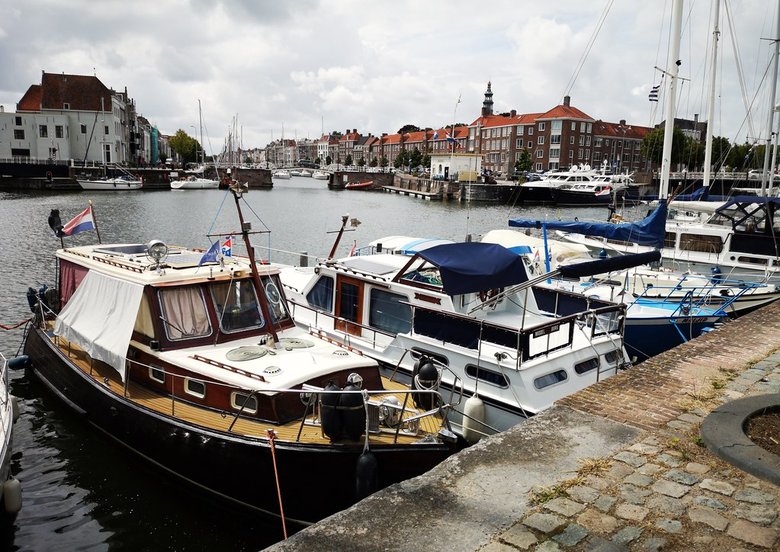
Middelburg is the capital of Zeeland, the southwesternmost province of the Netherlands — a land of islands, polders, and sea inlets that once rivalled Amsterdam in maritime ambition. The province gave its name to New Zealand, sent Admiral Michiel de Ruyter to sail the Dutch fleet up the Thames, and built much of its wealth on the spice trade. Today it is one of the quieter corners of the Netherlands, but Middelburg itself rewards a visit with a compact historic centre that emerged largely intact from the devastation of the Second World War.
The old town is built around a network of canals lined with stepped-gable merchant houses. The great Middelburg Abbey complex at its heart dominates the skyline and houses the provincial government in the same medieval buildings where monks once kept accounts of the spice trade. The market square, the Markt, has one of the finest Gothic town halls in the Netherlands — the Middelburg Town Hall bristles with statues of the counts and countesses of Zeeland. Alongside it, the Vleeshal (old Meat Hall) now hosts contemporary art exhibitions. The Zeeuws Museum, housed within the abbey, holds the extraordinary Zeeland Tapestries — six enormous sixteenth-century woven panels recording Dutch naval victories. For something entirely different, Miniature Walcheren is a 1:20 scale model of the whole peninsula, commissioned by Queen Juliana in 1954.
Getting here takes some effort from the rest of the Netherlands. The best approach is by train from Rotterdam — just over an hour, with a change at Roosendaal. From Belgium, a bus-and-ferry combination from Bruges makes for a particularly scenic approach across the Westerschelde estuary.