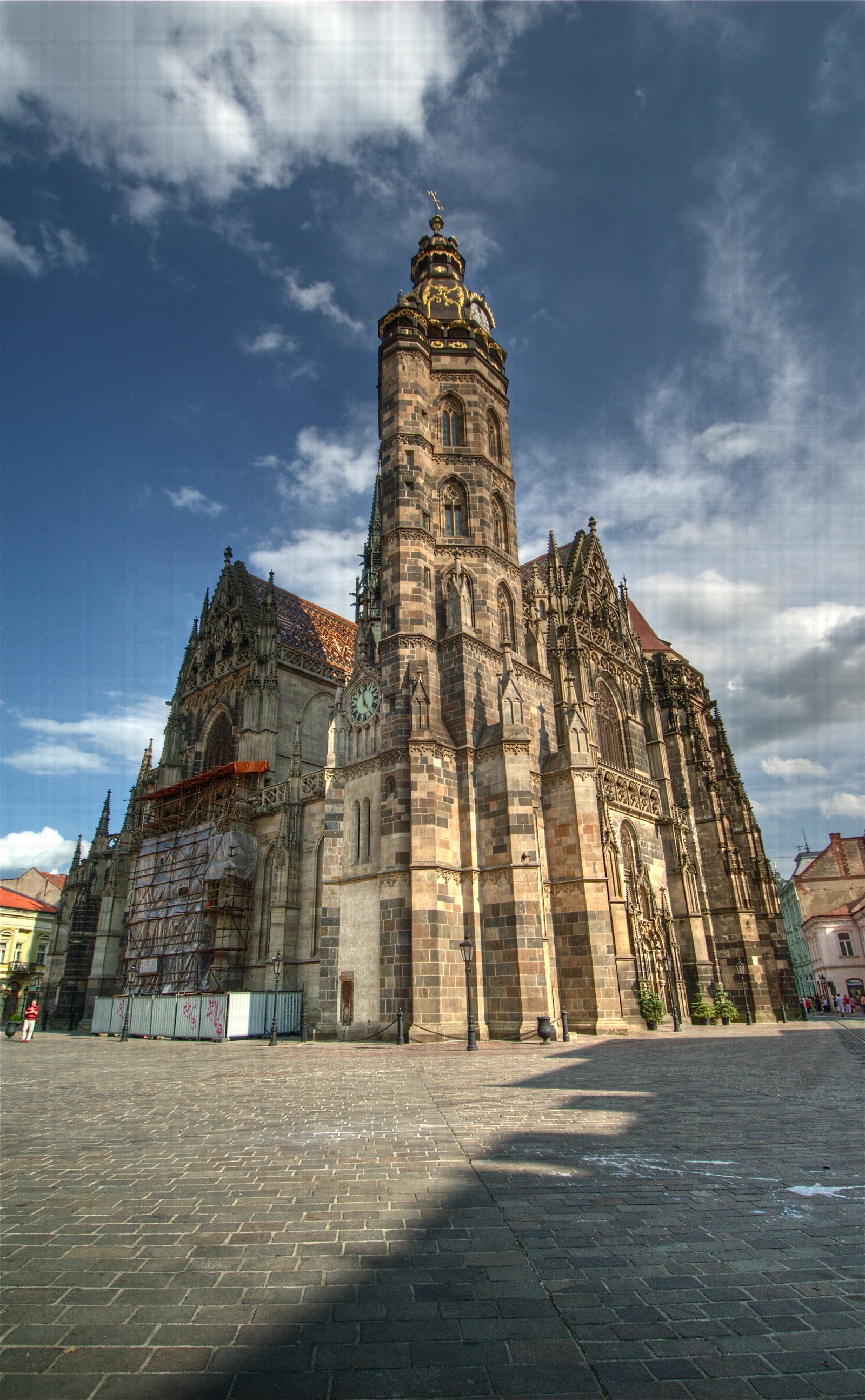
Košice is Slovakia's second city, a substantial regional capital of about 240,000 people in the far east of the country, close to the Hungarian and Ukrainian borders. It is the largest city in eastern Slovakia and in many ways feels like a different country from Bratislava — more Central European in character, with a strong Hungarian cultural tradition (the city was known as Kassa under Hungarian rule) and a historic centre that is larger and better preserved than most visitors expect.
The heart of the city is Hlavná ulica, the main street — actually a long, broad pedestrian promenade roughly 1.5 kilometres long and lined with churches, palaces, theatres, and cafés that give it the feel of a small Viennese boulevard. At the centre stands St. Elisabeth Cathedral, the easternmost Gothic cathedral in Europe and the largest in Slovakia, an extraordinary building whose scale still comes as a surprise to first-time visitors. The nearby St. Michael Chapel and the State Theatre Košice complete a grouping of buildings that makes the central part of Hlavná ulica one of the finest civic spaces in Slovakia.
The East Slovak Museum is the most historically significant museum in the region, holding the famous Košice Gold Treasure — a hoard of over 3,000 gold coins found in 1935 during construction work, representing one of the largest medieval gold finds in European history. Outside the centre, the Košice Zoo and the Museum of Aviation at the airport attract visitors with families. Košice served as European Capital of Culture in 2013, and several cultural institutions expanded or built during that period remain active.