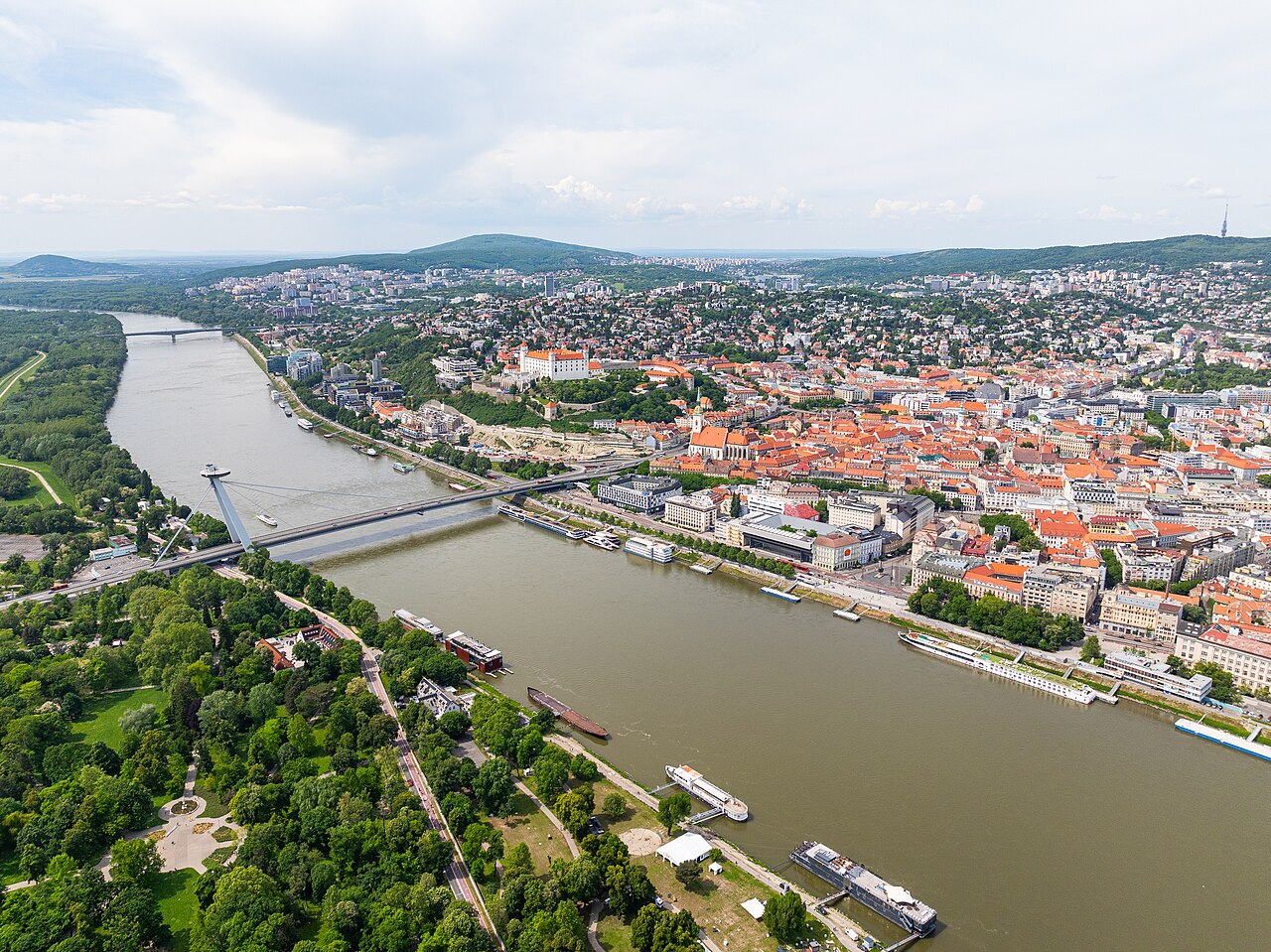
Bratislava is one of Europe's smallest and most underrated capitals. Sitting on the Danube where Slovakia, Austria, and Hungary meet, it spent centuries in the shadow of nearby Vienna — and for much of that time, it was the coronation city of the Hungarian kings.
The old town is compact and walkable. Bratislava Castle, perched on a hill above the Danube, dominates the skyline and houses several museums including the Museum of Jewish Culture. Below, the medieval streets lead to the Main Square, where the Renaissance Maximilian Fountain and Gothic Town Hall anchor a cluster of pastel-coloured houses. The Primate's Palace, a few steps away, is the finest Classicist building in Slovakia.
St Martin's Cathedral, a 13th-century Gothic church where 19 Hungarian monarchs were crowned, anchors the western edge of the old town. The Slavín war memorial, on the city's highest hill, offers panoramic views and a sombre reminder of the 6,845 Soviet soldiers buried here. For a lighter afternoon, pack a picnic for Janko Kráľ park on the south bank of the Danube, or head to Horský Park for a walk in the woods.
The Christmas Market on the Main Square is one of the best in Central Europe — worth timing a visit around if you are in the region in December.