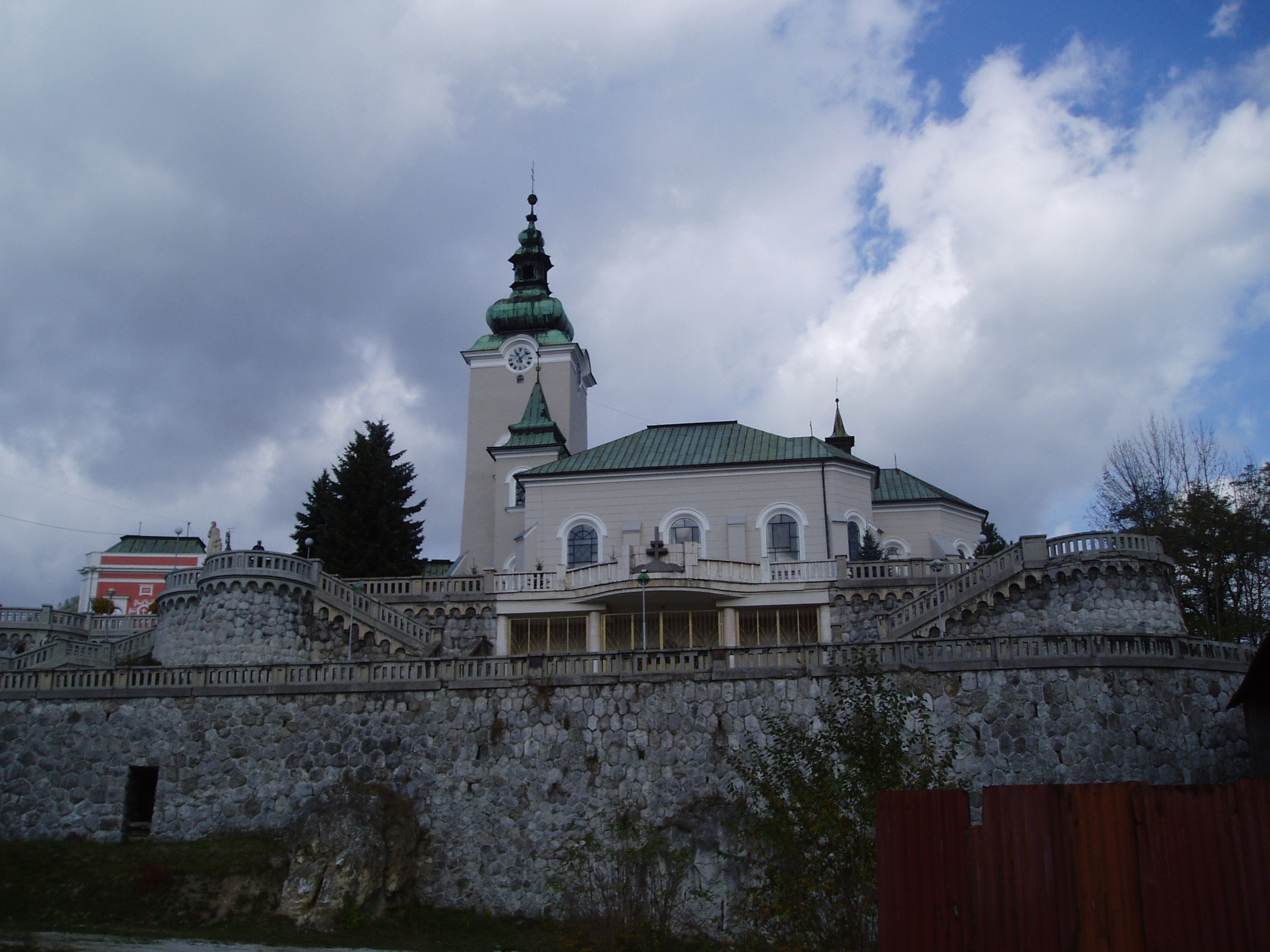
Ružomberok sits in a broad valley where the Váh and Revúca rivers meet, hemmed in by the Greater Fatra mountains, the Low Tatras, and the jagged limestone peaks of Chočské vrchy. It is not a postcard town — a paper mill dominates the skyline and the communist-era housing blocks are hard to miss — but it is an honest working town with real character, and the surroundings are spectacular.
The main draw is what lies just outside the city limits. The village of Vlkolínec, a UNESCO World Heritage Site since 1993, is a perfectly preserved cluster of traditional wooden houses perched on a hillside just a few kilometres south — one of the finest examples of traditional Slovak folk architecture anywhere. Malinô Brdo, the local ski area, offers solid winter skiing and summer hiking with panoramic views across the Liptov basin. And the ruins of Likava Castle brood on a forested hilltop to the north, reachable by a short walk through the woods.
In town, the compact centre around Andrej Hlinka Square rewards a wander. The Church of St Andrew dates to 1318, rebuilt in Renaissance-Baroque style, and anchors the main square. The Ľudovít Fulla Gallery, a branch of the Slovak National Gallery, houses a fine collection of this modernist painter's bold, folk-inspired work. The nearby suburb of Černová is the site of the 1907 Černová massacre, one of the defining events in Slovak national history. Veľká Fatra National Park begins at the town's edge and offers excellent hiking through forested limestone ranges with brown bear, lynx, and wolf.
Ružomberok is well connected by rail and road — about an hour from Žilina and three hours from Bratislava — making it a practical base for exploring the Liptov region. The town itself does not take long to see, but the mountains, castles, and villages around it can fill several days.