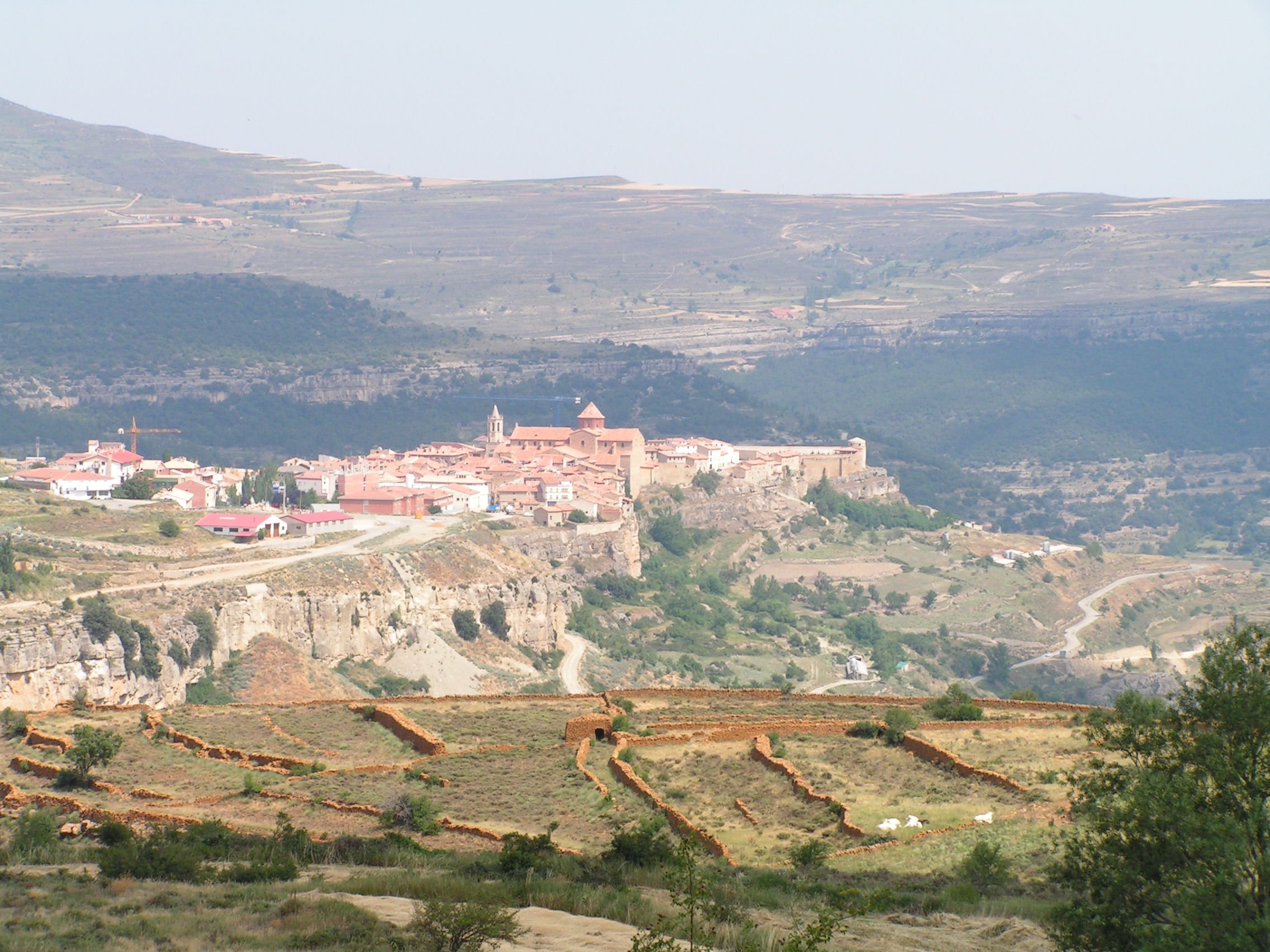
Fortified Maestrazgo hill village in Teruel, perched on a windy rocky spur above mountain country
Cantavieja is a fortified hilltop village in Teruel province, perched on a rocky spur above the wild Maestrazgo mountains. It sits at over 1,300 metres and the winds that tear across its streets are a constant reminder of just how exposed the position is — yet that same position gives it a drama that stays with you.
The village works well as an overnight stop on the classic circuit between Valencia, Teruel, the Maestrazgo interior, and Castellón. The old town is small enough to cover on foot in an afternoon: the Plaza de Cristo Rey with its Baroque church and the attached ayuntamiento (town hall) is the centre of it all, and the TIC occupies the same porticoed stretch. The Iglesia de Nuestra Señora de la Asunción dominates the square and is worth a look inside. Wander the narrow streets and you will quickly notice that several houses are built right over a sheer rocky precipice — to see this properly from below requires a short walk out of town.
If you have more than a night, the surrounding Maestrazgo landscape opens up into good walking country, with empty roads and austere villages that see very few visitors. Mirambel, 10 kilometres north, is one of the best-preserved medieval walled villages in Aragón and worth the short drive.
Guide
Getting There
Cantavieja is not easy to reach without your own car, which is part of why so few visitors make it there. By road, it is about 100 kilometres inland from Castellón and 120 kilometres from Teruel — roughly 90 minutes from either. The most scenic approach is from Valencia or Castellón via the CS-840 and GV-9006 through the Maestrazgo mountains: the road climbs steeply from the coast plain into austere limestone country, passing through almost-deserted villages before arriving at the rocky spur.
There is no rail connection to the Maestrazgo. There are occasional bus services from Teruel and from Castellón, but frequencies are very low (sometimes a single service a week) and do not support a day trip. Self-driving is the practical option for most visitors. Fill up with fuel before leaving the larger towns — petrol stations in the Maestrazgo interior are scarce.
Guide
When to Go
Cantavieja sits at over 1,300 metres altitude, which gives it a climate quite different from the Spanish coast two hours away. Winters are cold and can be snowy; the roads into the Maestrazgo are occasionally closed after heavy snowfall, though they are cleared quickly. Spring (April–June) is the best time to walk: the landscape is green, wildflowers are out, and the temperatures are comfortable. Summer is warm rather than hot — rarely above 30°C — and dry, which makes it a genuine refuge from the coast's heat and crowds.
Late September and October bring good light and quiet roads. The August festival period brings the village to life, but this is the only time crowds become a consideration.