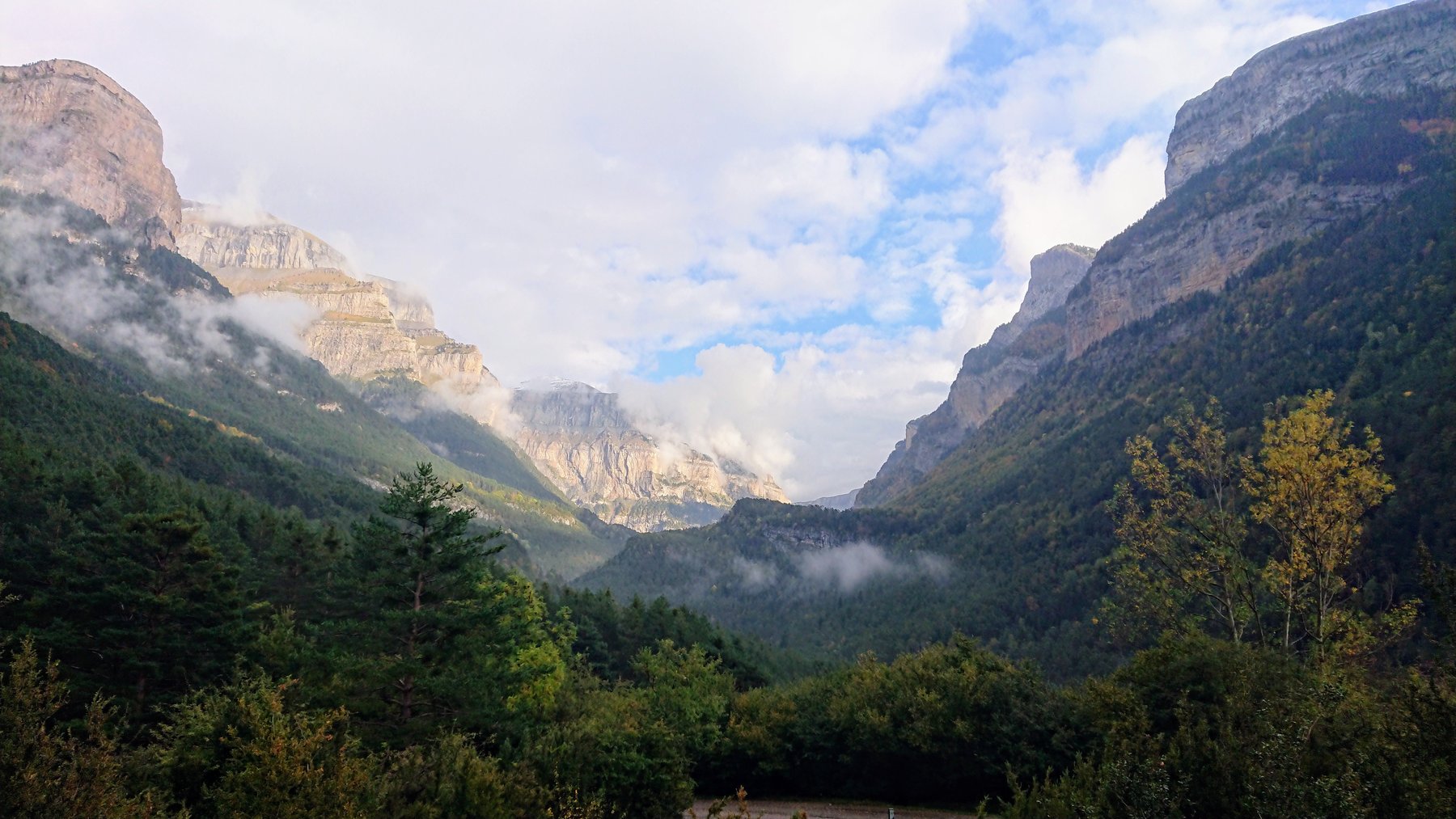
Pyrenean mountain park of glacial canyons, limestone walls, waterfalls, and Monte Perdido.
Ordesa y Monte Perdido National Park is one of the great mountain parks of Europe — a deep glacial canyon cut into the Spanish Pyrenees, ringed by sheer limestone walls and waterfalls, with Monte Perdido (3,355 m) dominating the skyline. It was Spain's first national park, established in 1918, and it feels like it was made for walking.
The park is divided into four valleys: the Ordesa canyon, the Añisclo gorge, the Escuaín canyon, and the Pineta cirque. The Ordesa valley is the most visited and the most spectacular — a broad, flat-bottomed canyon with the Arazas river threading through beech and pine forest, framed by walls of orange and grey limestone rising almost vertically. On a clear morning in late spring, with the snowmelt waterfalls still running, it is genuinely breathtaking.
The most famous walk is the Circo de Soaso route, which follows the valley floor upstream to the Cola de Caballo (Horse Tail) waterfall at the head of the canyon. It takes about five or six hours return and is one of the best day walks in Spain — straightforward enough for fit walkers, spectacular enough to justify the effort. The path up to the Brecha de Rolando and into France via the Faja de Pelay is harder and more exposed, but rewards with views across the whole massif.
Wildlife is abundant: chamois graze on the high ledges, griffon vultures wheel overhead, and if you're lucky you may spot a lammergeier — the enormous bearded vulture that drops bones from height to crack them on the rocks below. The park also holds one of the last viable populations of Pyrenean brown bear, though you are very unlikely to encounter one.
The gateway town is Torla-Ordesa, a handsome stone village 8 km from the park entrance. In summer, private cars are banned from the road into the valley; a shuttle bus runs every twenty minutes from the large car park below Torla. The park is also accessible from Ainsa to the south, which gives access to the Añisclo and Pineta sectors.
Guide
Getting There
The nearest town is Torla-Ordesa, 8 km from the park entrance, which is the standard base for visiting the Ordesa valley. Torla is reached by road from Ainsa (35 km south on the A-138 and A-135), which in turn connects to Barbastro and the Zaragoza–Huesca motorway.
By bus: There is a bus service from Sabiñanigo (on the Zaragoza–Canfranc rail line) to Ainsa, with connections onward. Timetables vary by season; check current schedules before travelling. Jaca is also a useful staging point, with connections from the north via the Canfranc rail tunnel from France.
By car: Drive to the large car park below Torla. From late June to mid-September, private vehicles are not permitted on the road into the Ordesa valley — a shuttle bus runs every twenty minutes from the car park to the valley floor (small fee). Outside this period, you can drive in.
From France: The Brecha de Rolando pass (accessible only on foot in summer) and the Bielsa tunnel road (open year-round) are the main cross-border connections. The tunnel emerges near Bielsa and Ainsa.
The park has no facilities for arriving visitors beyond the parking areas and the shuttle stops. There are no trains to the park itself.
Guide
When to Go
Late June to mid-September is the prime season. The high trails are snow-free, the waterfalls are still running from snowmelt (especially in June and July), and the days are long. July and August are the busiest months — the shuttle bus from Torla runs frequently and the valley fills by mid-morning on weekends. Weekday visits are noticeably quieter.
September is arguably the best month: the summer crowds thin out, the light turns golden, and the beech forest starts to colour. The high routes remain open until the first significant snowfall, usually in October.
Spring (May–June) is beautiful but unpredictable. Snow can linger on the upper paths until June, and some sections may require an ice axe. The valley floor is accessible and the wildflowers are exceptional.
Winter closes most of the high trails but the lower valley is walkable year-round. Private cars are permitted on the valley road in winter (the bus service operates at reduced frequency). Snowshoeing is possible with the right equipment.
The park receives heavy rainfall — the Pyrenees catch Atlantic weather systems year-round. Always carry waterproofs, whatever the season.