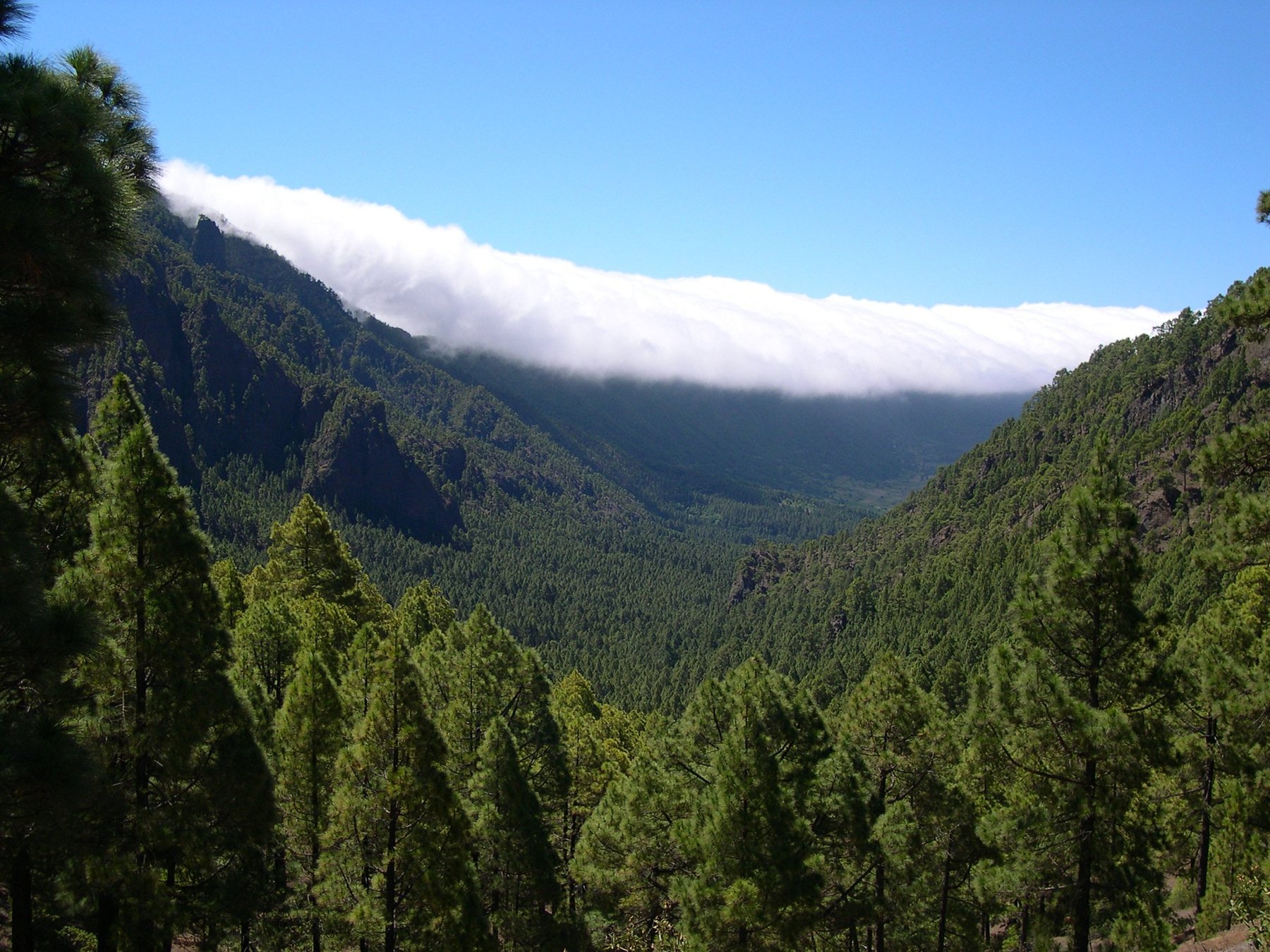
La Palma is the steepest island in the world relative to its size, a volcanic spike rising nearly 2,500 metres straight out of the Atlantic. Most of the Canary Islands have been reshaped by tourism; La Palma largely hasn't. It has stayed green, quiet, and agricultural, which is either a reason to go or a reason to go elsewhere, depending on what you're after.
The island's full name is San Miguel de La Palma, and it has a noticeably different feel from Tenerife or Gran Canaria. The northeast gets soaked by Atlantic trade winds and stays lush even in summer — banana plantations and laurel forest cover the slopes. The southwest is drier and sunnier, where the beach resorts of Los Cancajos (near the airport and capital) and Puerto Naos (on the western shore, more reliably warm) sit on stretches of dark volcanic sand.
The capital, Santa Cruz de La Palma, is one of the more handsome towns in the Canaries: a compact old town of Canarian timber balconies running down to a seafront promenade. Los Llanos de Aridane, in the west, is the island's commercial centre and the base for exploring the Caldera de Taburiente, a vast collapsed volcanic crater that is now a national park.
The summit ridge at Roque de los Muchachos (2,426 m) hosts one of the world's major astronomical observatories — the altitude and isolation produce some of the clearest skies in the northern hemisphere, protected by law. On a clear night from the coast you can see the observatories' domes lit up far above the clouds.
In 2021 the Cumbre Vieja volcano erupted for 85 days, destroying around 3,000 homes in the southwest and adding new land to the island's coastline. The Tajogaite lava fields are still raw and stark when you drive through them — an unsettling reminder that the island is actively building itself. At the southern tip, the Fuencaliente Saltworks operate between two volcanic craters, producing sea salt and attracting migrating birds.