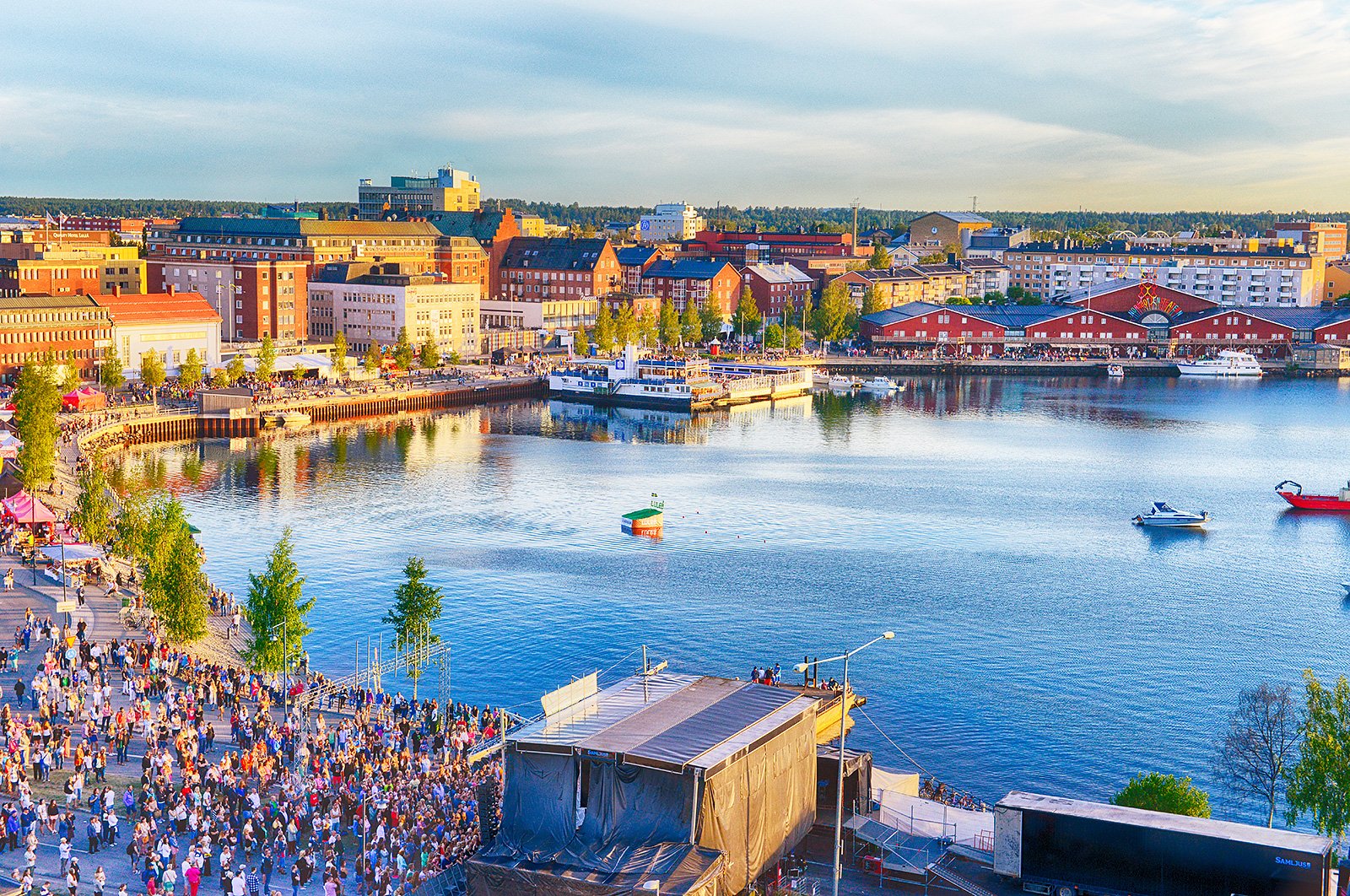
Luleå is the capital of Norrbotten, Sweden's northernmost county, perched where the Lule River empties into the Bothnian Bay. For much of the year this is a genuinely Arctic city — the bay freezes solid from January to April, and in deep winter the sun barely clears the horizon. That said, Luleå is a lively university city with a student population that keeps the bars and restaurants humming even when temperatures fall to minus twenty.
The city has two great claims on the traveller's attention. The first is Gammelstad Church Town, a UNESCO World Heritage Site about ten kilometres to the northwest. This is the best-preserved example of a Scandinavian church town — the practice of building cottages around a church so that parishioners from outlying farms could stay over on Sundays and holy days. Over 400 red-painted timber cottages survive here, clustered around a medieval stone church, and the whole ensemble gives a vivid picture of rural Swedish religious life before roads and railways changed everything.
The second is the winter itself. The Bothnian Bay freezes to extraordinary thickness, and Luleå operates ice roads across the frozen water to nearby islands. You can walk or drive to places that are only accessible by boat in summer, passing through a landscape of pure silence and snowfields. The northern lights are a regular presence in winter skies. In summer the situation reverses: the midnight sun, warm archipelago islands, and long evenings on café terraces.
Luleå Cathedral anchors the compact city centre, and the Norrbottens Museum covers the natural and human history of the north. Teknikens Hus, a science centre on the university campus, is particularly good if you are travelling with children. The archipelago of over 1,700 islands and skerries stretching into the bay is superb kayaking and sailing territory in summer.