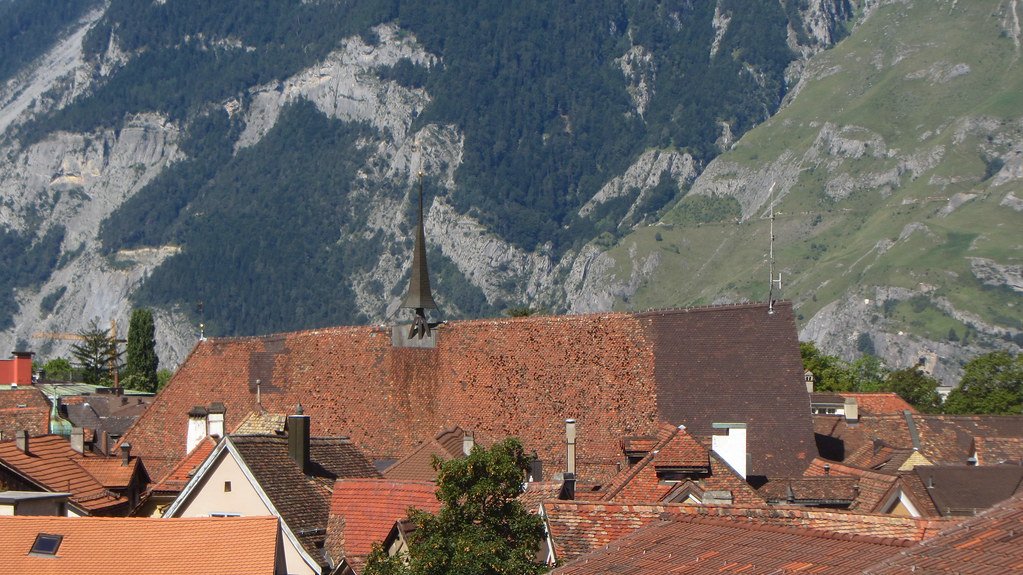
Alpine Rhine-valley city and Graubünden capital, with a crooked old town and deep Roman roots
Chur claims the title of oldest city in Switzerland, with evidence of settlement stretching back more than 5,000 years. Tucked into the Rhine valley at the foot of the Alps, it is the capital of Graubünden, the country's largest and most sparsely populated canton. The old town is small enough to walk in an hour, but dense with crooked lanes, painted facades, and quiet squares that reward a slower pace.
The city works as a gateway to some of Switzerland's most spectacular mountain scenery. The Glacier Express and Bernina Express both depart from Chur, threading through valleys and over passes that justify Switzerland's reputation for dramatic train journeys. In winter, the ski resorts of Arosa and Lenzerheide are less than an hour away. In summer, the hiking trails that fan out into the surrounding mountains are world-class.
Chur Cathedral, dating from the 12th century, anchors the upper old town, and the Bündner Kunstmuseum — with its outstanding Giacometti collection — is a short walk away. In the lanes between them, you will find the Gigerplatz fountain, quietly celebrating H.R. Giger, Chur's most famous modern son. For a wider view, walk or cycle north along the Rhine to Haldenstein Castle, perched above the valley with panoramic views back toward the city.
Guide
Day Trips
Chur is surrounded by some of the most spectacular mountain scenery in the Alps, and the Rhaetian Railway network makes a car entirely unnecessary for day excursions. The Arosa line climbs from Chur's city streets into the mountains in a series of tight curves and viaducts — a remarkable piece of engineering that ends at the ski resort of Arosa, about an hour above town. Lenzerheide and Savognin are reachable by postbus and offer hiking in summer and skiing in winter.
The Glacier Express and Bernina Express both depart from Chur and can be ridden in segments: a day trip by train to Davos and back covers some of the most dramatic mountain scenery in the region. The road south to Thusis and the Viamala gorge is worth a detour — the gorge, where the Rhine cuts through 300-metre walls of gneiss, is one of the most dramatic canyon landscapes in Switzerland and can be visited on foot through a series of tunnels and galleries cut into the rock face.
Guide
Getting There
Chur is well connected by rail. From Zurich, trains run roughly every half hour and take about 75 minutes; from Basel it is about two hours. The station sits at the edge of the old town, which is walkable from the platform. Chur is the starting point for the Glacier Express (toward Zermatt via St Moritz and Andermatt) and the Bernina Express (toward Tirano, Italy, via St Moritz and the Bernina Pass) — two of the most scenic mountain railway routes in Switzerland. Both require reservations and seat supplements.
By car from Zurich, Chur is about 90 minutes on the motorway. The A3 and A13 run directly there. Street parking in the old town is limited; the car parks signposted from the motorway exits are the most practical option. Switzerland is not a country where you need a car in the cities themselves — train travel is excellent and the whole of Graubünden's mountain resorts are accessible by rail or postbus from Chur.
Guide
When to Go
Chur is pleasant in all seasons, but the logic of when to visit depends on what you want to do. In summer (June to September), the mountain hiking is at its best, the Rhine valley is green, and the city has a lively outdoor cafe culture. The ski resorts of Arosa and Lenzerheide are operational from December through April; the Glacier and Bernina Express trains run year-round, though winter adds the drama of snow-covered passes to the journeys.
Spring and autumn are the quietest times, when the crowds thin out and the light in the old town is at its most interesting — low-angled and golden in October, bright and green in April and May. The Chur carnival (Fasnacht) in February is a boisterous local tradition if you happen to be in the region.
The city's altitude (580 metres) keeps temperatures moderate in summer: comfortable rather than hot, with cooler evenings than the Swiss Mittelland. In winter, expect temperatures around zero and occasional snow in the city itself, though snowfall in the valley is less reliable than at the higher resorts.