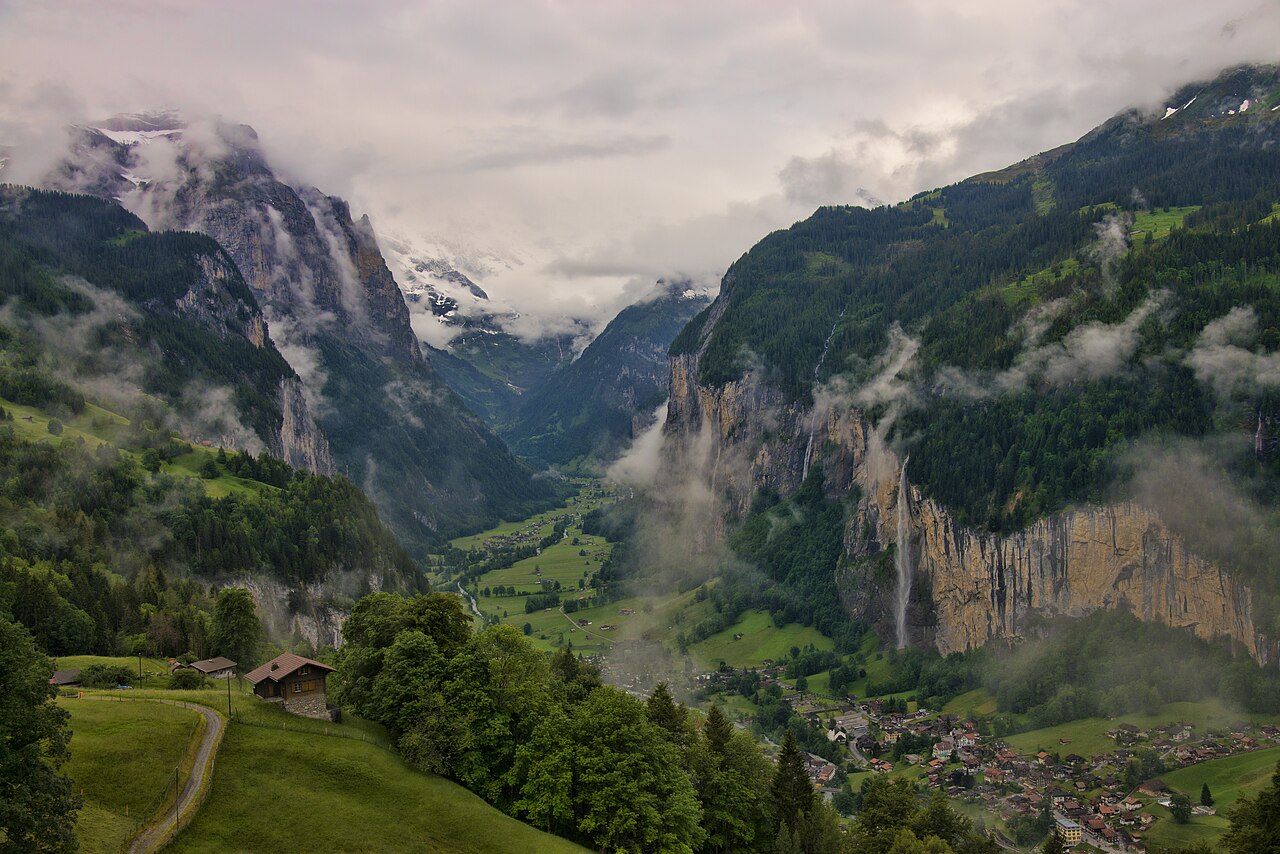
Lauterbrunnen
©
Lauterbrunnen

Lauterbrunnen

Alpine valley village below sheer limestone cliffs, where more than 70 waterfalls drop from the rim.

Lauterbrunnen is a small town 10 km south of Interlaken, spectacularly sited at the entrance to one of the most dramatic valleys in the Alps. Limestone cliffs rising up to 1,000 metres line both sides, and more than 70 waterfalls drop from the rim — the most visible being the Staubbach Falls, which fall 297 metres directly above the village and dissolve into mist before reaching the ground.

The valley is a base for three different mountain worlds. To the east, the Wengernalp rack railway climbs to Wengen, a car-free village with views of the Jungfrau massif and access to the Jungfraujoch at 3,463 metres — the highest railway station in Europe. To the west, cable cars rise to Mürren and on to the Schilthorn, whose revolving restaurant served as a James Bond villain's lair. South down the valley, the Trümmelbach Falls pour through the interior of a mountain with a force you feel in your chest.

The village itself is small and functional, with good transport connections and a supermarket. Most visitors use it as a base rather than a destination in its own right, which suits it well. The valley is also a centre for BASE jumping — the combination of high cliffs, reliable updrafts, and multiple exit points attracts jumpers from around the world.

Local tip

Lauterbrunnen sits in a sheer valley with 72 waterfalls — Staubbach plunges nearly 300 m right behind the village. Use it as a base and ride the trains up to car-free Wengen, Mürren and Jungfraujoch. The valley inspired Tolkien's Rivendell; on a misty morning you'll see why. Weather turns fast, so check the webcams before heading up.

Guide

Eating Out

The range of eating opportunities is not large, with several hotels on the main street serving traditional fare for the tourists, and only the Horner Pub at the Southern end of town serving decent meals at budget prices. There is a supermarket near the railway station, so picnic lunches and dinners are easily catered for.

Guide

Getting Around

The valley floor around Lauterbrunnen village is walkable and cycleable — a flat path runs along the river from the village south towards Stechelberg and the Trümmelbach Falls (about 2.5 km). A valley bus runs between the village and Stechelberg roughly every 30 minutes, stopping near the Trümmelbach Falls.

To reach the villages above:

  • Wengen: Wengernalp rack railway from Lauterbrunnen station (14 minutes up, 25 minutes down, frequent departures)
  • Mürren: Take the cable car from Grütschalp (opposite side of the valley, or take the valley bus to Stechelberg and the cable car up from there). The total journey from Lauterbrunnen to Mürren takes about 40 minutes
  • Schilthorn: From Mürren, then cable car series to the summit
  • Jungfraujoch: Train from Lauterbrunnen via Wengen to Kleine Scheidegg, then the Jungfrau Railway into the mountain (total journey about 2 hours)

A Swiss Travel Pass covers most of the valley transport and many of the mountain railways at a discount. The Jungfraujoch requires a supplement even with a pass.

Guide

Getting There

Lauterbrunnen is served by a direct train from Interlaken Ost (about 20 minutes) on the Bernese Oberland Railway. From Bern, trains run via Interlaken. From Zurich or Geneva, the journey takes about two hours with one or two changes. The train station in Lauterbrunnen is right in the village centre.

By car, Lauterbrunnen is about 15 km from Interlaken via the valley road. There is a large car park at the southern end of the village — the car-free villages of Wengen and Mürren are accessible only by train and cable car, so driving further up the valley is not possible. Leaving a car in Lauterbrunnen and continuing by public transport is the standard approach.

Guide

Things to Do in Lauterbrunnen

The Lauterbrunnen valley is one of the great Alpine spectacles — nearly vertical limestone walls rising up to 1,000 metres above the valley floor, more than 70 waterfalls threading down them. The sights here range from the free-standing Staubbach Falls (which inspired Goethe) to the Trümmelbach Falls inside the mountain, to the summit of the Jungfraujoch, the highest railway station in Europe. The car-free villages of Wengen and Mürren, perched on the valley walls above, are accessible by rail and cable car.

Guide

When to Go

Lauterbrunnen is a year-round destination, though the experience varies significantly by season.

Summer (June–September) is the main walking and sightseeing season. The waterfalls are at their fullest in June and July when snowmelt is running. Staubbach and Trümmelbach Falls are most dramatic then. The valley fills with hikers and the car-free villages of Wengen and Mürren are busy but not overwhelmingly so. Book accommodation in advance, especially in July and August.

Winter (December–March) brings skiing on both sides of the valley. Wengen has the famous Lauberhorn World Cup race in mid-January, which draws 30,000 spectators. The Schilthorn ski area above Mürren is quieter. The Jungfraujoch is accessible year-round; winter visits mean snow on the glacier and lower crowds, though clear days are less predictable.

Shoulder seasons (April–May, October) are cheaper and quieter. The waterfalls taper off in autumn, and some of the higher cable cars close in November and April for maintenance. But the valley itself is beautiful in all seasons, and the light in October on the mountain walls is exceptional.

One practical note: the Jungfraujoch train is expensive (around CHF 210 for a return from Interlaken) and not worth it in cloud. Check the summit webcam before booking.