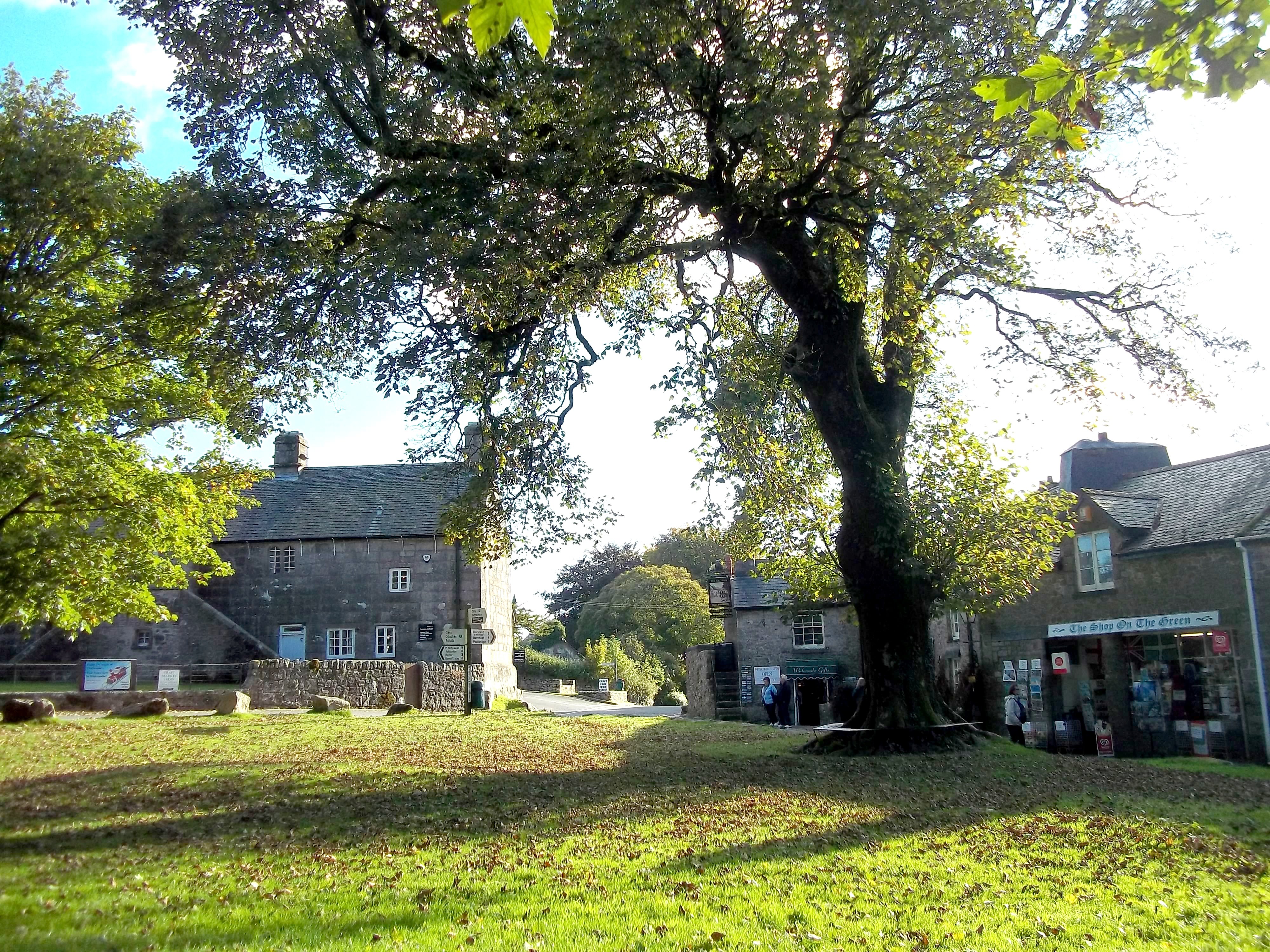
Widecombe-in-the-Moor is a small granite village at the heart of the southern part of Dartmoor, better known to most people through the old folk song "Widecombe Fair." The song tells the tale of a horse that died from the strain of carrying seven riders to the fair, and whose ghost still haunts the moor — a story that suits the windswept landscape rather well.
The village church, dedicated to St Pancras, is sometimes called the Cathedral of the Moors for its strikingly tall tower, which can be seen from miles across the open moorland. Adjacent to it, Sexton's Cottage is a 14th-century granite building run by the National Trust with information on the area. Two old pubs serve the village: the New Inn in the centre and the Rugglestone Inn half a mile to the south, a small, unspoiled local worth the short walk.
A short drive northeast across the moor brings you to Grimspound, one of the best-preserved Bronze Age settlements in Britain — a complete enclosure wall with 24 hut circles still legible on the hillside. Arthur Conan Doyle used this part of the moor as the backdrop for The Hound of the Baskervilles.