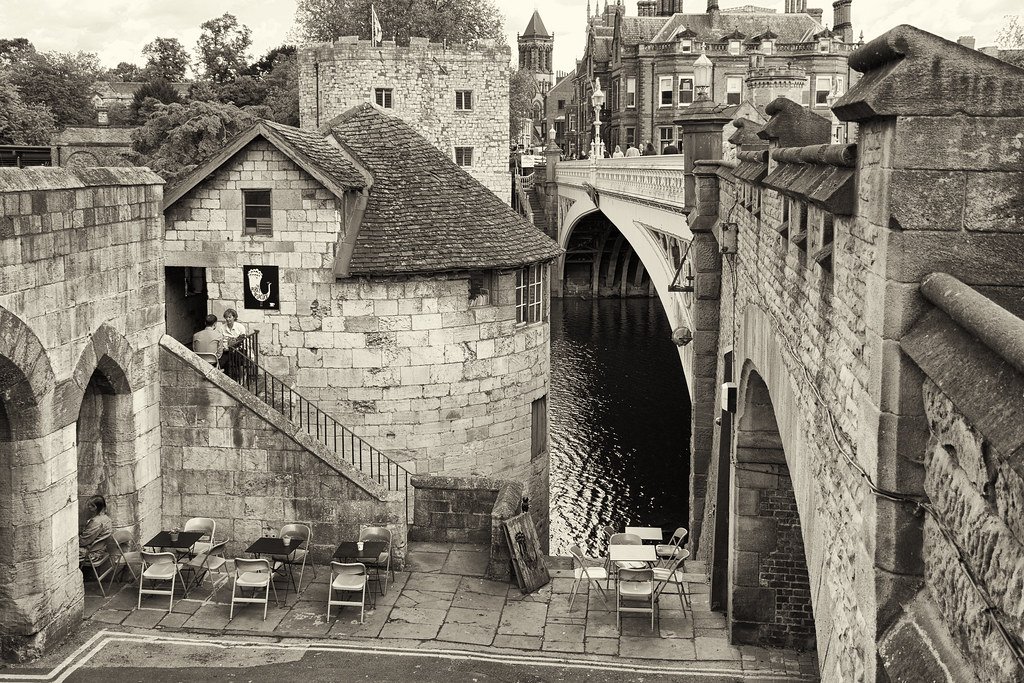
Two thousand years of history packed into a walkable city centre, and over 200 pubs to recover in afterwards. York is one of England’s finest cities, layering Roman foundations, Viking heritage, and medieval streets into a place that rewards every visit.
The York Minster dominates the skyline and deserves at least half a day. Climb to the top for sweeping views across the Vale of York, then lose yourself in the cobbled alleys of the Shambles, where timber-framed houses lean so close across the narrow street that neighbours could pass things between upper windows. The Shambles was once the city’s butchers’ quarter -- you can still see the meat hooks on some shopfronts. At its far end sits Whip-Ma-Whop-Ma-Gate, York’s shortest street with its longest name.
Walk the city walls, the longest intact medieval circuit in England, and you will pass through four medieval gateways -- called "bars" in York. Monk Bar houses a small Richard III museum. Micklegate Bar was where traitors’ heads were displayed on spikes; some reproductions are still there. The walls give you a bird’s-eye tour of the city before you have even set foot in a museum.
And the museums are worth your time. The Castle Museum, next to Clifford’s Tower, features Kirkgate, a brilliantly detailed reconstruction of a Victorian street. The National Railway Museum is one of the best free museums in the country, with engines spanning every era and a royal carriage. JORVIK Viking Centre recreates tenth-century York right down to the smells, which they are very proud of.
York claims both Guy Fawkes and Dick Turpin among its famous former residents. Guy Fawkes was born here and educated at St Peter’s School. Dick Turpin was hanged at the Tyburn, now York Racecourse, and his grave can be found at St George’s Church. Memorial plaques and a pub bearing Fawkes’s name dot the city centre.
The city is criss-crossed with hidden alleyways known as "snickelways" -- narrow passages that locals use to navigate past the Saturday crowds. If the crowds get too much, duck into one of York’s many tea rooms. Bettys on St Helen’s Square is the most famous, though Little Bettys in Stonegate is cosier and usually has a shorter queue. York is also reputedly one of the most haunted cities in England, and the Castle Museum claims to be the most haunted museum in the country.
With over 200 pubs, York is a serious drinking city. The traditional pubs serve real ale and good food -- try the Maltings near Lendal Bridge for cask beer. The city has excellent rail connections and makes an ideal base for the Yorkshire Dales, the North York Moors, and the heritage coast towns of Scarborough and Whitby.