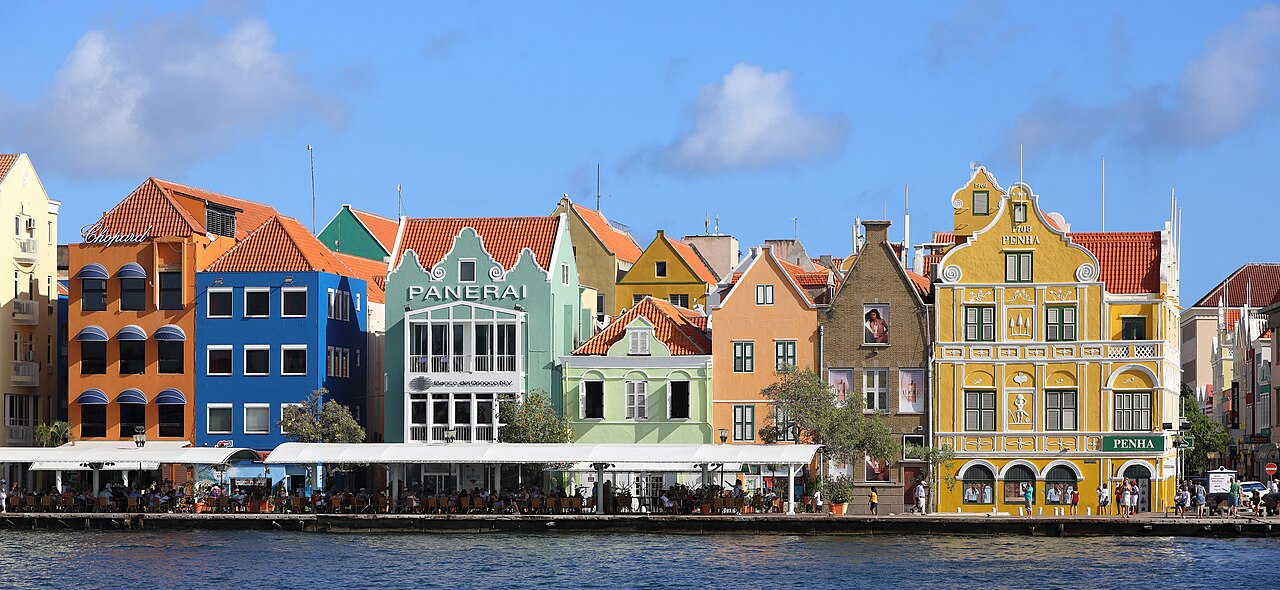
Willemstad is the capital of Curacao and one of the most visually striking cities in the Caribbean. The historic center, a UNESCO World Heritage Site since 1997, is built around the Sint Annabaai, a narrow ocean inlet with Punda on the east and Otrobanda on the west. Pietermaai and Scharloo extend the historic city beyond that central pair. The Handelskade waterfront on the Punda side is the signature view — a row of tall Dutch colonial buildings painted in sherbet shades of pink, yellow, blue, and orange, reflected in the harbor water. The colors are not a modern invention; legend has it that a 19th-century governor claimed the white buildings gave him headaches, and the painting began.
The two halves of the city are connected by the Queen Emma Bridge, a floating pontoon bridge that swings open to let ships pass through the harbor. Watching the bridge swing is one of those small pleasures that never gets old, and the crossing on foot puts you right in the middle of the city's life. When the bridge is open, a free ferry takes pedestrians across. On the Punda side, the narrow streets are lined with shops, cafes, and the excellent Mikvé Israel-Emanuel Synagogue, the oldest continuously used synagogue in the Americas, dating to 1732. Its sand-covered floor is a distinctive tradition with multiple origin stories.
Otrobanda is the grittier, more residential half, with the Kura Hulanda Museum occupying a restored slave-trade courtyard — a powerful and well-presented collection covering the African diaspora. West of its historic streets, the Rif Mangrove Park protects a surprising pocket of wetland beside the cruise terminal. The floating market, where Venezuelan traders sell fish and produce from their boats, is another unique Willemstad experience, though it has shrunk in recent years due to Venezuela's economic crisis.
Beyond the historic center, Willemstad spreads out into modern suburbs, but the old town is compact and best explored on foot. The food scene is excellent, reflecting Curacao's multicultural heritage: Indonesian, Surinamese, Dutch, and Caribbean influences all show up on menus. Try the local Kadushi cactus soup and wash it down with Blue Curacao liqueur at the Landhuis Chobolobo, where the original is still made. The city has a sophistication and depth that sets it apart from many Caribbean capitals — it feels like a real place where people live, not just a cruise-ship backdrop.