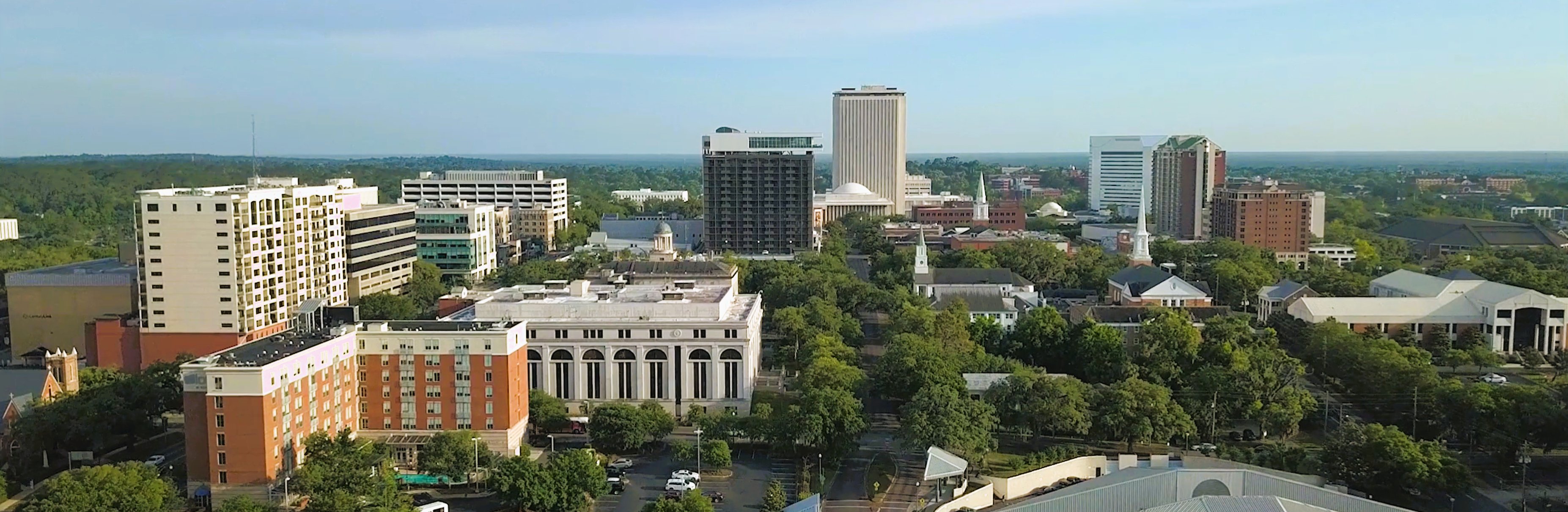
Florida's state capital sits in the panhandle, far removed — geographically and culturally — from the resort cities of the peninsula. Tallahassee runs on two industries: politics and higher education. Florida State University and Florida A&M University together bring some 45,000 students into a city of roughly 200,000, and the state legislature fills the town with lobbyists and journalists during session. Beyond both, Tallahassee has a distinct Southern character that feels closer to Georgia than to Miami.
The city is compact. Downtown fits within a short drive of almost everything. The capitol complex, where the 1902 Beaux-Arts building stands in the shadow of the 1977 glass tower, is free to explore. The Park Avenue Historic District has the best 19th-century architecture in the city. Cascades Park is a well-designed urban green space a short walk from downtown.
What makes Tallahassee genuinely worth a visit is the landscape. The city sits amid rolling hills — unusual for Florida — and its famous canopy roads, where centuries-old live oaks arch over quiet lanes, are unlike anything else in the state. The Apalachicola National Forest starts at the western edge of town. The St. Marks Trail, a former rail corridor converted to a multi-use path, runs 16 miles south to the coast. Cycling and hiking options are legitimately good here.
The Gulf coast is about 30 miles south. Apalachicola and St. George Island are 75 miles southwest — among the quietest and most beautiful stretches of the Florida coast, worth the detour.
Tallahassee is not a city that will overwhelm you with things to do, and that's part of its appeal. It moves at a slower pace than the resort cities, has real neighborhoods, and rewards visitors who are interested in the natural Florida rather than the commercial one.