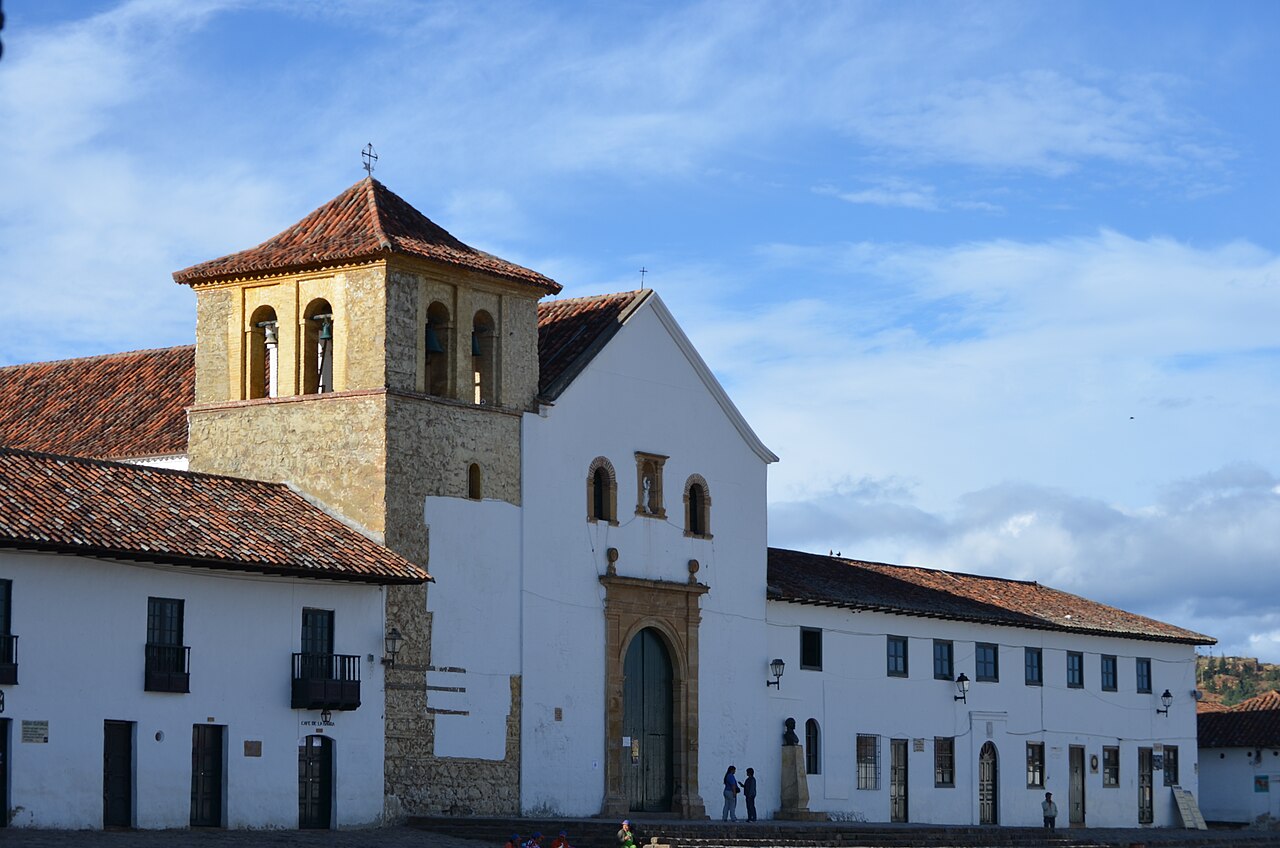
Villa de Leyva is one of the finest colonial towns in Colombia, and it earns that distinction without effort. Its Plaza Mayor — one of the largest cobblestoned squares in South America — is surrounded by whitewashed buildings with orange-tiled roofs, and the whole ensemble has been protected as a national monument since 1954. About 160 kilometres north of Bogotá, it draws Colombians who want to escape the city, and foreign visitors who want to understand what Andean colonial life looked like.
The town is small enough to cover on foot in an afternoon, but the surrounding countryside rewards a longer stay. The area around Villa de Leyva is a palaeontological and archaeological landscape: a Kronosaurus skeleton over 120 million years old lies exposed at El Fósil, a few kilometres west; the Muisca astronomical site of El Infiernito — stone monoliths used to track planting seasons — is nearby; and the 17th-century Dominican convent of El Santo Ecce Homo sits partway along the same road, its floor stones embedded with petrified coral and plant fossils. The Santuario de Flora y Fauna Iguaque, a sacred Muisca lagoon high in the páramo, is a full-day hike and one of the finest natural experiences in Boyacá.
The town's house museums commemorate two figures central to Colombian independence. Antonio Nariño, who translated the Rights of Man into Spanish, lived here until his death in 1823 — his house is now the Casa Museo Antonio Nariño. Antonio Ricaurte, born here in 1786, is remembered for his extraordinary sacrifice at the Battle of San Mateo — the Casa Museo Capitán Ricaurte tells his story. The eccentric Casa Terracota — a house built entirely from clay, in effect a giant piece of pottery — is perhaps the most unusual building in Colombia.