Cairo suburb layered over ancient Heliopolis, with Egypt's oldest standing obelisk beside Baron Empain's desert city.
Heliopolis carries two histories at once. The ancient one — Iunu, City of the Sun, seat of the cult of Ra — is mostly gone. Where priests once tended to towering temples, Cairo's northeastern suburbs now sprawl. The one surviving monument is the Obelisk of Senusret I, a 68-tonne spike of pink granite that has stood in what is now the working-class neighbourhood of Matariyya since around 1950 BCE. It is the oldest standing obelisk in Egypt.
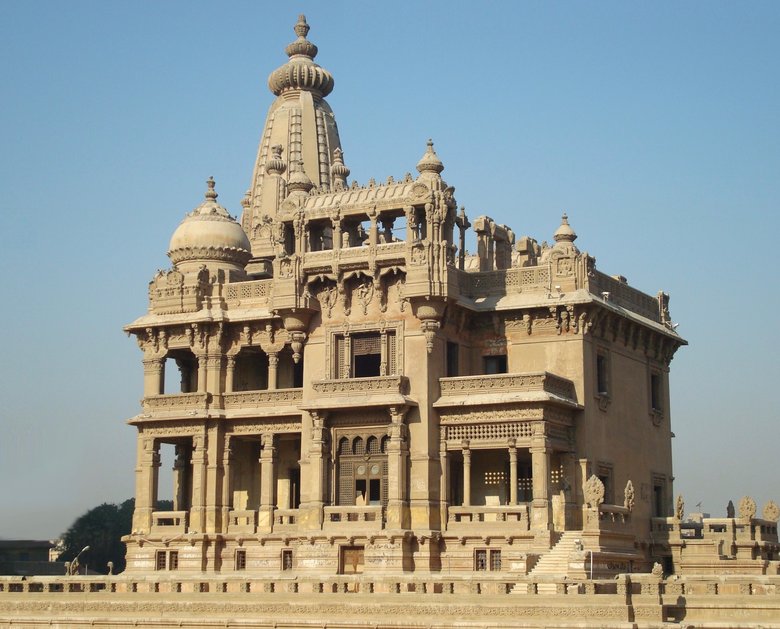
The modern Heliopolis — officially Masr al-Gedida, "New Cairo" — is something else entirely. In 1905, a Belgian industrialist named Édouard Empain struck a deal with the Egyptian government: he would build a new city in the desert northeast of Cairo, connected by electric tram to the old centre. The result is one of the most distinctive planned suburbs anywhere in the Arab world: tree-lined boulevards, Moorish arcaded buildings, Art Nouveau villas, and at its heart the Baron Empain Palace — a Hindu-temple-inspired fantasy of a mansion that Empain had built for himself and that still stops people dead in their tracks.
Through much of the twentieth century, Heliopolis was one of Cairo's most desirable addresses — prosperous, cosmopolitan, and relatively quiet. Today it is fully absorbed into the city, connected by metro and hemmed in by traffic, but it retains its distinct character. The wide streets, the belle-époque architecture, the large gardens attached to older villas — all of it sets Heliopolis apart from the crowded districts closer to the Nile.
The neighbourhood is also the location of the Presidential Palace, which means you will encounter checkpoints, but for visitors the draw is simply wandering. The Baron Palace is now open to the public after decades of neglect and a lengthy restoration. The Basilica of Notre Dame de Heliopolis is worth a look. And the tram — the last surviving tram line in Cairo — still runs, though barely.
Guide
Books
Cairo Trilogy by Naguib Mahfouz — The three novels (Palace Walk, Palace of Desire, Sugar Street) follow a Cairo merchant family through the first half of the twentieth century, the exact period when Heliopolis was being built and flourishing. Mahfouz is the master of Egyptian urban fiction and these books give the social texture of Cairo's bourgeoisie in a way nothing else quite matches.
Birds of Passage by Robert Solé — A novel following a Syro-Lebanese family in early twentieth-century Cairo, covering much the same period as the Mahfouz trilogy from a different angle. The Levantine Christian communities who settled in places like Heliopolis are at the heart of it.
Cairo: The City Victorious by Max Rodenbeck — The definitive modern history of Cairo in English: comprehensive, readable, and genuinely illuminating about how the city became what it is. The chapters on the colonial and early independence periods put Empain's project in context.
Rough Guide to Egypt or Lonely Planet Egypt — Either of the main Egypt travel guides will have practical coverage of Cairo and Heliopolis, useful for logistics and for placing the suburb within the wider city.
Guide
Day Trips
Heliopolis is part of Cairo, and Cairo is full of things worth spending a day on.
Egyptian Museum and Tahrir Square — About 30 minutes from Heliopolis by metro (change at Attaba or Sadat). The Egyptian Museum on Tahrir Square holds the world's greatest collection of ancient Egyptian artefacts, including the Tutankhamun treasures. Downtown Cairo around the museum has its own character: crumbling belle-époque buildings, bookshops, and coffee houses.
Coptic Cairo — About 45 minutes south by metro or taxi. The oldest part of Christian Cairo, with a cluster of ancient churches including the Hanging Church (built over a Roman gate), the Church of St Sergius (reputedly built over the site where the Holy Family sheltered), and the Coptic Museum. One of the more quietly remarkable places in the city.
Giza Pyramids — About 45 minutes by car or taxi (the metro does not go to Giza directly). The pyramids of Khufu, Khafre, and Menkaure, the Sphinx, and the vast plateau they occupy are the obvious reason many people come to Egypt at all. Go early in the morning if possible, before the heat and the crowds.
Khan el-Khalili — About 30 minutes by taxi from Heliopolis. The great medieval bazaar of Cairo, centred on the al-Husayn mosque and spreading through a labyrinth of covered alleys. Touristy in parts but substantial and genuine underneath: the spice market, the goldsmiths' quarter, and the coffee houses have been here for centuries.
Guide
Getting There
Cairo Metro Line 1 has a Nozha station serving the eastern edge of Heliopolis, making the suburb accessible from central Cairo in around 30 minutes from Tahrir Square. Taxis and Uber are easy from anywhere in the city and relatively cheap by international standards.
The historic tram (Line 2) still runs through the suburb, connecting Heliopolis to the Abbaseya area to the southwest. It is slow and irregularly maintained, but it is also the last surviving tram line in Cairo and atmospheric in its own right.
From Cairo International Airport: Heliopolis is only about 10 minutes by taxi — closer to the airport than to central Cairo. This makes it an excellent option for a layover visit. If you have three or four hours between flights, you can comfortably walk the main streets, visit the Baron Palace, and have lunch before heading back.