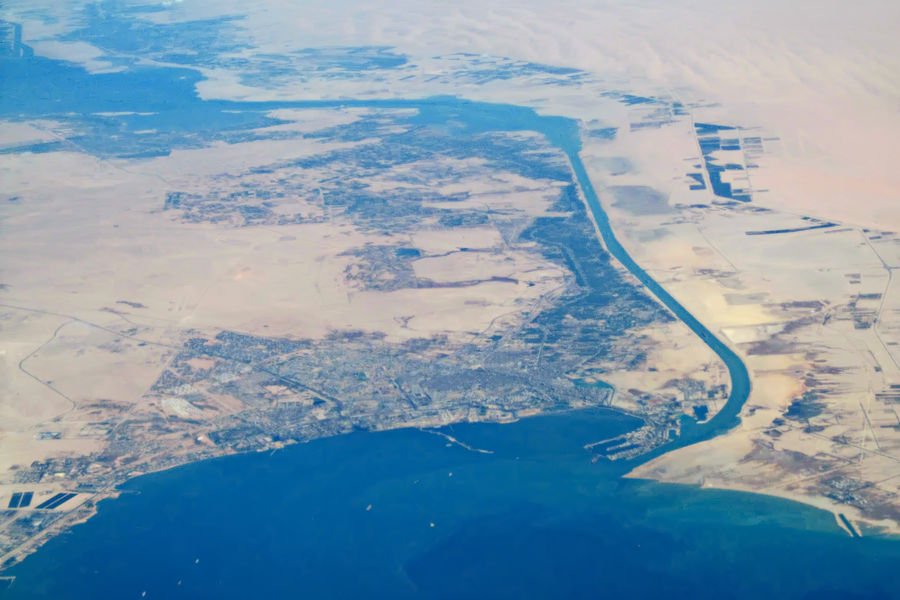
Suez sits at the southern mouth of the canal that bears its name, where the Red Sea meets one of the world's busiest shipping lanes. It is a gritty transport hub rather than a tourist destination, but it serves as the jumping-off point for travel into the Sinai Peninsula, and there is something mesmerizing about watching massive container ships glide through a desert landscape. The Suez Canal Viewpoint at Port Tewfik is the best place to watch the convoys pass, and the Port Tewfik Memorial commemorates the First World War campaigns fought across the canal zone. The Suez National Museum covers the city's history from ancient Clysma through the 1973 war.
Transiting the Suez Canal
On a clear, cool morning, with all signs of the last few days' sand haze blown away, we left Port Suez and lined up behind sixteen other ships for our northbound convoy. For the next ten hours, covering the 200 kilometres between Port Suez and Port Said, there was always something of interest to see. On the eastern side the barren Sinai Desert stopped right at the edge of the canal, and a few kilometres away trucks could be seen on the main highway running south to Sharm el Sheikh. The sand between the road and us was covered with abandoned military posts, burnt-out trucks, and other debris from the 1967 and 1973 wars. On the western side, towns and villages lined the banks most of the way, benefiting from the Nile delta irrigation systems.
In the Great Bitter Lake we passed a southbound convoy of twenty-five ships, anchored there to let us through, including a British submarine and minesweeper heading for the Red Sea or the Gulf. Everywhere, construction was taking place. A huge bridge spans the canal at one point; at another, a tunnel takes traffic beneath it. An ingenious swing bridge carries a railway track across the water when convoys are not passing.
Finally, in the late afternoon we arrived in Port Said, with the main part of the town on our left. One of the first buildings we saw was the Suez Canal House with its striking green domes, built for the canal's inauguration in 1869. The waterfront looked busy and prosperous, and we tied up right outside the new Port Said National Museum. (Contributed by Howard Banwell)