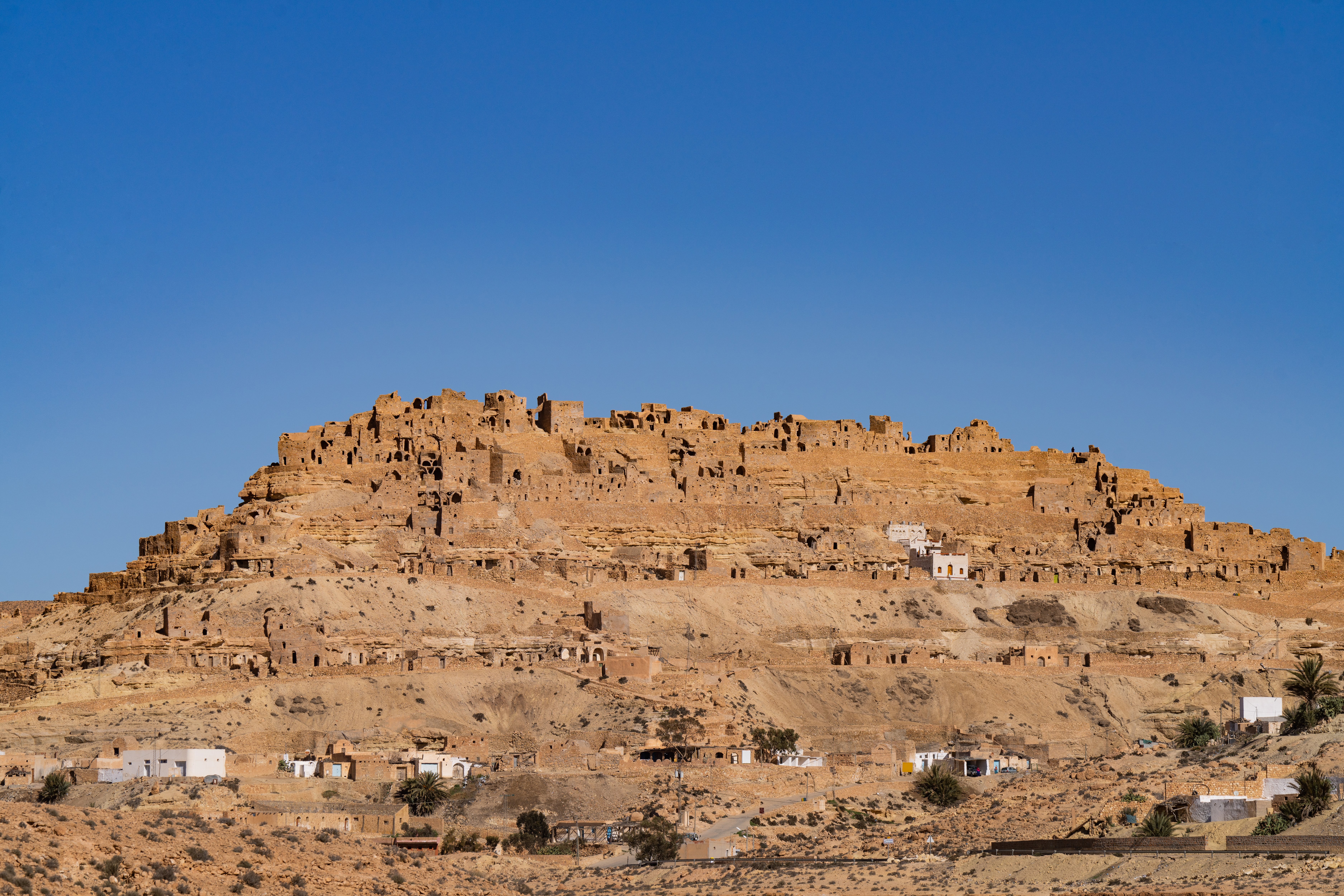
Chenini is a hilltop Berber village in southern Tunisia, its ancient stone dwellings carved into the rock face and cascading down a steep ridge. A white mosque perches at the top, visible for miles across the dry plain below. It is one of the most striking villages in the country and one of the last places where the indigenous Berber language is still spoken in Tunisia.
The village is largely abandoned now — most residents have moved to the new village at the base of the hill — but the ancient ksar and cave dwellings remain, and a handful of families still live among them. The walk up the ridge to the Mosque of the Seven Sleepers takes about twenty minutes and the views from the top are extraordinary: an endless ochre plain fading south toward the Sahara.
The oldest structures date to the 12th century. Ksar Chenini — the fortified granary that crowns the crest — once held over 200 vaulted storage chambers, and in 2020 Tunisia submitted it for UNESCO World Heritage consideration. Some ghorfas are still used by families from the valley below; the architecture is entirely utilitarian, but there is a severe beauty to it.
Chenini is usually visited as a day trip from Tataouine, about 18 kilometres to the northeast. It combines well with nearby Douiret, another spectacular hilltop settlement a little further southwest. Together with Ksar Ouled Soltane — the most photogenic and best-preserved ksar in the region — they form the core of the Tataouine ksar circuit.