Carthage needs to be destroyed — so declared the Roman senator Cato, who reportedly ended every speech with that demand. The Romans eventually obliged, flattening the city in 146 BC. Yet Carthage outlasted Rome: its history stretches across nearly twice as many centuries as the Roman Empire's.
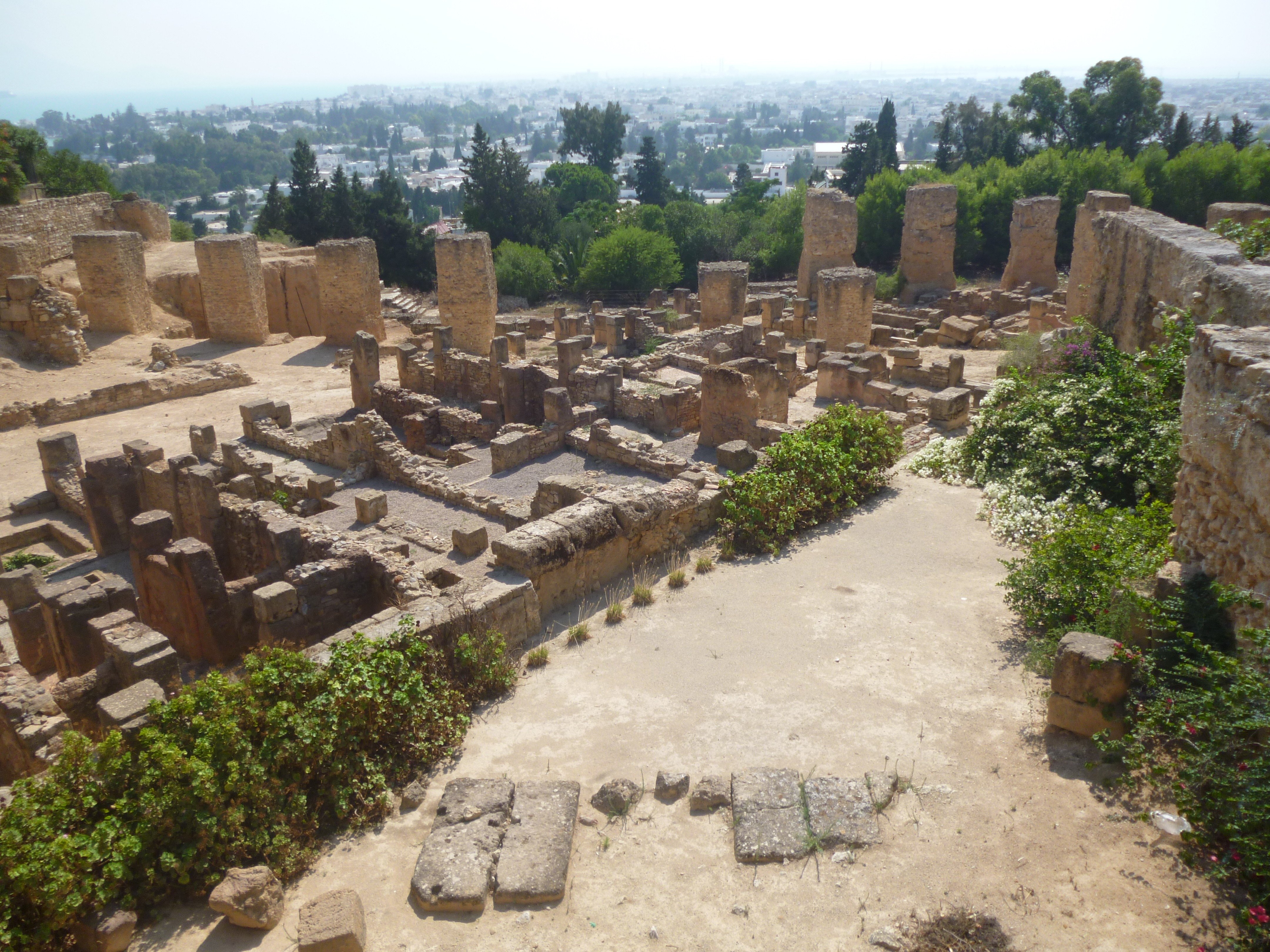
Piecing together what Carthage actually looked like is difficult. The "total destruction" was never quite complete, and some structures survived, but centuries of quarrying for building material stripped away much of what remained — both from the original Punic city and from the Roman one built on top of it.
The best place to start is the Punic Ports, which capture the essence of Carthage as a maritime power. They are unmistakably man-made: a 100-metre-wide canal leading to a perfectly circular inner harbour 130 metres in diameter, which served as both quay and dry dock. In this compact space, 220 warships could be berthed and repaired. Today only a few stone remnants survive, but in places you can still trace the outlines of the individual dock bays — enough to give a real sense of the ships' scale.
About 300 metres south of the ports lies the Tophet, the burial ground where urns containing cremated remains — many of them infants — have been found in large numbers. The interpretation is contested, but the site is haunting. Tunisia has invested little in presenting it, perhaps understandably reluctant to foreground evidence of child sacrifice in its ancient heritage.
A kilometre north of the ports, the Byrsa quarter holds the largest surviving concentration of Punic settlement and is where the main Carthage National Museum stands. Below the hill on the seafront sit the colossal Baths of Antoninus — the largest Roman thermae in Africa. On the western fringe, the Amphitheatre, Circus, and Cisterns of La Malga flesh out the imperial city. Finish with a climb up to Sidi Bou Said — the blue-and-white cliff-top village just to the north, where a mint tea and the view across the Bay of Tunis cap the day.