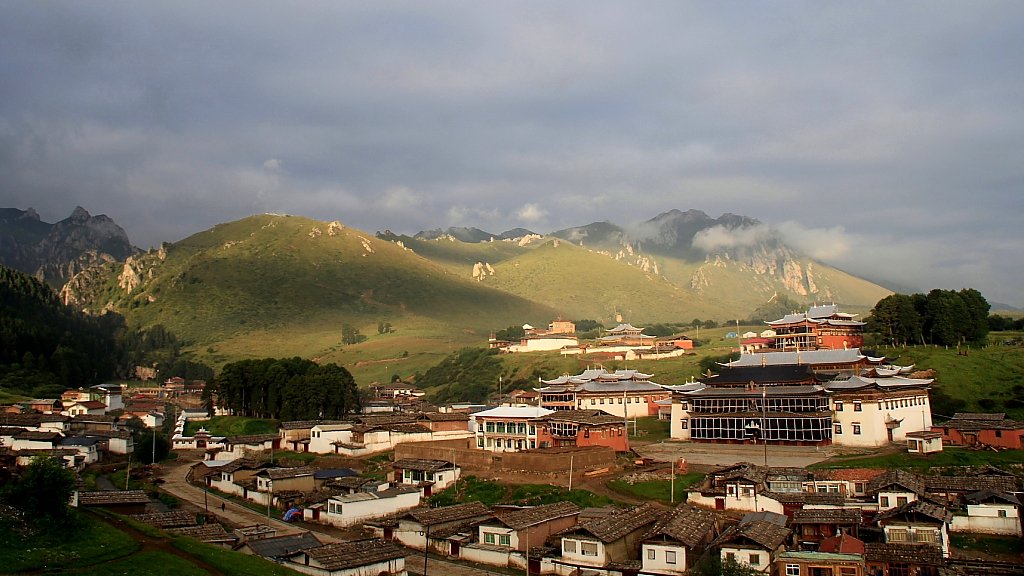
Langmusi is a small Tibetan village straddling the border between Sichuan and Gansu provinces, set in a mountain valley at around 3,400 metres where the landscape has a quality that several travellers have independently described as reminiscent of alpine Austria — broad grasslands, limestone gorges, and snowpeaks — transplanted to central Asia and populated by Amdo Tibetans, Han Chinese, and Hui Muslims in an unlikely coexistence. It is genuinely remote and genuinely beautiful.
The village has two monasteries facing each other across a small river that marks the provincial border. On the Gansu side, Sertri Gompa is where traditional sky burial still takes place — the Tibetan practice of offering the deceased to vultures on a high rock platform. It is not a spectacle for casual visitors but it is open to those who approach it with appropriate respect. On the Sichuan side, Kirti Gompa is an active monastery with a distinctive architectural style and a history of political sensitivity; it has been the centre of significant tension between monks and Chinese authorities in recent decades.
The surrounding terrain rewards those who stay for more than a night. Red Stone Mountain, a sandstone formation above the village, is a straightforward hike with panoramic views and prayer flags at the summit. Horse trekking lasting one to three days into the surrounding plateau, with overnight stays in nomadic tents, is the best way to understand how most people in this region actually live — following yak herds across grasslands that stretch uninterrupted to the horizon. Longer routes connect to Flower Lake and the dramatic rock formations at Zhagana in Gansu.
Langmusi is best reached from Xiahe in Gansu or via Jiuzhaigou to the south, and the bus connections, while real, are infrequent and slow. Accommodation in small guesthouses and youth hostels is basic but adequate. The combination of genuine Tibetan culture, accessible trekking, and relative absence of mass tourism makes it one of the more rewarding stops in the entire Sichuan-Gansu borderland.