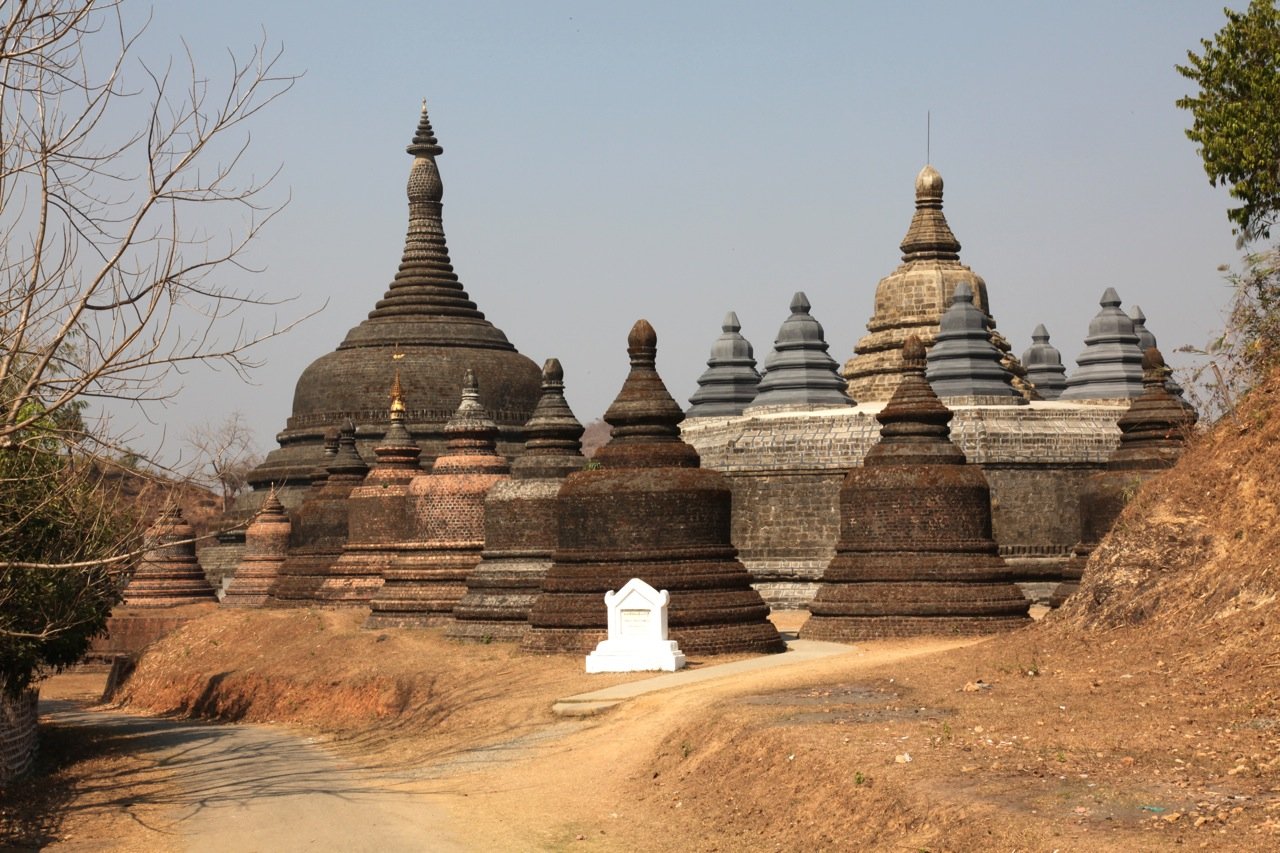
Mrauk-U was once one of the wealthiest cities in Asia. As capital of the Rakhine kingdom from the 15th to 18th century, it controlled the Bay of Bengal trade and drew merchants from Portugal, the Netherlands, and across South Asia. The Burmese sacked it in 1784, moving the sacred Mahamuni Buddha image to Mandalay, and the city never recovered. What remains is a landscape of crumbling temples rising from the jungle, with a small market town at its centre.
The defining sights are the fortress-like Buddhist temples on the ridge north of town — the Shite-thaung ("Temple of 80,000 Buddhas"), the spiral-corridored Htukkanthein, the elegant Andaw-thein, and the solid stone Ratanabon. A short distance east is the vast and half-ruined Koe-thaung, the largest temple of all. At the centre of town, the walled foundations of the Mrauk-U palace and a small archaeological museum trace the kingdom's history.
Getting here takes effort — a flight to Sittwe followed by a boat up the Kaladan River — but that difficulty is part of what makes Mrauk-U so rewarding. The site sees few visitors, and the surrounding Chin villages in this corner of Rakhine State, near the borders with Bangladesh and Chin State, feel genuinely remote. The poverty is real and the people are warm.