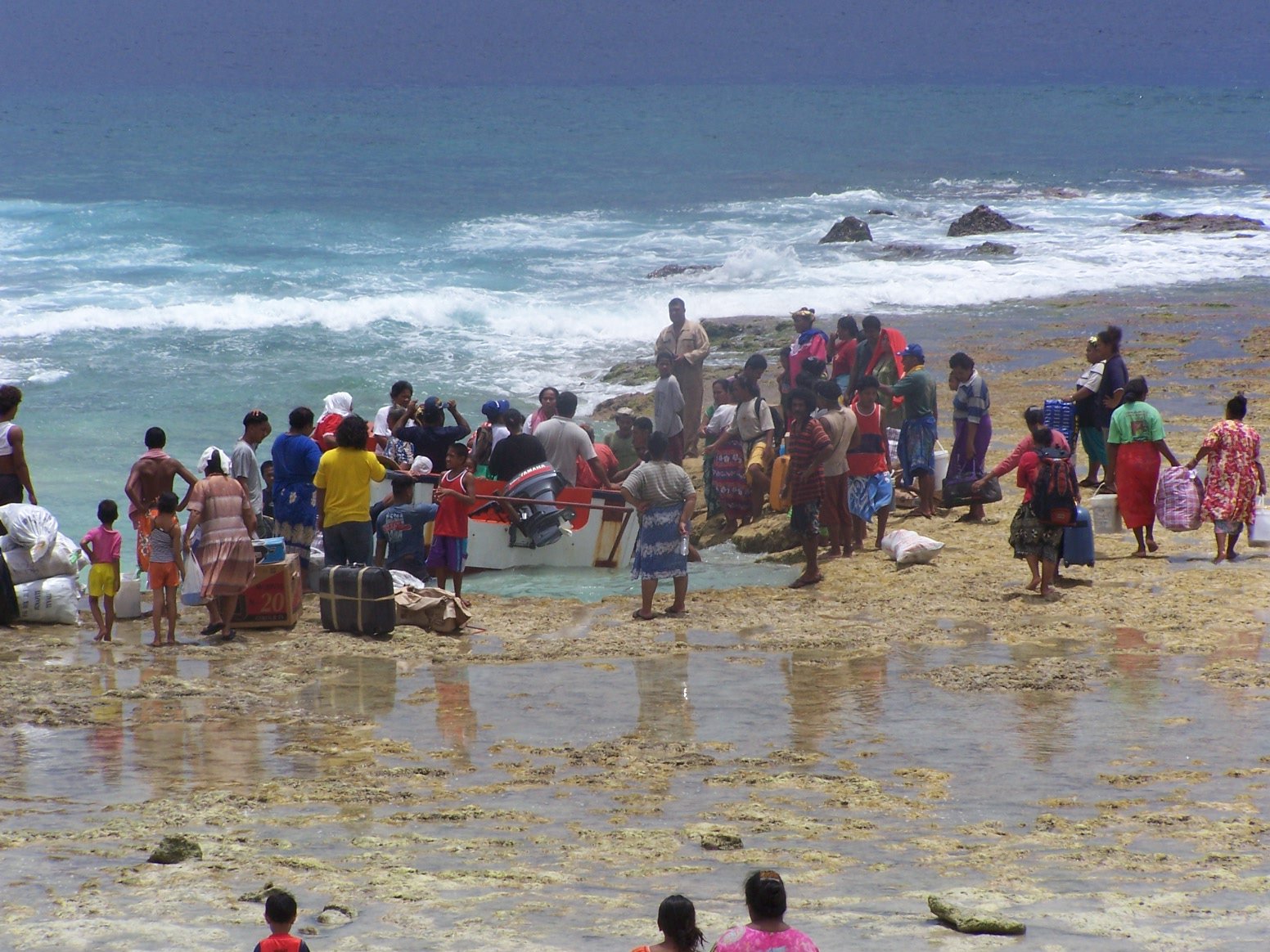
Niutao is a small reef island in the northern part of Tuvalu, about 240 kilometres north of Funafuti. Unlike most of Tuvalu's other islands it is not a true atoll: there is no central lagoon, only the island itself — roughly two kilometres across, ringed by a steep reef that drops abruptly into deep ocean. Two small landlocked brackish ponds, Lake Manu'a and Lake Vaiaki, sit in the interior, surrounded by dense coconut and pandanus.
Around 600 people live on Niutao, in two main villages — Kulia and Teava — set on the western and eastern sides of the island and connected by a single dirt road. The community has long had a reputation for self-sufficiency: the island has no harbour and no anchorage, so all cargo from the inter-island vessel has to be lightered ashore through the surf by small boats, a process that demands serious local skill and is the first thing any visitor remembers about Niutao.
Historically, overcrowding on Niutao led to one of the country's more unusual migrations. In 1949 the colonial administration resettled a group of Niutao families on the uninhabited southern island of Niulakita, establishing a community there that endures to this day; the connection between the two places remains strong. The Catholic mission ruins on the southern side of Niutao are a quiet reminder of the missionary century that reshaped life across the Pacific.
There is essentially no tourist infrastructure: no guesthouses, no shops with more than basics, and no scheduled transport in or out. Visits happen by accident or by serious determination, on the long swing of the inter-island boat. If you make it here, expect to be the only outsider on the island.