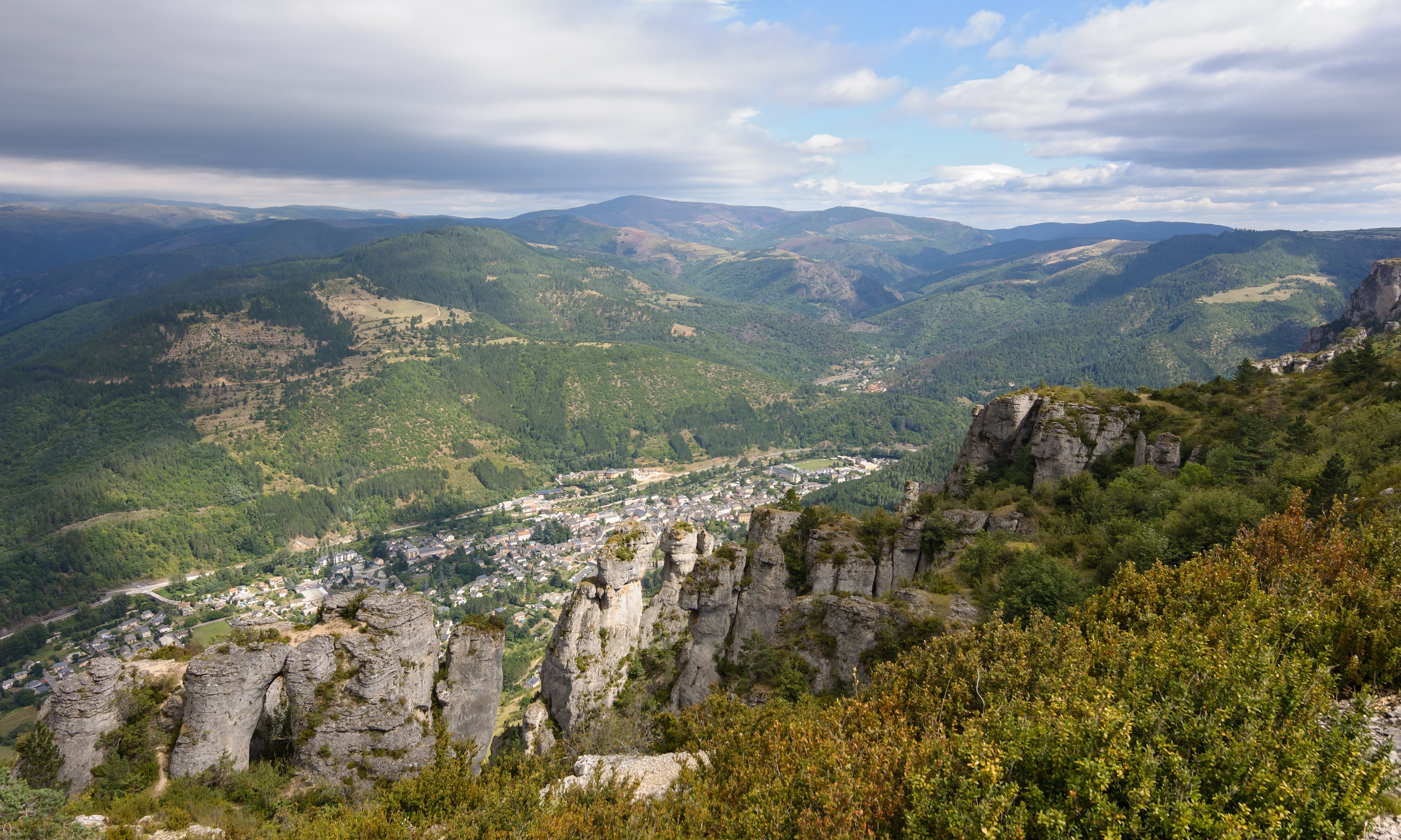
Cévennes gateway town where three rivers meet below limestone plateaus and national-park trails
Florac (now officially Florac Trois Rivières) is the gateway to the Cévennes, sitting at the foot of the dramatic Causse Méjean where three rivers converge. The Cévennes National Park headquarters is here, and the town makes the natural base for exploring one of France's least populated and most beautiful landscapes.
The Gorges du Tarn begin just north of town — a deep limestone canyon that you can drive, kayak, or hike through. The Causse Méjean above is a vast, windswept limestone plateau dotted with sheep farms and menhirs. Robert Louis Stevenson walked through here with a donkey in 1878, and the GR70 (Chemin de Stevenson) passes close to town.
Florac itself is small and quiet: a château, a spring, a handful of restaurants, and a Saturday market. It empties out in winter and fills with hikers and kayakers in summer. The surrounding landscape is the real draw — wild, rocky, and empty in a way that most of France is not.
Guide
Getting There
Florac is a long way from anywhere on a fast road, which is part of its appeal. The nearest big stations are Mende (40 km north) on the Paris–Béziers line, and Alès (75 km south-east). Both have a couple of buses a day to Florac — check the Lozère Lio bus network.
By car it is about an hour from Alès on the N106, a slow but scenic drive up the Mimente valley. From the north, the A75 motorway crossing the Causse Méjean drops you at the Aumont-Aubrac exit; from there the D907 to Florac is another hour. There is no train station in town.
Guide
When to Go
The Cévennes are best in late spring and early autumn. May and June are ideal: long days, wildflowers on the Causse, full rivers, and the high country still cool enough to walk in. September and early October are quieter and beautiful — the chestnut woods turn gold, the gorges empty out, and the weather is usually settled.
July and August can be hot in the gorges (mid-30s) and the popular bases like La Malène fill up; Florac itself stays calmer. Winter is cold, often snowy on Mont Lozère and the Causse, and most accommodation in the smaller villages closes. The Pêcher spring is at its most dramatic in late winter and early spring after the snowmelt.