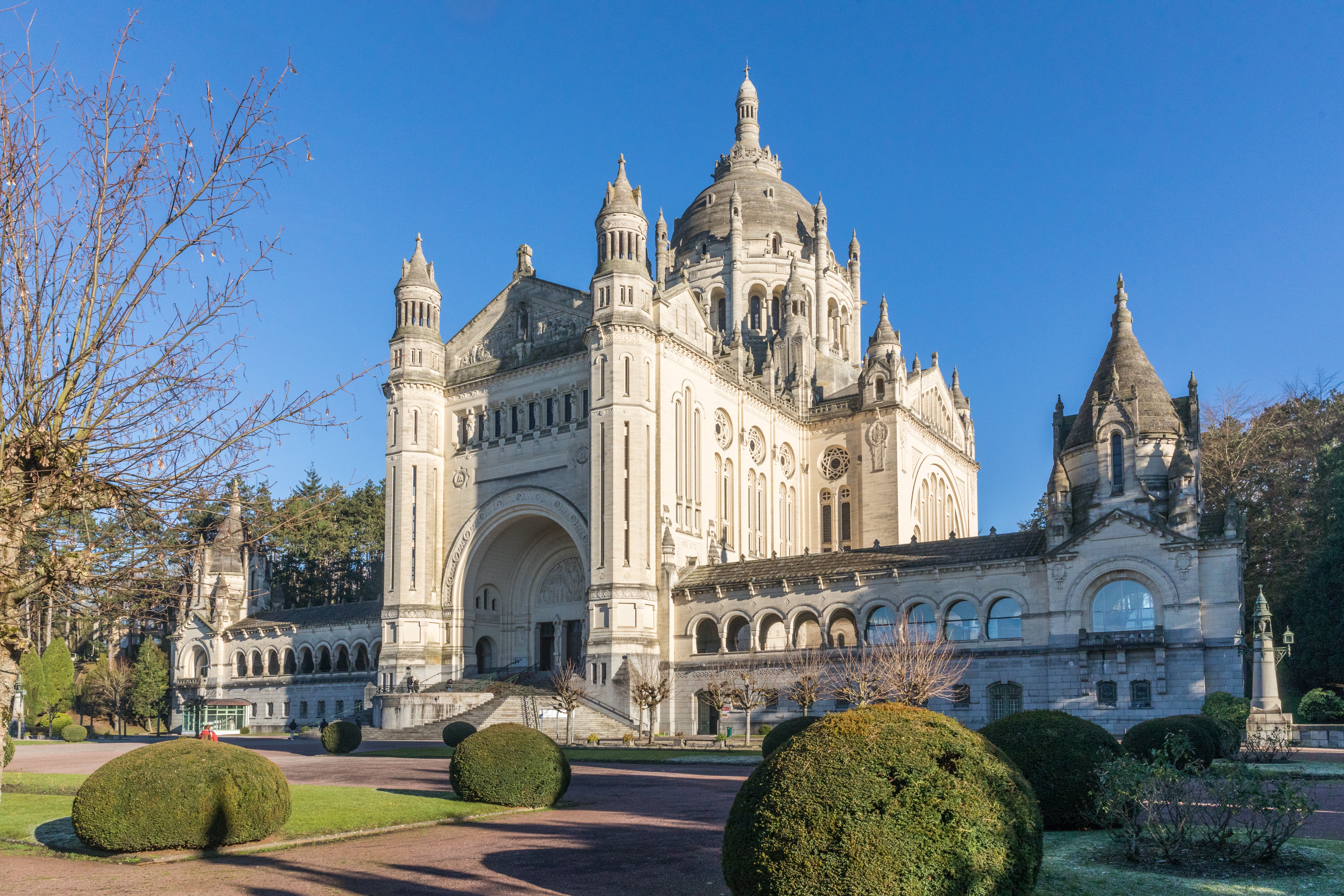
Lisieux is an important centre of Catholic pilgrimage in Normandy, devoted to Saint Thérèse of Lisieux (Thérèse Martin, 1873–1897). Over two million pilgrims a year come to visit the Basilique Sainte-Thérèse, a vast neo-Byzantine building on the hill above town reminiscent of the Sacré-Coeur in Paris. It is one of the largest churches built in France in the 20th century.
The pilgrimage circuit takes in several sites: the basilica, the Carmel convent where Thérèse lived and is buried, Les Buissonnets (her family home), and the Bishop's chapel in the old town. From a purely architectural standpoint, the Cathédrale Saint-Pierre in the old town centre is the more interesting building — a fine 12th-century Gothic structure that survived the heavy bombing of 1944 largely intact, in a town that lost over 80 percent of its medieval fabric. Much of the rest of Lisieux was destroyed and rebuilt in functional postwar style, but the area around the cathedral retains some character.