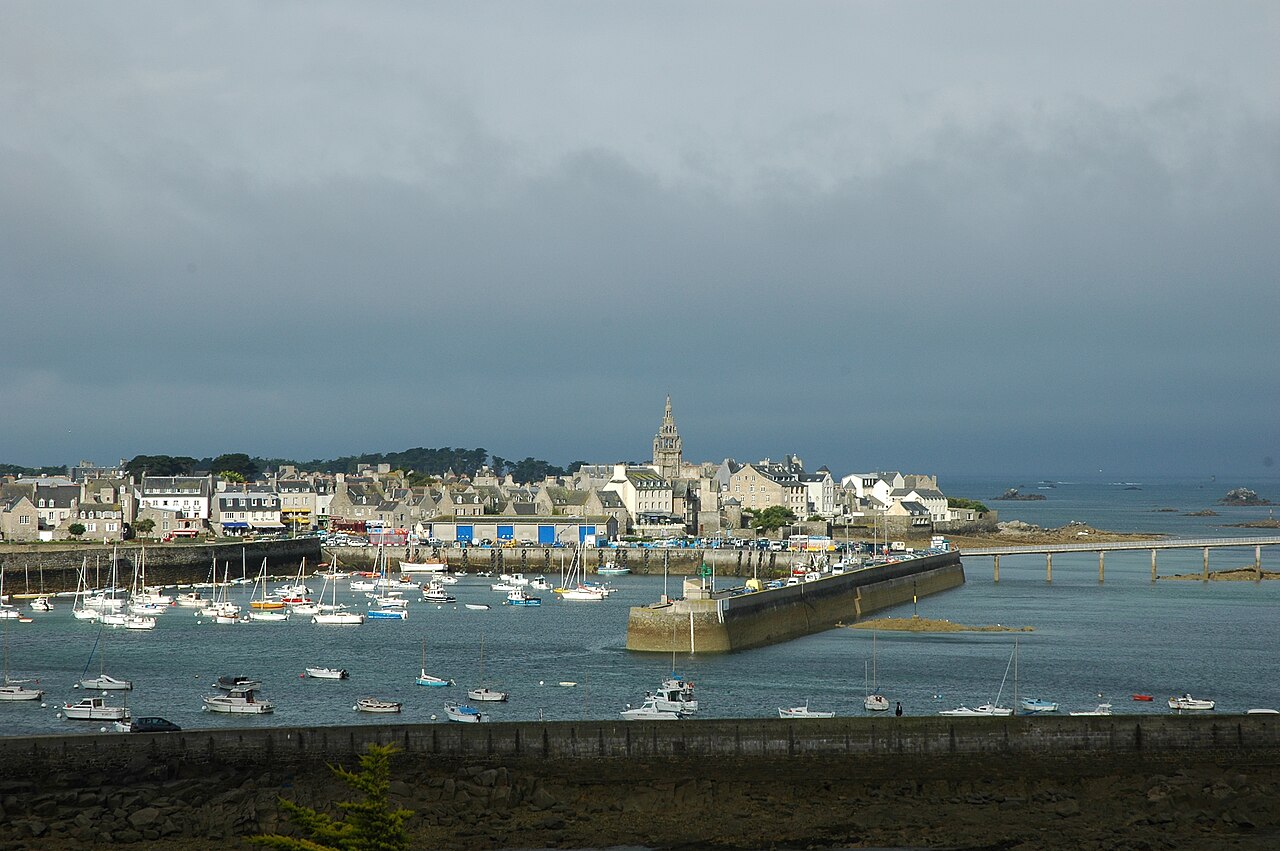
Granite Breton port town known for Plymouth ferries, merchant houses, and the old pink-onion trade.
Roscoff is a small granite port town at the tip of northern Brittany, the French end of the ferry crossing from Plymouth. Most people arriving here drive straight on toward the rest of Brittany or south into France, which is a shame — the town is worth a few hours at least.
The old port is attractive, with 16th- and 17th-century stone houses built by wealthy merchants who traded in linen and onions (Roscoff's "Johnnies" were famous for cycling across Britain selling strings of pink onions door to door). The Église Notre-Dame de Kroaz-Baz has an ornate Renaissance bell tower, and the Jardin Exotique de Roscoff, perched on a rocky outcrop, has a surprisingly rich collection of subtropical plants thriving in the mild Gulf Stream climate. The Île de Batz, a low-lying island with sandy beaches and a remarkable exotic garden, is a short boat ride from the harbour.
The Station Biologique de Roscoff, founded in 1872, is one of Europe's oldest marine research centres and has a small public aquarium. For most visitors, the town is a one- or two-night stop rather than a destination in its own right — but it's a very pleasant one.
Guide
Getting There
Roscoff is the French end of the ferry crossing from Plymouth in England. Brittany Ferries operates the service, with crossings taking around 6 hours overnight or slightly longer during the day. This is the most straightforward way to arrive if you're bringing a car or travelling from southwestern England.
By train, the nearest main-line station is Morlaix, about 27 km to the south, connected to Paris by TGV. Local trains and buses connect Morlaix to Roscoff, though the service is infrequent — check timetables in advance.
By road, Roscoff sits at the end of the N12/E50 corridor from Rennes and Paris. The drive from Paris takes around 5 hours. From Brest it's about an hour.
Guide
When to Go
Roscoff has a mild maritime climate, warmer than you'd expect for northern Brittany thanks to the Gulf Stream. That said, it rains and the wind comes in off the sea — this is the Atlantic coast, not the Mediterranean.
The best time to visit is May to June or September. The Jardin Exotique is in full bloom in late spring, the Île de Batz is uncrowded, and the weather is often crisp and clear. July and August are peak season — the ferry terminal is busy, prices are higher, and the town fills with English families who just stepped off the boat.
The onion harvest — the famous Roscoff pink onions (oignons roses de Roscoff) — runs from August into October. Local markets sell them in quantity.