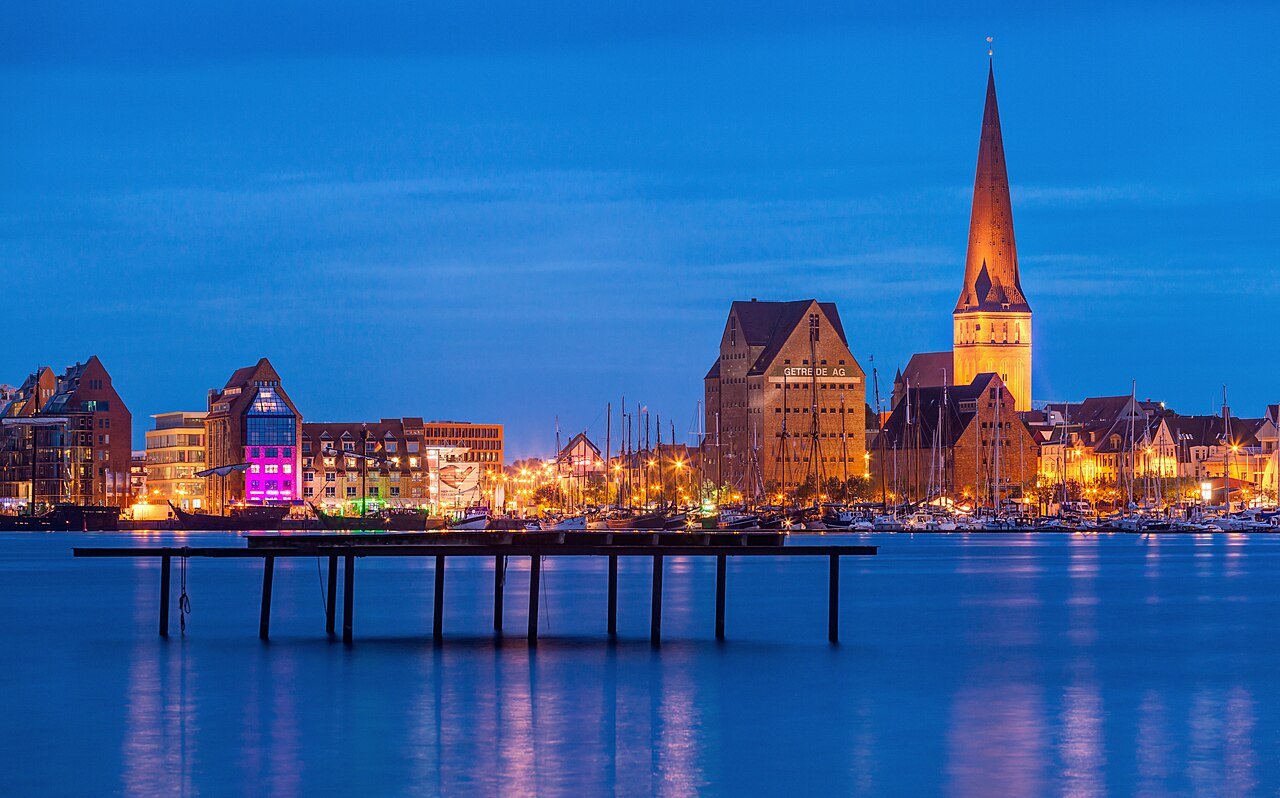
Rostock is the largest city in Mecklenburg-Western Pomerania, a former Hanseatic League trading port on the Baltic coast with a population of around 200,000. The old town retains much of its medieval character — gabled merchant houses, brick Gothic churches, and stretches of the old city wall, all rebuilt after heavy wartime damage.
The St Mary's Church (Marienkirche) is the architectural highlight, a vast Gothic basilica with a magnificent astronomical clock dating from 1472. The Abbey of the Holy Cross, a 13th-century Cistercian nunnery, now houses the Cultural History Museum. St Petri Church, with its 117-metre spire, offers panoramic views over the city and the harbour.
Warnemünde, Rostock's seaside district at the mouth of the Warnow River, has a broad white sand beach, a lighthouse, and a strip of fish restaurants along the Alter Strom harbour. It is one of the most popular beach destinations on the German Baltic coast.
Rostock also has one of the oldest universities in northern Europe, founded in 1419, which gives the city a youthful energy. The Rostock Zoo is one of the best in northern Germany, and the Kunsthalle Rostock has a strong collection of 20th-century German art. Day trips from Rostock include the Molli narrow-gauge railway to Bad Doberan and Heiligendamm (Germany's oldest seaside resort), and the Renaissance town of Güstrow, about 50 kilometres south.