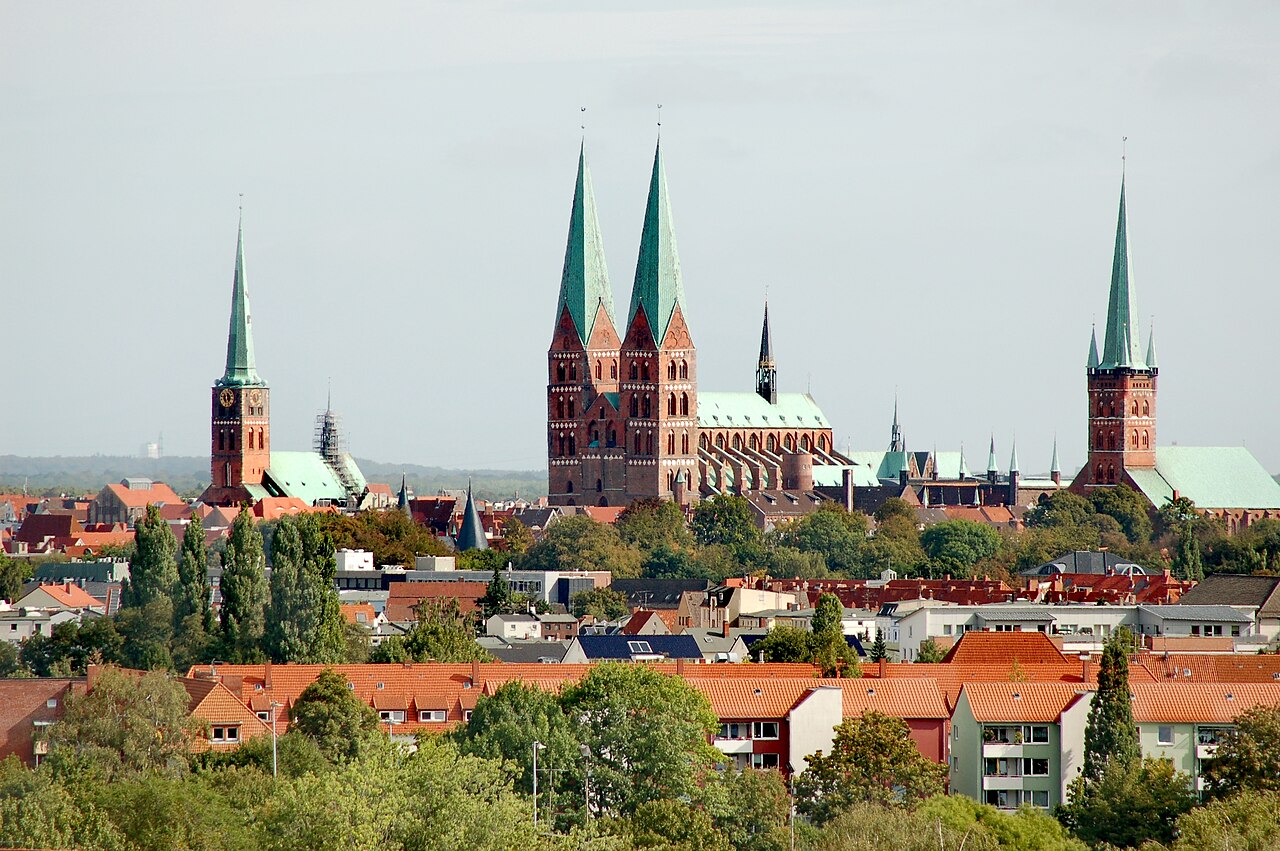
Lübeck is the old capital of the Hanseatic League, the medieval trading federation that once dominated the Baltic and the North Sea, and for several centuries it was probably the richest and most powerful city in northern Europe. Today it is a UNESCO-listed old town of about 215,000 people in Schleswig-Holstein, an hour from Hamburg by train. The entire medieval core — an egg-shaped island encircled by the Trave river and a moat — was heavily bombed in 1942 (the first significant attack by RAF Bomber Command on a German city) but rebuilt with great care, and much of what you see is the original brick.
The city's signature is the twin-towered Holstentor, the 15th-century brick gatehouse on the west side of the old town that appears on the German two-euro coin and was for centuries one of the defining images of the country. From there you pass into the Altstadt, a compact maze of step-gabled merchants' houses, narrow courtyards, and enormous Backsteingotik (brick Gothic) churches — St Marienkirche beside the market square is the prototype of the style, with bells that still lie smashed on the floor where they fell during the 1942 firestorm, left as a war memorial. The Rathaus (town hall) behind it is one of the finest Gothic civic buildings in Europe.
Lübeck has also given the world two Nobel laureates in literature — Thomas Mann, born here in 1875, whose novel Buddenbrooks is set in the city and based on his own family's mercantile dynasty, and Günter Grass, who lived here for the last three decades of his life. The Buddenbrookhaus (closed for renovation but reopening in a new building), the Günter Grass-Haus, and the Willy Brandt-Haus (honoring the former chancellor, also a local) form a trio of serious literary and political museums. And on a sweeter note, Lübeck is famous for marzipan — the city has been making it since the Middle Ages, and Café Niederegger on Breite Straße, across from the town hall, is the place to taste it.