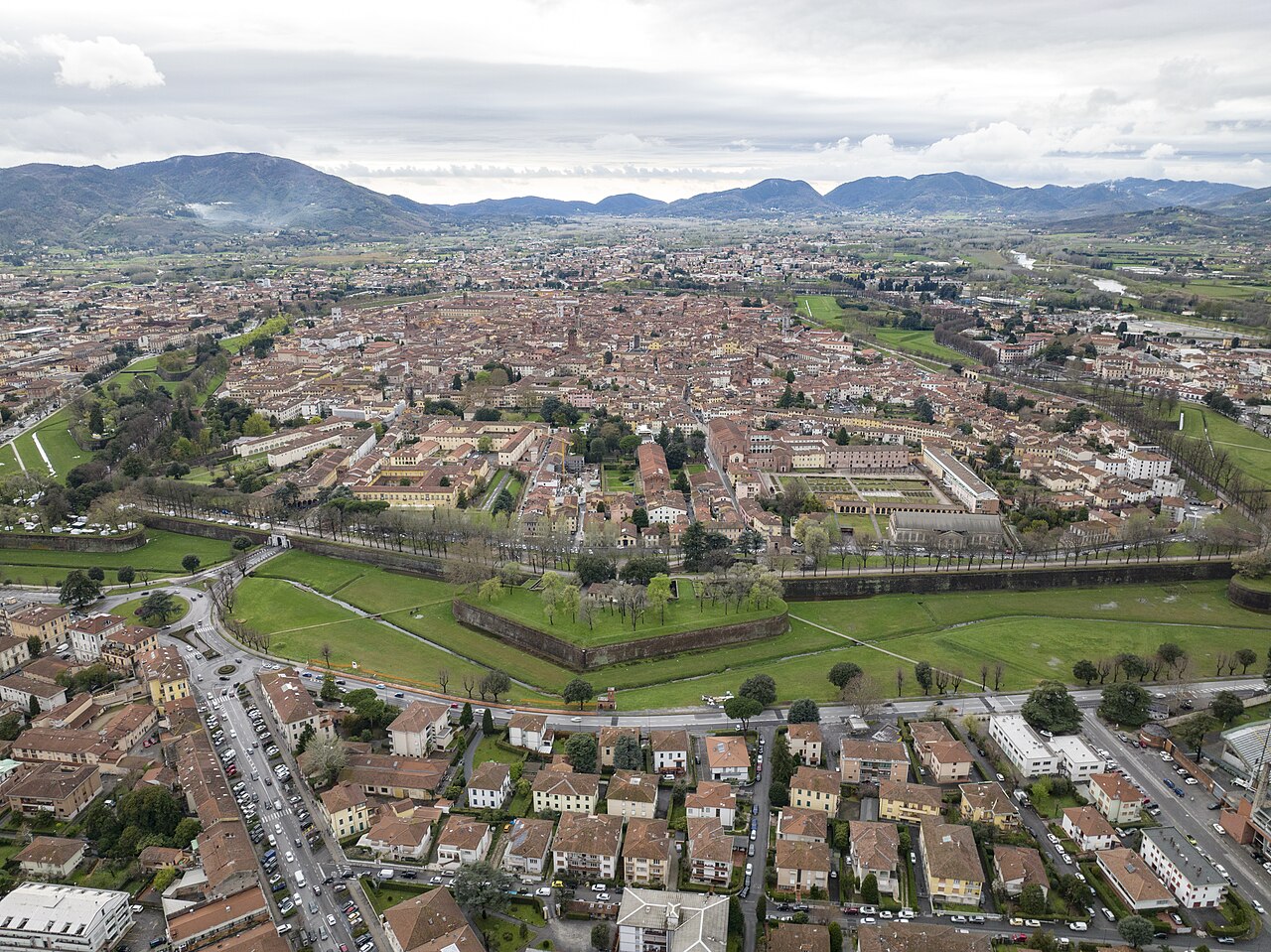
Lucca is a compact, walled city on the Tuscan plain between Pisa and Florence — and for many people who know Tuscany well, the pick of the three. Where Pisa has the tower and Florence has the Uffizi, Lucca has something rarer: it is still a real, working, lived-in Italian town rather than a tourist backdrop. The medieval centre is almost entirely surrounded by a thick Renaissance wall, four kilometres long, built in the 16th and 17th centuries against Florentine attack and never actually used. Today the top of the ramparts has been turned into a broad elm-lined promenade — arguably the most pleasant urban park in Italy — where you can walk, jog, or (much better) rent a bicycle and cycle right around the top of the city in about 40 minutes.
Inside the city walls, Lucca is a maze of narrow stone streets, Romanesque churches, and handsome 17th-century palazzi. Start at Piazza San Michele, built on the site of the old Roman forum and dominated by the extraordinary striped marble façade of San Michele in Foro — a 13th-century church whose upper storeys are pure Pisan-Romanesque fantasy, with tier upon tier of mismatched twisted columns and heraldic animals. The city's other great church is the Duomo di San Martino, just inside the southern walls, with a wonky asymmetrical façade (the builders ran out of room) and, inside, Nicola Pisano's Deposition and the Volto Santo, a mysterious dark-wood crucifix that legend says was carved from life by Nicodemus and that has been venerated here since the 8th century.
Lucca's single most photographed spot is Piazza dell'Anfiteatro, a perfect oval square built into the footprint of the old Roman amphitheatre. The amphitheatre is long gone, but the shape is preserved in the pastel-coloured houses that ring the square — now filled with cafés and a handful of restaurants. Nearby, the Torre Guinigi is the odd medieval tower with a clump of holm oaks growing out of the top. Climb it for the best view of Lucca's terracotta rooftops. Via Fillungo is the main shopping street, lined with beautiful Art Nouveau shopfronts from the early 20th century.
Lucca was the birthplace of Giacomo Puccini, and the Puccini Birthplace Museum near Piazza San Michele preserves his childhood home. Every summer the Puccini Festival at Torre del Lago, a few kilometres away on Lake Massaciuccoli, puts on open-air performances of La Bohème, Tosca, Madama Butterfly, and Turandot in the theatre Puccini helped design. For art, Palazzo Mansi has Baroque palace interiors that rival anything in Florence, and Palazzo Pfanner has the only formal garden within the city walls. Eat tordelli lucchesi (meat-stuffed pasta in ragù) and buccellato (a sweet anise-and-raisin bread), stay at least one night rather than day-tripping from Pisa or Florence, and take a long evening walk on the walls.