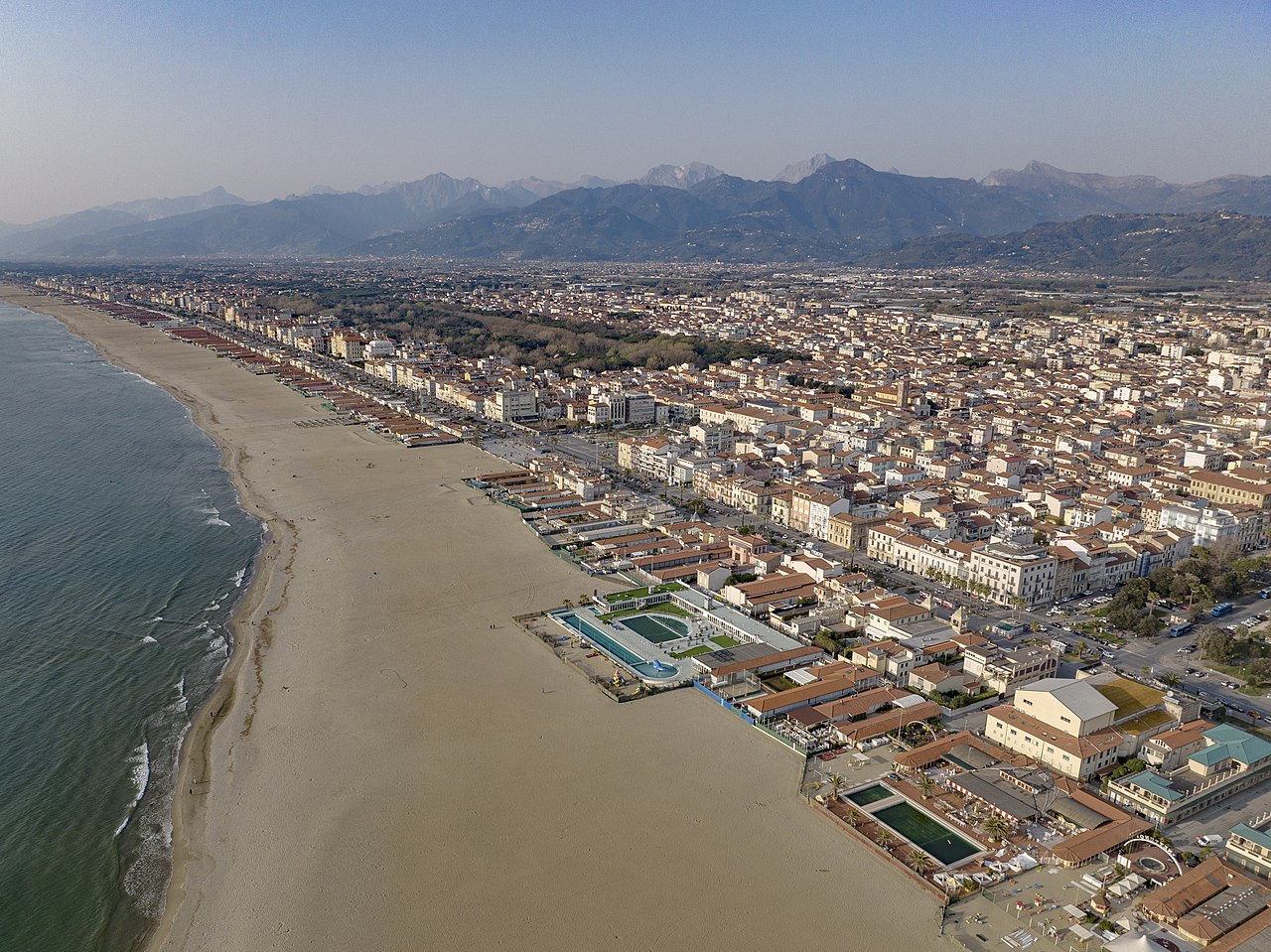
Viareggio is the largest town on the Versilia coast in northern Tuscany — a historic seaside resort with a long sandy beach, an elegant promenade lined with Liberty-style Art Nouveau architecture, and one of Italy's most spectacular carnivals. The town became fashionable in the early twentieth century when wealthy families built ornate bathhouses and pavilions along the seafront; a handful of these still stand as protected monuments, their fanciful wooden turrets and painted facades giving the boardwalk a theatrical quality unlike anywhere else on the Italian coast.
Every February, Viareggio hosts its famous Carnival — second only to Venice in scale and technical ambition. Giant satirical floats, some reaching twelve metres high, take months to build from papier-mâché and steel armature in dedicated workshops across town. On parade Sundays the Passeggiata Margherita fills with tens of thousands of spectators and costumed revellers. The floats are as much political commentary as spectacle, caricaturing politicians and world leaders with an irreverence the town has celebrated since 1873.
Beyond the beach and the Carnival, Viareggio has a working port and a serious yacht-building industry: Benetti, one of the world's leading superyacht builders, has its main yard here. The canal district that runs behind the seafront is lively with boat workshops, seafood restaurants, and the kind of workaday energy that keeps the town feeling real even in high summer.
The Versilia coast makes a superb base for exploring Tuscany. Lucca, the beautiful walled city, is a 20-minute drive inland. Pisa is 20 minutes south by car or train, and Florence is about an hour away. Just inland, the marble mountains rise dramatically — Pietrasanta and Forte dei Marmi are worth an afternoon each, and the quarries of Carrara, where marble has been extracted for over two thousand years, are a remarkable sight.