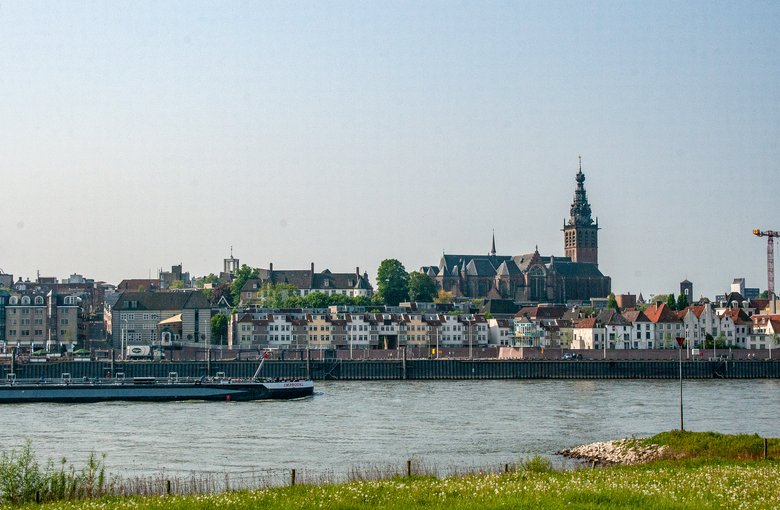
Nijmegen is a city of about 180,000 people in the east of the Netherlands, on the south bank of the Waal river (the main branch of the Rhine as it enters the country). It claims to be the oldest city in the Netherlands: a Roman legionary camp was established here around 12 BCE, which makes Nijmegen the first place in the country to be granted town rights — though the claim is sometimes disputed by Maastricht. The Valkhof hill, the site of a medieval imperial palace built by Charlemagne and later rebuilt by Frederick Barbarossa in 1155, was one of the most important administrative centres of the Holy Roman Empire. Only fragments of the Barbarossa palace — including the elegant octagonal Saint Nicholas Chapel and the ruined 16th-century apse — survive on the hill today, overlooking a pleasant park.
For most of its history Nijmegen was a quiet provincial town. Then, in September 1944, it became briefly one of the most important places in Europe: the Waal Bridge was the second of the three great river crossings that the Allies had to take in Operation Market Garden, Field Marshal Montgomery's ambitious failed plan to punch through the German lines into the Ruhr. The American 82nd Airborne Division's assault crossing of the Waal in canvas boats on 20 September 1944 under German machine-gun fire is one of the most famous American military actions of the Second World War, depicted in the film A Bridge Too Far. A small but affecting Liberation Museum at nearby Groesbeek commemorates the campaign.
Today Nijmegen is a pleasant university city. Radboud University, founded in 1923, is one of the top Dutch universities, and the student population of around 20,000 gives the city a much livelier feel than its modest size would suggest. The compact centre around the Grote Markt and the Gothic Sint-Stevenskerk is good for a wander; the riverfront has been recently redeveloped with a walking and cycling route along the Waal. Nijmegen is best known across the Netherlands, however, for the Vierdaagse — the Four Days Marches — held every July, when around 45,000 walkers from all over the world march 30, 40 or 50 km a day for four consecutive days in the largest multi-day marching event on earth. The accompanying Vierdaagsefeesten turns the whole city into a week-long street party.